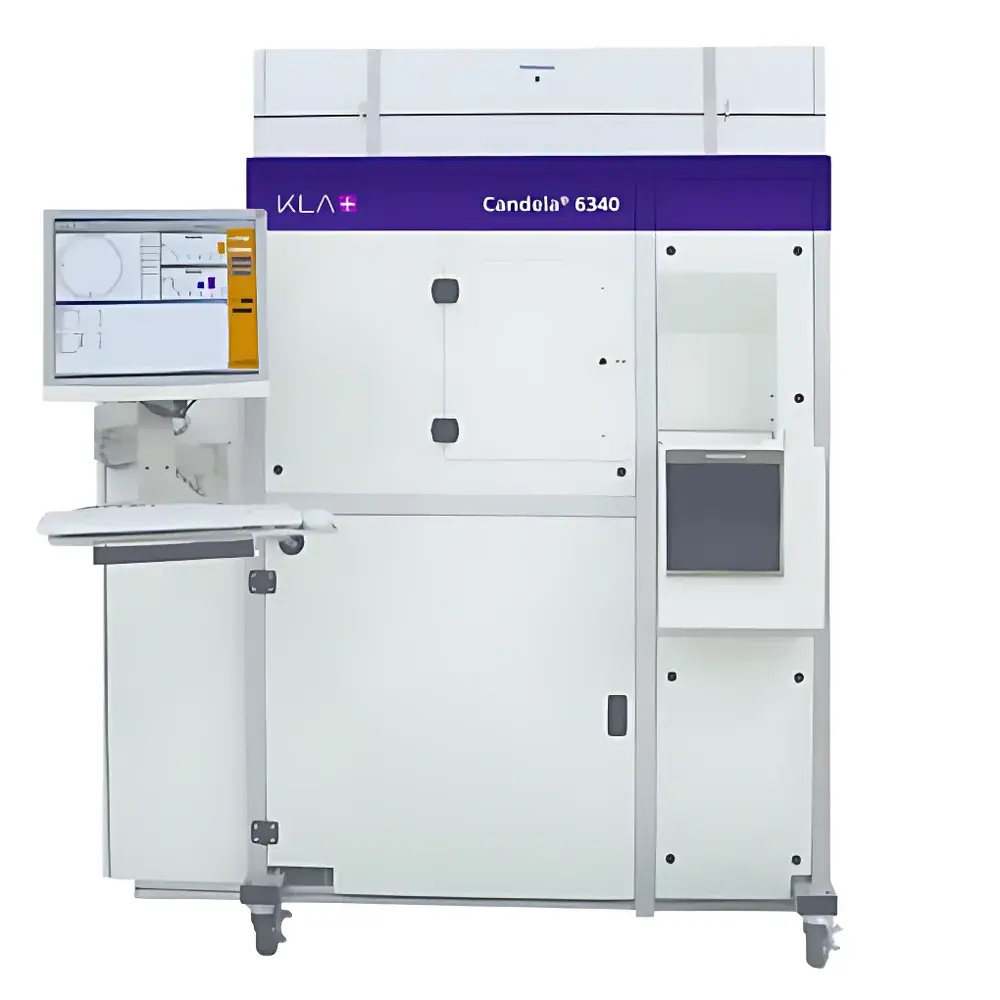
KLA Candela® 6300 Series Optical Surface Analyzer System
| Brand | KLA |
|---|---|
| Origin | USA |
| Manufacturer | KLA Corporation |
| Product Type | Optical Patterned Defect Inspection System |
| Model | Candela® 6300 |
| Detection Sensitivity | Sub-0.1 Å surface roughness change |
| Spatial Bandwidth | 0.22–2000 µm |
| Measurement Modes | Radial & tangential topography profiling, roll-off analysis, texture uniformity, particle/scratch detection |
| Compliance | Designed for semiconductor and data storage manufacturing environments |
Overview
The KLA Candela® 6300 Series Optical Surface Analyzer System is a high-precision, non-contact metrology and inspection platform engineered specifically for the characterization of ultra-smooth surfaces in advanced data storage media and semiconductor wafer-level fabrication. Based on patented multi-channel optical interferometry combined with active laser power stabilization and low-noise photodetection architecture, the system delivers quantitative surface topography across an industry-leading spatial bandwidth—from sub-micron texture features (0.22 µm) up to macro-scale waviness (2000 µm). Unlike conventional scanning probe or stylus-based methods, the Candela 6300 employs coherent optical scattering and phase-resolved imaging to resolve surface height variations with sub-angstrom root-mean-square (RMS) noise floor, enabling traceable correlation with atomic force microscopy (AFM) reference measurements. Its design addresses critical process control requirements in hard disk drive (HDD) media manufacturing—particularly as head-disk interface (HDI) clearance shrinks below 5 nm—where nanoscale surface roughness, edge roll-off, and localized contamination directly impact read/write performance and yield.
Key Features
- Patented multi-channel optical architecture enabling simultaneous acquisition of amplitude, phase, and polarization contrast signals
- Sub-0.1 Å RMS measurement noise floor achieved through thermal drift compensation, vibration isolation, and real-time laser intensity normalization
- Full-wafer radial and tangential scanning capability for comprehensive topographic mapping without stitching artifacts
- Elimination of sputtered-glass reference substrates—enabling direct measurement of native metal and fused-silica media surfaces
- Dual-mode operation: manual benchtop configuration (Candela 6310) and fully automated cluster-integrated platform (Candela 6340) with SECS/GEM interface support
- Integrated calibration traceability to NIST-traceable step-height standards and ISO 25178-2 surface texture parameters
Sample Compatibility & Compliance
The Candela 6300 accommodates 2.5″, 3.5″, and 5.25″ magnetic and glass substrates, including patterned and unpatterned wafers up to 150 mm diameter. It supports both bare media and finished disk assemblies with protective overcoats. All measurement protocols adhere to ASTM E2983 (Standard Practice for Measuring Surface Roughness Using Optical Interferometry) and ISO 25178-602 (Optical areal surface texture measurement). Data acquisition and reporting comply with FDA 21 CFR Part 11 requirements when configured with audit-trail-enabled software licenses, supporting validation under GMP/GLP-regulated environments typical in qualified HDD media fabs.
Software & Data Management
The system runs on KLA’s proprietary OSA (Optical Surface Analysis) software suite, featuring modular modules for roughness spectral analysis, defect classification via machine-learning-assisted clustering, and cross-platform data export (CSV, HDF5, Metrology XML). Offline analysis licenses support large-volume batch processing and statistical process control (SPC) integration with factory MES systems. Software versioning follows IEC 62304-compliant development lifecycle, with full revision history, electronic signature support, and role-based access control for operator, engineer, and QA reviewer accounts.
Applications
- Quantitative RMS roughness and power spectral density (PSD) profiling for HDI optimization
- Edge roll-off characterization at disk inner/outer diameters to assess polishing uniformity
- Detection and sizing of sub-100 nm particles, micro-scratches, and organic residues on coated media surfaces
- Waviness analysis for substrate flatness verification prior to thin-film deposition
- Process qualification of chemical-mechanical polishing (CMP), ion-beam etching, and diamond scribing steps
- Root-cause analysis of yield-limiting defects in high-density interconnect (HDI) patterning
FAQ
What surface materials can the Candela 6300 measure without coating or reference substrates?
It directly measures bare aluminum-magnesium alloy, nickel-phosphorus plated disks, fused silica, and Corning® Eagle XG™ glass—no sputtered layers required.
Is the system compatible with cleanroom Class 100 (ISO 5) environments?
Yes—the 6340 variant includes HEPA-filtered enclosure options and meets SEMI S2/S8 safety and emissions specifications.
Does the software support automated pass/fail decision logic based on user-defined thresholds?
Yes—OSA software allows configurable rule sets per parameter (e.g., Ra < 0.15 nm, PSD slope deviation < ±0.05), with configurable alarms and auto-report generation.
Can measurement data be exported to third-party SPC or MES platforms?
Yes—via standard OPC UA, RESTful API, or flat-file exports compliant with IPC-2581 and STDF formats.
What level of training and service support does KLA provide for global installations?
KLA offers on-site installation qualification (IQ), operational qualification (OQ), and preventative maintenance contracts with remote diagnostics and 24/7 application engineering support.