
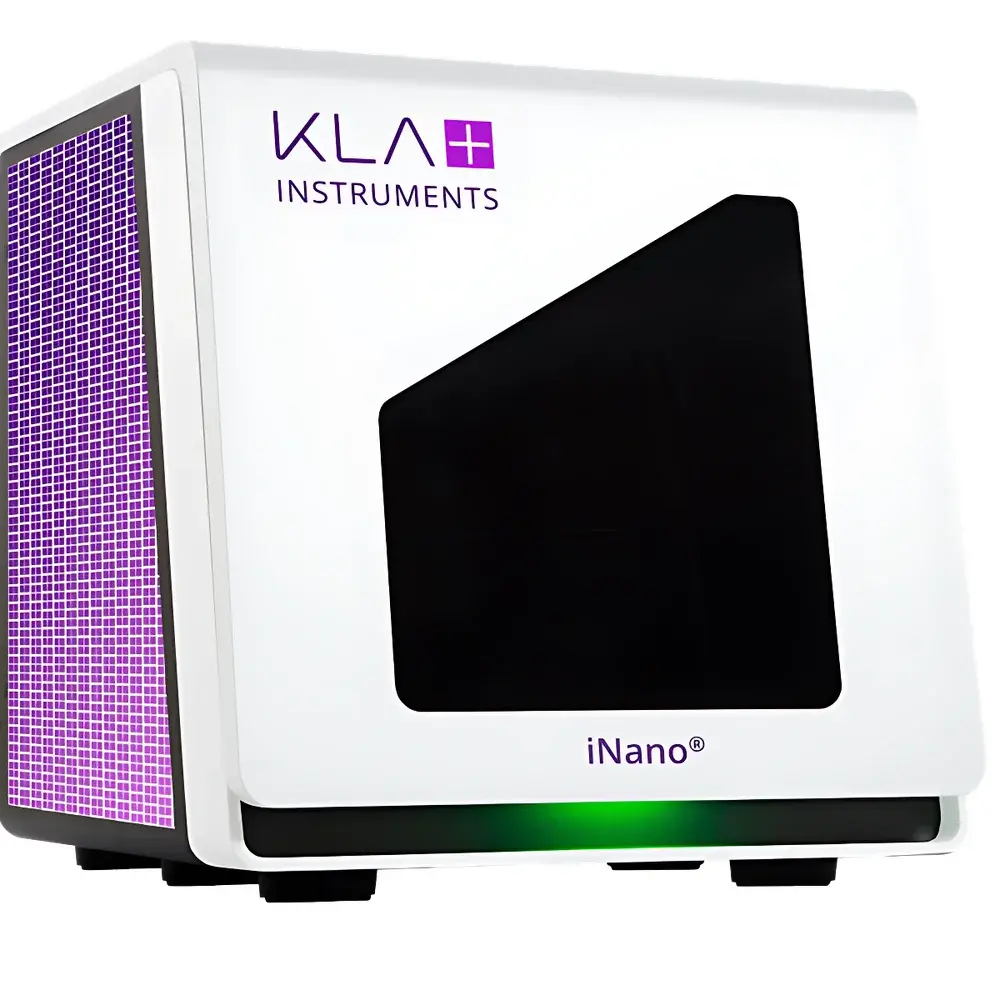
KLA iNano® Nanoindentation and Scratch Tester
| Brand | KLA |
|---|---|
| Origin | USA |
| Manufacturer | KLA Corporation |
| Instrument Type | Nanoindentation and Scratch Tester |
| Model | iNano® |
| Force Range | 0.1 µN – 50 mN |
| Displacement Range | ±25 µm |
| Force Resolution | < 10 nN |
| Displacement Resolution | < 0.01 nm |
| Thermal Drift | < 0.05 nm/s (at 25 °C, stabilized) |
| Maximum Scratch Load | 50 mN |
| Available Indenter Types | Berkovich, Cube-Corner, Spherical (1–100 µm radius), Conical, Flat Punch |
| Integrated Microscope | 10×–100× digital zoom, 1 µm lateral resolution |
| Controller | InQuest™ high-speed electronics (100 kHz sampling, 20 µs time constant) |
| XY Stage Travel | 100 mm × 100 mm |
| Z-Stage Travel | 25 mm |
| Compliance with Standards | ASTM E2546, ISO 14577-1/2/3, JIS H 8509 |
Overview
The KLA iNano® Nanoindentation and Scratch Tester is a benchtop, high-precision instrument engineered for quantitative nanomechanical characterization of thin films, coatings, bulk materials, and microscale specimens. It operates on the principle of controlled quasi-static and dynamic contact mechanics, using electromagnetic actuation and capacitive displacement sensing to deliver sub-nanometer positional fidelity and nano-Newton force control. The system implements the Oliver–Pharr method for depth-sensing indentation analysis, enabling rigorous extraction of reduced Young’s modulus (Er) and hardness (H) from load–displacement curves. Its architecture supports both standard nanoindentation and advanced modalities—including continuous stiffness measurement (CSM), creep compliance mapping, viscoelastic loss factor (tan δ) quantification, and high-temperature mechanical testing—making it suitable for R&D, process development, and quality assurance in regulated environments.
Key Features
- InForce 50 Actuator: Electromagnetic force driver with 50 mN maximum load and 50 µm displacement range; features real-time capacitive gap sensing for closed-loop displacement control and <0.01 nm displacement resolution.
- InQuest™ High-Speed Controller: 100 kHz data acquisition rate, 20 µs time constant, and synchronized multi-channel signal conditioning for simultaneous force, displacement, acoustic emission, and thermal feedback capture.
- Modular Indenter System: Interchangeable diamond indenters (Berkovich, cube-corner, spherical, conical, flat-punch) with automated tip calibration via integrated software-based area function validation per ISO 14577-2 Annex B.
- Integrated Optical Navigation: Motorized, digitally zoomed optical microscope (10×–100×) with 1 µm lateral resolution and real-time focus tracking; enables precise indentation site selection and post-test defect imaging.
- Expanded Motion Platform: 100 mm × 100 mm XY motorized stage with magnetic sample mounting interface and 25 mm Z-axis travel—accommodates wafers, cross-sectioned devices, MEMS packages, and irregularly shaped specimens without repositioning.
- Thermal Stability Architecture: Passive vibration isolation base combined with low-drift thermal enclosure design; typical thermal drift < 0.05 nm/s after 2-hour stabilization at ambient 25 °C.
Sample Compatibility & Compliance
The iNano® accommodates diverse material classes including metallic alloys (Al, Cu, Ti, Ni-based superalloys), ceramics (Al2O3, SiC, SiN), semiconductor layers (Si, SiO2, SiNx, low-k dielectrics), polymer films (PET, PI, PMMA, hydrogels), biological tissues, battery electrode composites, and multilayer stacks. All measurements adhere to internationally recognized standards: ISO 14577-1 (general principles), ISO 14577-2 (instrument calibration and verification), ISO 14577-3 (data processing), ASTM E2546 (nanoindentation practice), and JIS H 8509 (hardness testing of thin films). Optional high-temperature module (up to 300 °C) complies with ASTM E2546 Annex A4 for elevated-temperature indentation. The system supports GLP/GMP-aligned workflows through audit-trail-enabled software logging and 21 CFR Part 11-compliant electronic signatures when configured with InView Enterprise licensing.
Software & Data Management
The InView™ software suite provides a unified interface for test design, execution, real-time monitoring, and post-processing. Core modules include RunTest (method-driven protocol builder), ReviewData (interactive curve analysis with Oliver–Pharr fitting, CSM modulus extraction, and creep parameter modeling), InFocus Report (customizable PDF/Excel reporting with traceable metadata), and InView University (on-demand video training library). Advanced capabilities include NanoBlitz® 3D/4D property mapping—enabling rapid generation of spatially resolved hardness, modulus, and tan δ maps across user-defined grids—and remote operation via InView Mobile for iOS/Android. All raw data are stored in vendor-neutral HDF5 format with embedded calibration history, environmental logs, and operator annotations—ensuring full FAIR (Findable, Accessible, Interoperable, Reusable) compliance.
Applications
- Hardness and elastic modulus profiling of PVD/CVD coatings in automotive and aerospace components.
- Process window qualification for BEOL/FEOL layers in semiconductor fabrication (e.g., Cu/low-k interconnect reliability).
- Mechanical heterogeneity mapping in fiber-reinforced composites and gradient biomaterials using NanoBlitz®.
- Viscoelastic parameter extraction (storage modulus G’, loss modulus G”, tan δ) for polymer electrolytes and soft hydrogels under oscillatory loading.
- High-temperature nanoindentation to quantify thermal softening, yield onset, and plastic transition temperatures in thermally aged alloys and ceramic matrix composites.
- Scratch adhesion assessment per ISO 20502 for paint, DLC, and anti-reflective coatings on optical substrates.
- MEMS device-level mechanical validation—including cantilever spring constant, fracture toughness of release etch anchors, and stiction quantification.
FAQ
What standards does the iNano® support for nanoindentation testing?
The system natively implements ISO 14577-1/2/3, ASTM E2546, and JIS H 8509, with pre-configured test methods, calibration routines, and reporting templates aligned to each standard.
Can the iNano® perform creep or relaxation tests?
Yes—it supports constant-load hold segments with time-resolved displacement recording up to 10,000 s, enabling full creep compliance and stress-relaxation analysis.
Is high-temperature testing available as a factory option?
Yes—the optional heated stage operates from ambient to 300 °C with ±0.5 °C temperature stability and integrated thermocouple feedback, validated per ASTM E2546 Annex A4.
How is indenter tip geometry calibrated?
The InView software includes an automated tip calibration workflow using fused silica and sapphire reference samples, generating tip-area functions compliant with ISO 14577-2 Annex B.
Does the system support third-party data import/export?
Raw data are exported in HDF5 format with metadata schema; Python and MATLAB APIs are provided for custom analysis pipelines and integration with LIMS or MES platforms.



