
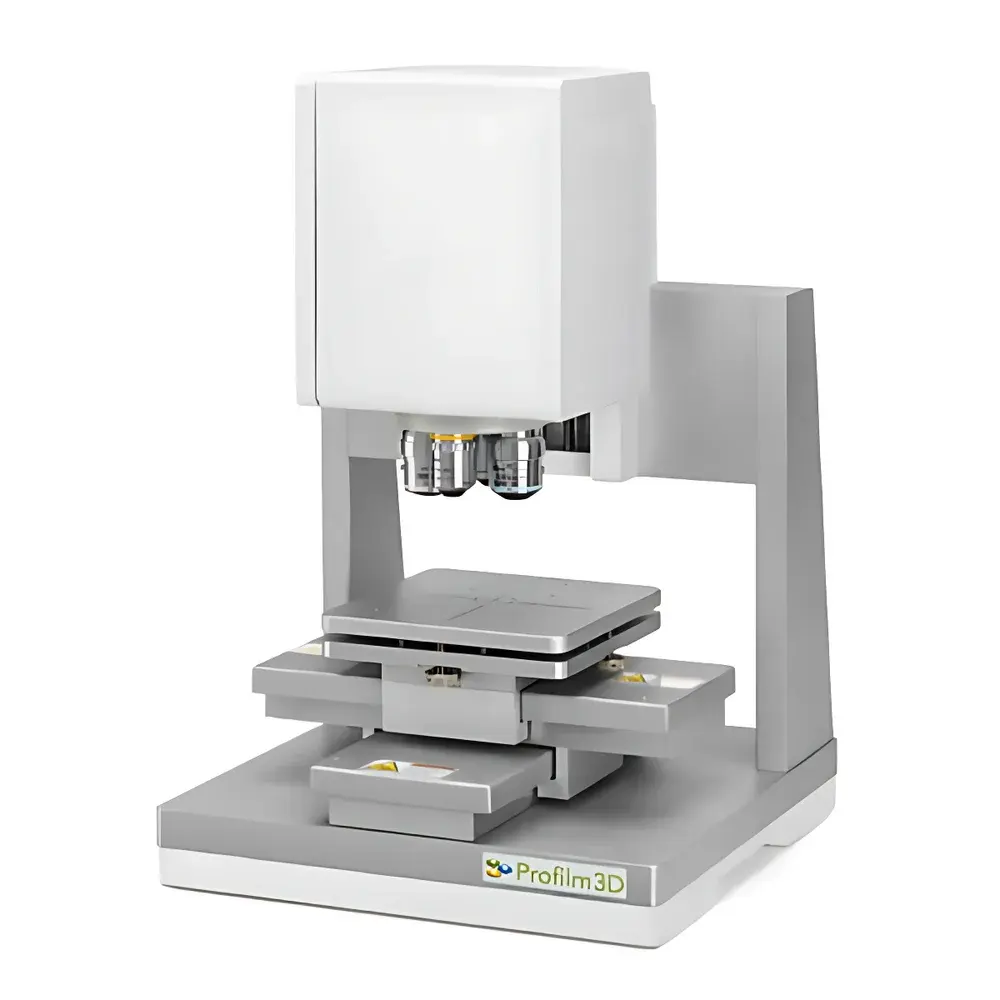
KLA Profilm 3D White Light Interferometric Optical Profilometer
| Brand | KLA |
|---|---|
| Origin | USA |
| Model | Profilm 3D |
| Measurement Principle | Vertical Scanning Interferometry (VSI) & Phase-Shifting Interferometry (PSI) |
| Thickness Range (VSI) | 50 nm – 100 mm |
| Thickness Range (PSI) | 0 – 3 µm |
| Reflectance Range | 0.05% – 100% |
| Piezo Scan Range | 500 µm |
| XY Stage Options | 100 mm × 100 mm or 200 mm × 200 mm |
| Compliance | ISO 25178-604, ISO 9000, ASME B46.1 |
| Roughness Parameters | 47 standardized (ASME Y14.36M, ISO 4287, ISO 25178-2) |
| Software | ProfilmOnline cloud-based analysis platform |
Overview
The KLA Profilm 3D is a benchtop white light interferometric optical profilometer engineered for high-precision, non-contact 3D surface topography characterization. It integrates two complementary interferometric modalities—Vertical Scanning Interferometry (VSI) for broad vertical range and robust step-height measurement, and Phase-Shifting Interferometry (PSI) for sub-nanometer vertical resolution on smooth, reflective surfaces. This dual-mode architecture enables traceable, repeatable measurements across diverse surface geometries—from ultra-flat silicon wafers to highly curved polymer lenses or structured microelectromechanical systems (MEMS). Unlike contact stylus profilers, the Profilm 3D eliminates mechanical loading, tip wear, or surface deformation—critical for soft photoresists, thin-film stacks, and delicate nanostructured coatings. Its optical design conforms to ISO 25178-604, which explicitly standardizes Coherence Scanning Interferometry (CSI), the technical foundation of WLI-based systems.
Key Features
- Dual-interferometry engine supporting both VSI (50 nm–100 mm vertical range) and PSI (0–3 µm, <0.1 nm vertical repeatability on ideal surfaces) for optimal flexibility across roughness, step height, and form metrology.
- Large-area XY motorized stage with configurable travel (100 mm × 100 mm standard; optional 200 mm × 200 mm) enabling automated stitching of up to 100+ individual fields-of-view for wafer-scale or panel-level mapping.
- Integrated 500 µm piezoelectric scanner delivering high-speed, vibration-insensitive Z-axis scanning with closed-loop feedback for enhanced linearity and thermal stability.
- Single broadband LED illumination source—no lasers, no consumables, no alignment maintenance—ensuring long-term operational consistency and reduced total cost of ownership.
- Real-time 3D rendering engine allowing interactive rotation, slicing, cross-sectioning, and false-color height mapping directly within the acquisition interface.
- Compliance-ready software architecture supporting audit trails, user access control, electronic signatures, and data export formats compatible with FDA 21 CFR Part 11 and GLP/GMP documentation workflows.
Sample Compatibility & Compliance
The Profilm 3D accommodates a broad spectrum of material classes without sample preparation or coating: bare and patterned silicon wafers (including amorphous and polycrystalline Si), dielectric thin films (SiO₂, SiNₓ), hard coatings (DLC, TiN), ceramics, optical glasses, polymers, photoresists, and biomedical substrates. Its wide reflectance tolerance (0.05%–100%) permits direct measurement of low-reflectivity surfaces such as black anodized aluminum or carbon composites, while maintaining signal fidelity on highly reflective mirrors or metal foils. All surface texture and areal roughness analyses adhere to ISO 25178-2 (areal parameters) and ISO 4287 (profile-based parameters), with full support for all 47 standardized metrics—including Sa, Sq, Sz, Ssk, Sku, and functional parameters like Spk, Svk, and Smr. Instrument calibration is traceable to NIST standards via KLA’s certified reference artifacts.
Software & Data Management
ProfilmOnline is a secure, browser-based cloud platform that serves as the central hub for data storage, collaborative review, and advanced post-processing. Users upload native .pro3d files from any Profilm 3D system and perform full-featured analysis—including filtering (Gaussian, spline, robust polynomial), segmentation, grain analysis, defect detection, and custom parameter scripting—on Windows, macOS, iOS, or Android devices. Raw interferograms, height maps, intensity images, and metadata are preserved in immutable format. Role-based permissions, version-controlled reports, and PDF/CSV/XLSX export ensure regulatory compliance during internal audits or external quality assessments. The software supports automated report generation with embedded pass/fail thresholds aligned to internal SOPs or industry specifications (e.g., SEMI, JEDEC, IPC).
Applications
The Profilm 3D delivers quantitative surface metrology for R&D, process development, and production QA/QC across multiple sectors: semiconductor front-end (film thickness uniformity, CMP endpoint verification, trench depth profiling), MEMS packaging (bond interface flatness, cavity height), display manufacturing (touch sensor electrode uniformity, OLED encapsulation layer integrity), precision optics (lens surface figure error, mold replication fidelity), and advanced packaging (copper pillar height, underfill void analysis). Its ability to resolve sub-100 nm steps on multi-layer stacks—combined with large-area stitching and automated recipe-driven workflows—makes it suitable for inline process monitoring when integrated into factory automation environments via SECS/GEM or RESTful API interfaces.
FAQ
What interferometry methods does the Profilm 3D support?
It supports both Vertical Scanning Interferometry (VSI) for high-dynamic-range topography and Phase-Shifting Interferometry (PSI) for ultra-high-resolution measurement on smooth, coherent surfaces.
Is the system compliant with ISO 25178?
Yes—the Profilm 3D implements Coherence Scanning Interferometry (CSI), which is explicitly defined in ISO 25178-604 as a validated optical method for areal surface texture measurement.
Can it measure transparent or semi-transparent thin films?
While primarily designed for surface topography, multi-layer film thickness can be inferred indirectly using fringe contrast analysis in VSI mode; however, dedicated spectroscopic reflectometry is recommended for precise optical thickness quantification.
Does ProfilmOnline require local server installation?
No—ProfilmOnline operates entirely in the cloud; no on-premise IT infrastructure, database administration, or software updates are required by the end user.
How is measurement traceability maintained?
KLA provides annual calibration services using NIST-traceable step-height standards, with full documentation including uncertainty budgets per ISO/IEC 17025 requirements.



