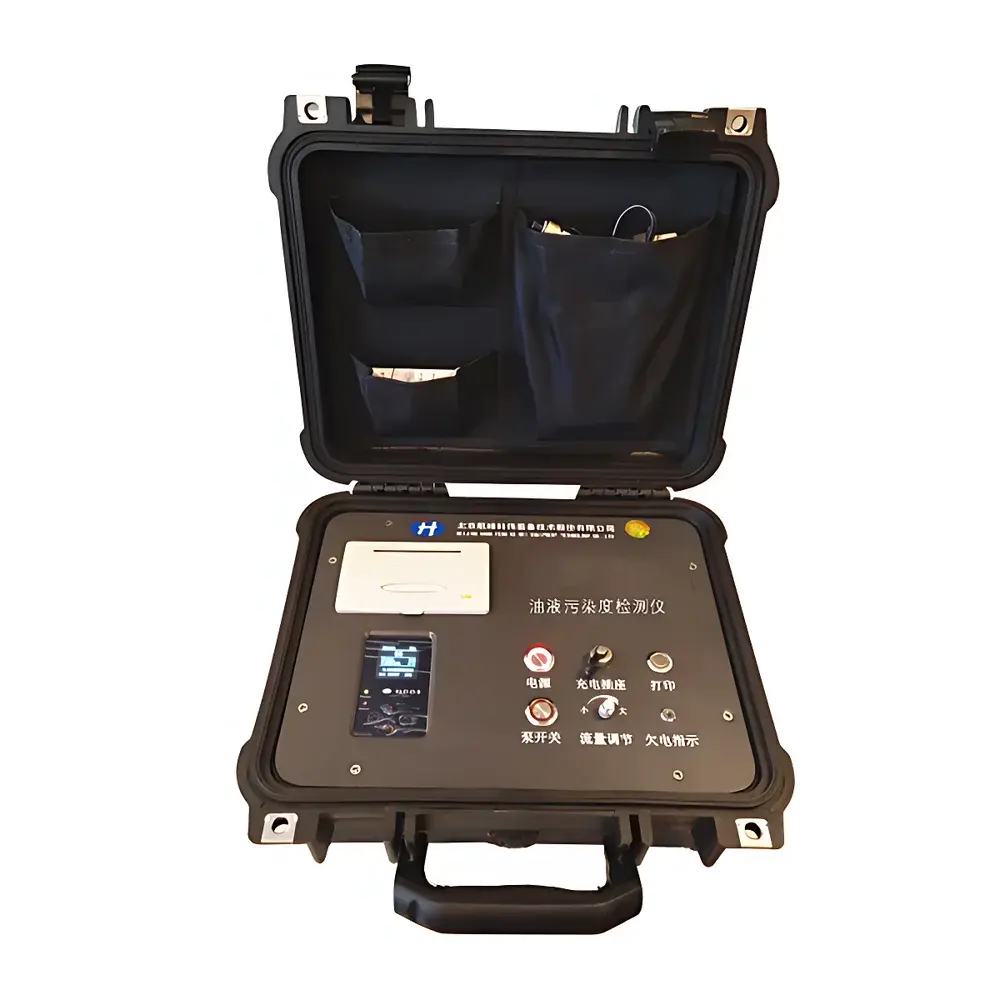
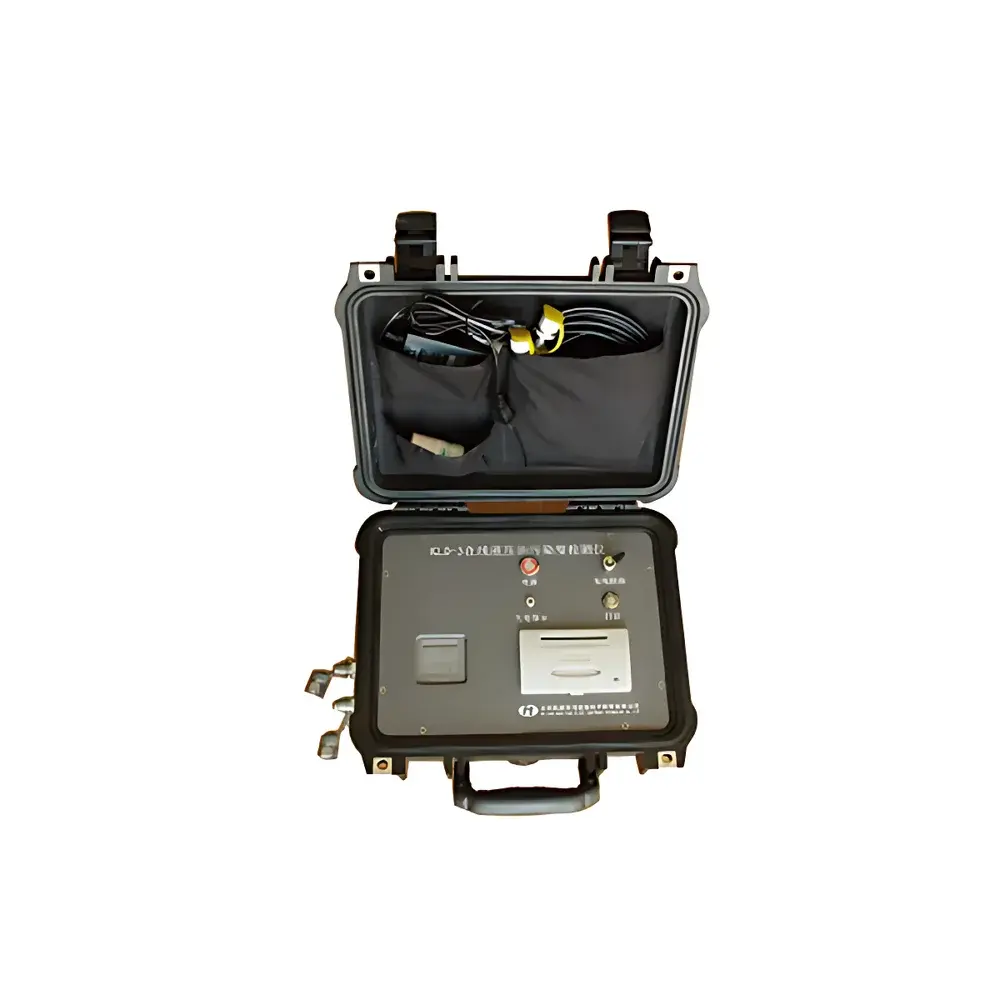
KLD-B-2 Portable Oil Contamination Analyzer by Beijing Hangfeng
| Brand | Beijing Hangfeng |
|---|---|
| Origin | Beijing, China |
| Manufacturer Type | Authorized Distributor |
| Country of Origin | China |
| Model | KLD-B-2 |
| Pricing | Available Upon Request |
Overview
The KLD-B-2 Portable Oil Contamination Analyzer is an engineered field-deployable instrument designed for quantitative assessment of particulate contamination in hydraulic fluids, lubricating oils, turbine oils, and other petroleum-based operational fluids. It operates on the light extinction (light blockage) principle—also known as the optical blockage or laser obscuration method—in accordance with ISO 11171 and ISO 4402 calibration standards. A collimated laser beam passes through a precisely metered fluid sample; particles suspended in the fluid interrupt the beam, generating pulses proportional to their cross-sectional area. These pulses are classified into user-selectable size channels (e.g., ≥4 µm(c), ≥6 µm(c), ≥14 µm(c), ≥21 µm(c), ≥38 µm(c), ≥70 µm(c)) to generate particle count distributions per unit volume (typically per milliliter). The system delivers traceable, repeatable, and field-validated contamination data without requiring laboratory infrastructure—making it essential for predictive maintenance, oil condition monitoring programs, and filtration efficiency validation.
Key Features
- Laser-based optical sensor with high signal-to-noise ratio and stable beam alignment for consistent particle detection across viscosity ranges up to ISO VG 100
- Dual-mode operation: real-time inline monitoring via flow cell integration (with optional pressure-rated bypass kit) and offline bottle sampling using calibrated syringe or vacuum-assisted draw
- Integrated microprocessor-controlled precision piston pump ensures constant flow rate (±1% repeatability) and volumetric accuracy (±0.5% per 10 mL draw)
- 7-inch capacitive touchscreen display with intuitive icon-driven menu navigation; physical numeric keypad available for rapid parameter entry under gloved-hand conditions
- Bilingual UI (English/Chinese) switchable via dedicated hardware key—no firmware reload required
- Onboard embedded PC running real-time OS: enables local data storage (≥10,000 test records), USB 2.0 host port for flash drive export, and firmware updates via FAT32-formatted media
- Integrated thermal line printer supports immediate hardcopy output of current results, trend summaries, and full historical reports with timestamp, operator ID, and sample ID fields
- Ruggedized ABS+PC carry case with molded foam insert, IP65-rated enclosure, and shock-absorbing handles—certified for transport per MIL-STD-810G Method 516.6 (transit drop)
Sample Compatibility & Compliance
The KLD-B-2 is validated for use with mineral-based, synthetic, and semi-synthetic lubricants, hydraulic fluids (including fire-resistant HFDU types), and aviation turbine oils (MIL-PRF-23699, MIL-PRF-6083). It complies with international reporting conventions including ISO 4406:2017 (code-based classification), NAS 1638 Class Code, and military specifications GJB 420A–1996 and GJB 420B–2006. Calibration traceability is maintained to NIST-traceable PSL (polystyrene latex) reference particles per ISO 21501-4. The instrument meets electromagnetic compatibility requirements per IEC 61326-1:2013 (industrial environment) and safety standards IEC 61010-1:2010 (measurement category II, pollution degree 2).
Software & Data Management
Data acquisition, analysis, and reporting are managed entirely onboard. Each test record includes date/time stamp, operator code, sample identification, temperature (via integrated RTD sensor), viscosity input (optional correction factor), and full particle count histogram. Export formats include CSV (for LIMS integration), PDF (print-ready reports), and XML (compatible with enterprise CMMS platforms). Audit trail functionality logs all configuration changes, calibration events, and user logins—supporting GLP/GMP-aligned workflows. USB mass storage mode allows drag-and-drop transfer without proprietary drivers. Firmware updates preserve user-defined settings and calibration history.
Applications
- Field verification of hydraulic system cleanliness prior to commissioning (per ISO 4406 target codes)
- Real-time monitoring of filter performance degradation during service life testing
- Condition-based oil change decisions in wind turbine gearboxes and marine propulsion systems
- Acceptance testing of new oil deliveries against OEM cleanliness specifications
- Root cause analysis of component wear through trending of >6 µm(c) and >14 µm(c) particle populations
- Support for ISO 17025-accredited laboratories performing third-party oil analysis services
FAQ
What particle size thresholds does the KLD-B-2 report?
It reports cumulative counts per milliliter for standard channels: ≥4 µm(c), ≥6 µm(c), ≥14 µm(c), ≥21 µm(c), ≥38 µm(c), and ≥70 µm(c), configurable per selected standard (e.g., ISO 4406 uses ≥4 and ≥6 µm(c); NAS 1638 uses ≥5, ≥15, ≥25, ≥50, and ≥100 µm).
Can the instrument be used with high-viscosity oils?
Yes—when paired with pre-heating accessories (optional 40–60 °C bath module) and adjusted flow rate settings, it accommodates oils up to ISO VG 150; viscosity compensation algorithms minimize sizing bias.
Is the built-in printer compatible with external label printers?
No—the integrated thermal printer is fixed-format only; however, full data export via USB supports custom label generation in external software.
Does the device support remote diagnostics or network connectivity?
Not natively—it lacks Ethernet/Wi-Fi; however, exported CSV files integrate seamlessly with cloud-based oil analysis dashboards via manual upload or scheduled FTP sync from connected host PCs.