
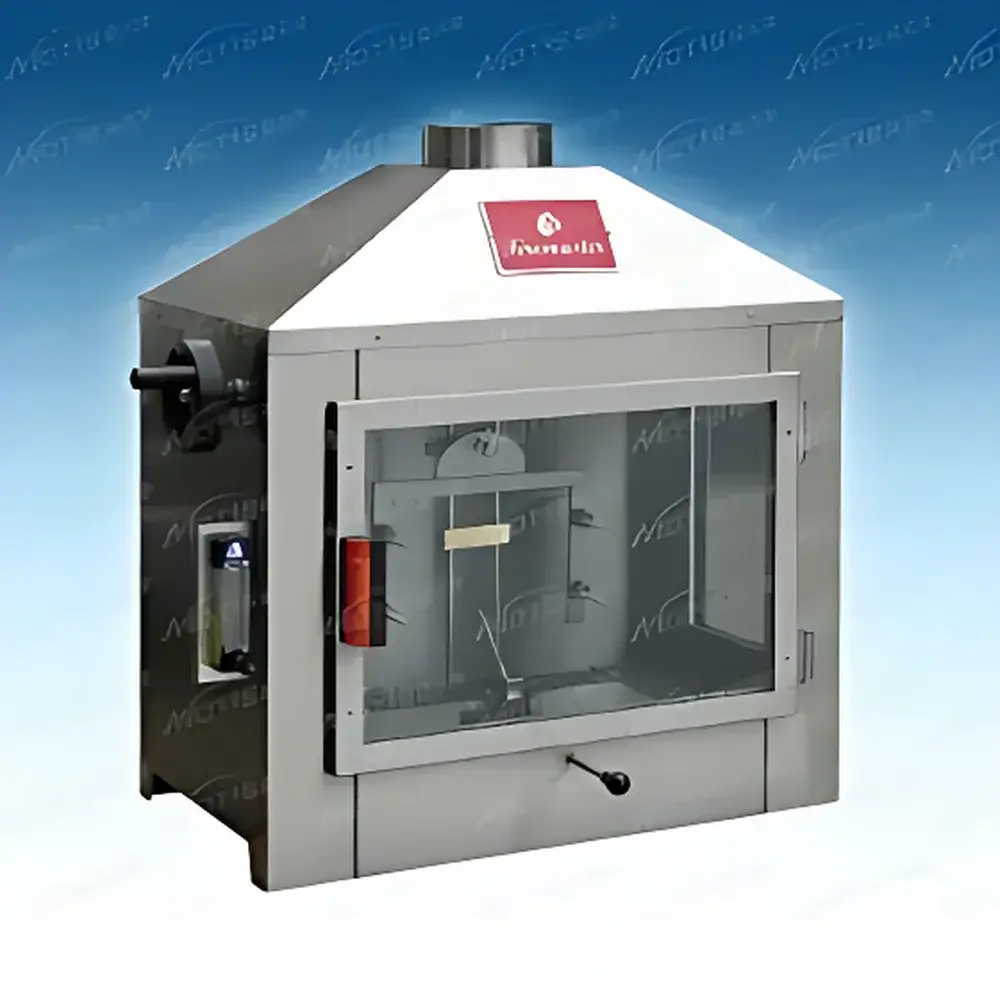
KleinBrenner ISO 11925-2 Single-Flame Ignitability Test Apparatus for Building Materials
| Origin | Tianjin, China |
|---|---|
| Manufacturer Type | Authorized Distributor |
| Origin Category | Domestic (China) |
| Model | ISO 11925-2 |
| Airflow Velocity Range | 0–10 m/s |
| Timer Resolution | 0.1 s |
| Ignition Angle Options | 0° (vertical) and 45° |
Overview
The KleinBrenner ISO 11925-2 Single-Flame Ignitability Test Apparatus is a precision-engineered combustion test system designed to evaluate the surface flammability behavior of building materials under controlled, small-flame impingement conditions. Based on the internationally recognized KleinBrenner principle—originally developed in Germany—the apparatus subjects vertically oriented specimens to a standardized propane or butane flame source for a defined duration (typically 30 s), while monitoring ignition occurrence, flame spread, and sustained burning. This test method directly supports classification schemes under ISO 11925-2:2010, GB/T 8626–2007, DIN 4102-1 (B2 class), and EN 13501-1 (for Bfl, Cfl, Dfl, Efl categories). The system operates on the fundamental principle of assessing ignitability as a function of heat flux, flame geometry, exposure time, and material thermal response—critical parameters for regulatory compliance in construction product certification.
Key Features
- All-stainless-steel chamber construction ensures long-term resistance to thermal oxidation, acid gas corrosion, and repeated flame exposure—significantly extending service life and maintaining dimensional stability over thousands of test cycles.
- Dual tempered glass observation doors provide unobstructed, high-visibility monitoring of flame interaction with the specimen without compromising safety integrity or airflow uniformity.
- Motorized or manually adjustable sample holder enables precise X-, Y-, and Z-axis positioning, guaranteeing repeatable flame impingement at the geometric center or at standardized distances (e.g., 10 mm, 40 mm) from edges—essential for inter-laboratory reproducibility.
- Combustion burner mounted on low-friction linear rail allows smooth, calibrated lateral translation to accommodate varying specimen geometries and flame alignment requirements.
- Two certified stainless steel sample clamps—manufactured via precision die-stamping per ISO 11925-2 Annex A specifications—ensure consistent specimen fixation, minimal thermal bridging, and zero deformation during heating.
- Integrated digital anemometer (0–10 m/s range, ±0.1 m/s accuracy), calibrated thermometer (−10 to 150 °C), and high-resolution timer (0.1 s resolution) enable real-time environmental validation prior to and during each test sequence.
- Imported rotameter with fine-control valve delivers stable, traceable gas flow regulation—critical for maintaining flame height between 20 mm and 30 mm as specified in ISO 11925-2 Clause 6.2.
Sample Compatibility & Compliance
The apparatus accommodates rigid and semi-rigid flat specimens up to 230 mm × 76 mm × 60 mm (L × W × H), including wall panels, ceiling tiles, insulation boards, decorative laminates, and coated substrates. It supports both non-edge and edge-ignition configurations per ISO 11925-2 Annexes A and B. Compliant testing outcomes contribute directly to national and European fire classification frameworks—including GB/T 8624–2007 (China), EN 13501-1:2018 (EU), and ASTM E136 (when adapted with supplementary protocols). All hardware components—including gas delivery lines, flame nozzles, and sample fixtures—conform to dimensional tolerances specified in ISO 11925-2 Annex A and DIN 4102-1 Appendix D. System design facilitates audit readiness for GLP-compliant laboratories and supports documentation traceability required under ISO/IEC 17025:2017 accreditation.
Software & Data Management
While the base configuration operates as a manual test platform, optional PC-based data acquisition modules are available to log real-time anemometer readings, thermocouple outputs, and timer events. These modules generate timestamped CSV reports compliant with ISO/IEC 17025 record retention requirements. Audit trails include operator ID, calibration status of transducers, ambient condition verification timestamps, and flame stabilization confirmation—enabling full traceability for FDA 21 CFR Part 11–aligned environments where electronic records are mandated. Firmware updates and calibration certificate management are supported through secure vendor portal access.
Applications
This apparatus is routinely deployed in national building material testing institutes (e.g., CNAS-accredited labs in China), third-party certification bodies (e.g., SGS, TÜV Rheinland), and R&D centers developing fire-retardant composites. Typical use cases include pre-certification screening of façade systems, validation of intumescent coatings, comparative analysis of mineral wool vs. polymer-based insulations, and technical due diligence for CE marking of construction products exported to EU markets. Its deterministic, flame-source-driven methodology makes it particularly valuable for root-cause analysis of unexpected field ignitions where surface ignition propensity—not bulk calorific value—is the governing failure mode.
FAQ
Does this apparatus meet ISO 11925-2:2010 edition requirements?
Yes—the mechanical configuration, burner geometry, sample fixture dimensions, and environmental measurement capabilities fully satisfy all mandatory clauses in ISO 11925-2:2010, including Annex A (sample holder) and Annex B (edge ignition setup).
Can it be used for EN 13823 (SBI) sample pre-screening?
No—it is not a substitute for SBI testing; however, it serves as a rapid, low-cost prescreening tool to identify materials highly susceptible to surface ignition before committing to full-scale SBI or room corner tests.
Is calibration documentation included with shipment?
Each unit ships with a factory calibration report covering timer accuracy, anemometer linearity, and rotameter flow verification against NIST-traceable standards.
What maintenance intervals are recommended for long-term reliability?
Quarterly inspection of gas seals, annual recalibration of the anemometer and timer, and biannual cleaning of burner orifices and sample clamp contact surfaces are advised per ISO/IEC 17025 preventive maintenance guidelines.
Are replacement parts—such as burners or sample clamps—available separately?
Yes—original-specification stainless steel clamps, KleinBrenner-certified nozzles, and calibrated rotameters are stocked and supplied with full dimensional certification and material test reports.



