
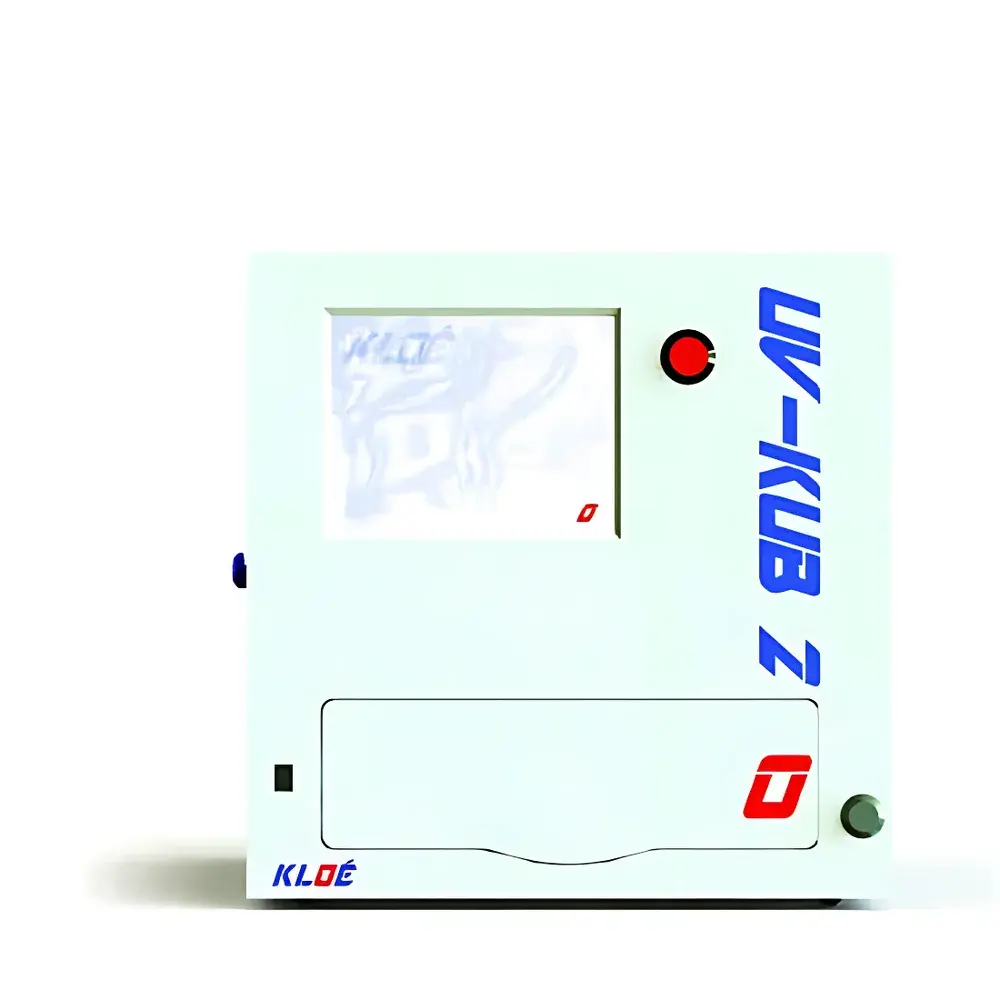
KLOE UV-KUB Series UV LED Mask Aligner for Microfluidic Chip Fabrication
| Brand | KLOE |
|---|---|
| Origin | France |
| Model | UV-KUB Series |
| Light Source Wavelengths | 365 nm / 385 nm / 405 nm |
| Minimum Resolution | 2 µm |
| Maximum Divergence Angle | < 2° |
| Energy Density | 25 mW/cm² ±10% (UV-KUB 2) / 30 mW/cm² ±10% (UV-KUB 3) |
| Max. Substrate Size | 4-inch wafer |
| Alignment Capability | Manual pre-alignment + fine manual alignment (UV-KUB 2) |
| Exposure Time Range | 1 s – 18 h |
| Thermal Rise During Exposure | < 1 °C |
| Max. Stored Programs | 10 (UV-KUB 2) / Unlimited (UV-KUB 3) |
| Display | 5.7″ color touchscreen (UV-KUB 2) / 15.6″ color touchscreen (UV-KUB 3) |
| Dimensions (W×D×H) | 260 × 260 × 260 mm (UV-KUB 2) / 480 × 480 × 480 mm (UV-KUB 3) |
| Weight | 8.2 kg (UV-KUB 2) / 55 kg (UV-KUB 3) |
| Compatible Photoresists | AZ, Shipley, SU-8, K-CL series |
| Contact Modes | Hard contact (direct contact) and soft contact (proximity mode) |
Overview
The KLOE UV-KUB Series UV LED Mask Aligner is a compact, benchtop photolithography system engineered for high-precision microfabrication of microfluidic chips, MEMS devices, and lab-on-a-chip platforms. Unlike mercury-vapor lamp-based aligners requiring warm-up time, cooling infrastructure, and frequent bulb replacement, the UV-KUB leverages solid-state UV-LED illumination at 365 nm, 385 nm, or 405 nm—enabling instant on/off operation, exceptional spectral stability, and >10,000-hour source lifetime. Its optical design ensures collimated, uniform irradiance across the full exposure field (up to 4-inch wafers), with divergence <2° and spatial intensity variation <±5%. The system operates via either hard-contact (zero-gap) or proximity-mode (25–50 µm gap) lithography, supporting standard photomasks and widely used negative and positive photoresists—including AZ series, Shipley S18xx, SU-8 2000/3000, and K-CL resists—without process requalification. Designed and manufactured in France, the UV-KUB platform complies with CE marking requirements and adheres to IEC 61000-6-3 (EMC) and IEC 62471 (photobiological safety) standards.
Key Features
- Benchtop footprint with no external chiller, vacuum pump, or exhaust ducting required—ideal for shared cleanroom labs and academic core facilities.
- Auto-adjustable mask stage compensates for substrate thickness variations (0.1–2 mm), maintaining optimal focus and gap control during proximity exposure.
- Dual-wavelength capability (365/405 nm) enables optimization for resist sensitivity, crosslinking depth, and sidewall profile control—critical for high-aspect-ratio microchannel fabrication.
- Thermally stable optical head limits substrate temperature rise to <1 °C during extended exposures (up to 18 hours), minimizing resist flow and dimensional drift.
- UV-KUB 3 integrates a high-resolution CCD camera (≥1.3 MP), real-time image overlay, digital coordinate registration, and programmable alignment mark detection—replacing traditional stereo microscopes and eliminating parallax errors.
- Full exposure parameter logging (wavelength, dose, time, mask ID, operator ID) supports GLP-compliant documentation and audit-ready traceability.
Sample Compatibility & Compliance
The UV-KUB Series accommodates rigid and semi-rigid substrates including silicon wafers (≤100 mm), glass slides (e.g., borosilicate, fused silica), quartz, and polymer films (e.g., PMMA, COP). It supports both spin-coated and laminated photoresist layers from 0.5 µm to 200 µm thickness. Process compatibility has been validated per ASTM F2651 (Standard Practice for Photolithography in MEMS Fabrication) and ISO 14644-1 Class 5 cleanroom operating conditions. All firmware and exposure logs are timestamped and user-authenticated, satisfying foundational requirements for FDA 21 CFR Part 11 electronic record integrity when deployed in regulated R&D environments.
Software & Data Management
Exposure protocols are configured via an intuitive, icon-driven GUI on the integrated color touchscreen (5.7″ on UV-KUB 2; 15.6″ industrial-grade display on UV-KUB 3). Each program stores wavelength selection, energy density setpoint, exposure duration, mask height offset, and alignment reference coordinates. UV-KUB 3 adds exportable CSV reports containing full exposure metadata, image snapshots of alignment marks pre/post-adjustment, and histogram-based intensity uniformity analysis. No proprietary drivers or OS dependencies are required—data export uses standard USB mass-storage mode. Firmware updates are delivered via encrypted .bin files with SHA-256 signature verification.
Applications
- Fabrication of polymeric microfluidic chips (PDMS, COC, PMMA) with channel widths down to 2 µm and aspect ratios >10:1.
- Prototyping of microelectrode arrays, electrophoretic separation devices, and droplet-based digital microfluidics platforms.
- MEMS sensor patterning (e.g., piezoresistive cantilevers, capacitive pressure sensors) on silicon or SOI wafers.
- Grayscale lithography for 3D microstructures using dose-modulated exposure strategies.
- Education and training in cleanroom microfabrication—low operational cost, minimal maintenance, and intuitive workflow reduce barrier-to-entry for graduate students and new technicians.
FAQ
Does the UV-KUB require ozone extraction or special ventilation?
No. UV-LED sources emit negligible ozone below 200 nm; operation is safe in standard laboratory air without forced exhaust.
Can the system be integrated into automated wafer-handling workflows?
Not natively—UV-KUB is a manual-load, operator-attended tool. However, its RS-232 and Ethernet interfaces support external PLC-triggered start/stop commands and status polling.
Is SU-8 2075 compatible with the 365 nm exposure mode?
Yes. Full crosslinking of SU-8 2075 has been verified at 365 nm with doses between 150–300 mJ/cm², depending on film thickness and post-exposure bake profile.
What is the recalibration interval for the energy sensor?
KLOE recommends annual verification using a NIST-traceable photodiode power meter; no user-serviceable recalibration is required—the built-in sensor is factory-calibrated and drift-compensated in firmware.
Are custom mask holders available for non-standard substrate shapes?
Yes. KLOE offers machined aluminum holders for rectangular glass slides (25 × 75 mm, 50 × 75 mm) and circular substrates up to Ø100 mm, all compatible with the auto-height adjustment mechanism.




