
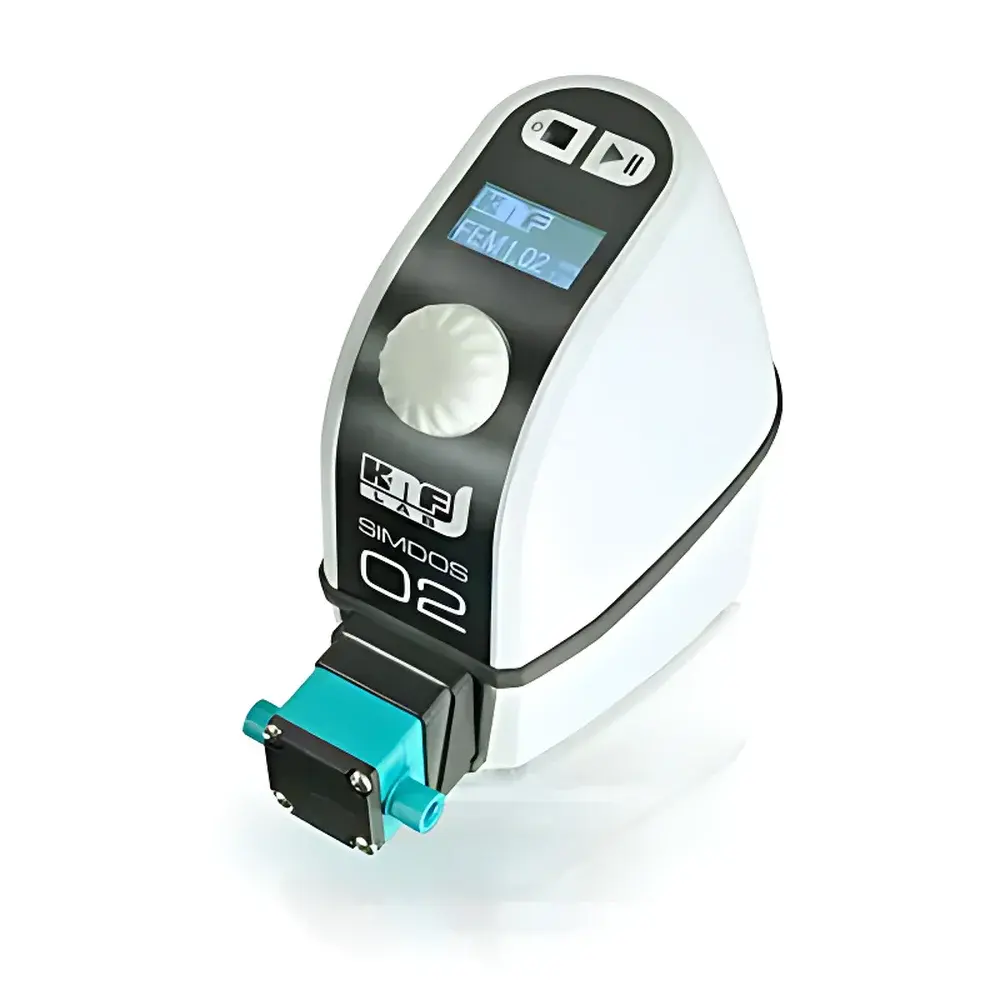
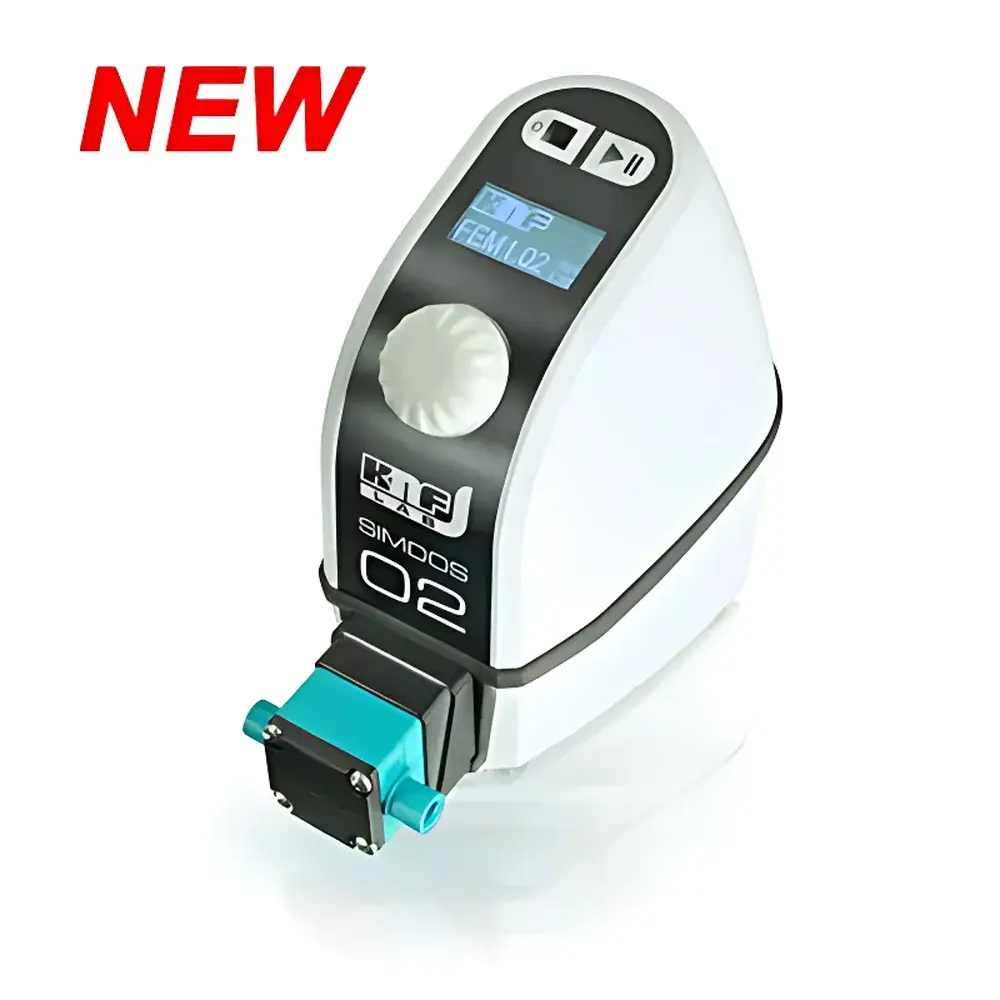
KNF FEM1.02 Precision Diaphragm Liquid Metering Pump
| Brand | KNF |
|---|---|
| Origin | Switzerland |
| Model | FEM 1.02 KT/TT/FT/ST.18 S (RC) |
| Pump Type | Oil-Free Diaphragm Metering Pump |
| Flow Rate | 0.03–20 mL/min |
| Max Vacuum | 3 mbar (abs) |
| Dimensions (L×H×W) | 143 × 93 × 145 mm |
| Weight | 0.9 kg |
| Motor Power | 10 W |
| Ingress Protection | IP65 |
| Ambient Temperature Range | 5–40 °C |
| Fluid Temperature Range | 5–80 °C |
| Fluid Viscosity Limit | ≤150 cSt |
| Accuracy | ±2% (RC mode, 1–100% range) |
| Repeatability | ±1% |
| Control Signals | 0–5 V, 0–10 V, 0–20 mA, 4–20 mA |
| Stroke Volume Range | 30 µL–999 mL |
| Electrical Supply | 99–264 VAC, 50–60 Hz |
| Port Thread | 1/4″-28 UNF |
| Wetted Materials | PP/PTFE-coated pump head + FFKM valves (KT), PVDF/PTFE-coated (TT), PTFE/PTFE-coated (FT), SUS/PTFE-coated (ST) |
Overview
The KNF FEM1.02 is a compact, oil-free precision diaphragm liquid metering pump engineered for high-accuracy, low-flow fluid handling in laboratory and R&D environments. Based on KNF’s proven positive displacement diaphragm technology, it delivers precise volumetric dosing via electronically controlled reciprocating motion of a chemically resistant PTFE-coated diaphragm. Unlike peristaltic or syringe pumps, the FEM1.02 eliminates tubing fatigue and pulsation-related inaccuracies while maintaining full dry-run capability and self-priming performance—critical for intermittent or low-volume transfer applications in chemistry, pharmaceutical development, and materials science. Its robust architecture supports continuous operation under variable backpressure and accommodates a wide range of aggressive solvents, aqueous solutions, and viscous media up to 150 cSt.
Key Features
- True oil-free operation with no lubricants contacting the fluid path—ensuring sample integrity and eliminating contamination risk.
- High repeatability (±1%) and calibrated accuracy (±2% in RC mode) across the full stroke volume range (30 µL–999 mL).
- IP65-rated enclosure for dust-tight and water-jet resistant operation—suitable for fume hoods, glove boxes, and wet lab benches.
- Integrated analog and pulse control interface (RC version) supporting standard industrial signals: 0–5 V, 0–10 V, 0–20 mA, and 4–20 mA for seamless integration into automated workflows.
- Modular wetted material configurations: PP/PTFE + FFKM (KT), PVDF/PTFE + FFKM (TT), PTFE/PTFE + FFKM (FT), and stainless steel (SUS)/PTFE + FFKM (ST)—enabling compatibility with acids, bases, halogenated solvents, and high-purity reagents.
- Compact footprint (143 × 93 × 145 mm) and lightweight design (0.9 kg) facilitate benchtop mounting, OEM integration, or mobile analytical platforms.
- Self-priming capability and safe dry-run operation eliminate the need for pre-filling or flow sensors—reducing system complexity and startup time.
Sample Compatibility & Compliance
The FEM1.02 meets stringent chemical compatibility requirements for use in GLP-compliant laboratories and early-phase process development. Wetted components conform to USP Class VI and FDA 21 CFR 177.2470 standards for fluoropolymer-coated surfaces. All variants are compatible with common organic solvents (e.g., acetone, THF, DCM), aqueous buffers (pH 1–14), and thermally stable formulations up to 80 °C. The pump operates within ambient temperature ranges of 5–40 °C and complies with IEC 61000-6-3 (EMC emission) and IEC 61000-6-2 (immunity) standards. While not certified for ATEX or IECEx hazardous areas, its low-power (10 W), non-sparking motor and sealed electronics make it suitable for general-purpose chemical handling under ISO 15195 and ASTM D3404 guidelines.
Software & Data Management
The FEM1.02 RC variant supports deterministic analog control without embedded firmware or proprietary software—ensuring long-term interoperability with third-party DAQ systems (e.g., National Instruments, LabVIEW), PLCs, and custom-built automation controllers. Analog input enables linear flow-rate mapping with traceable calibration curves; all control signals are galvanically isolated to prevent ground-loop interference. For audit-trail compliance in regulated environments, external data loggers can record voltage/current setpoints alongside timestamps, enabling retrospective verification of dosing parameters per 21 CFR Part 11 requirements when paired with appropriate electronic signature protocols. No internal memory or network interface is present—minimizing cybersecurity exposure and validation burden.
Applications
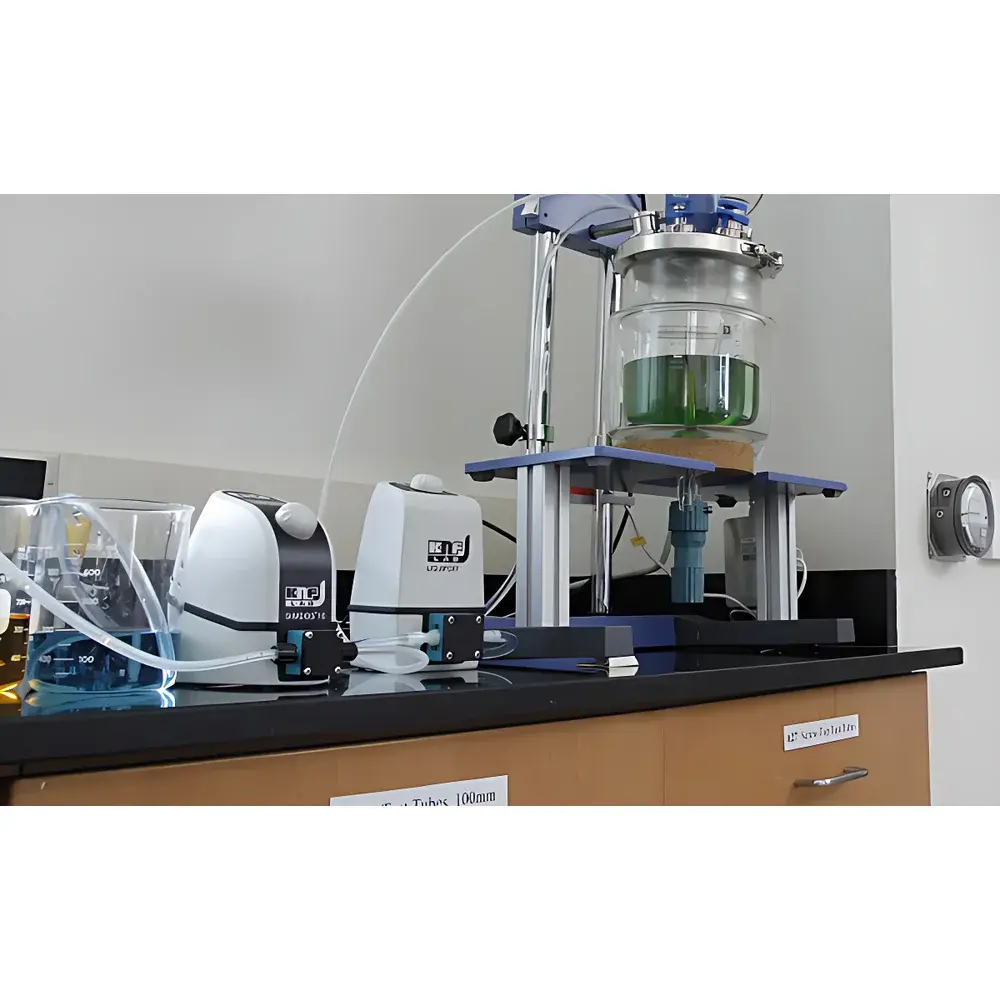
- Controlled reagent addition in parallel synthesis reactors and flow chemistry modules.
- Precise solvent delivery for HPLC mobile phase preparation and column equilibration.
- Dosing of catalysts, initiators, or crosslinkers in polymerization studies and adhesive formulation.
- Calibration fluid transfer in sensor validation and metrology labs.
- Low-flow nutrient or inhibitor delivery in bioreactor feeding strategies and microfluidic assay development.
- Automated cleaning-in-place (CIP) sequences requiring repeatable, low-volume chemical injection.
FAQ
Can the FEM1.02 handle abrasive or particulate-laden fluids?
No. The pump is designed for clean, low-viscosity liquids. Suspended solids exceeding 50 µm may compromise valve sealing and diaphragm longevity.
Is the pump suitable for vacuum-assisted filtration or degassing?
It is not optimized as a vacuum source; its maximum vacuum capability (3 mbar abs) is limited to priming assistance—not sustained vacuum generation.
What is the expected service life under continuous operation?
With proper fluid compatibility and maintenance intervals aligned to KNF’s recommended 5,000-hour diaphragm replacement schedule, mean time between failures exceeds 12,000 hours.
Does KNF provide NIST-traceable calibration certificates?
Yes—optional factory calibration reports (ISO/IEC 17025 accredited) are available upon request, including flow rate verification at three points across the operational range.
Can multiple FEM1.02 units be synchronized for multi-channel dispensing?
Yes—using identical analog control signals and matched power supply grounding, synchronization accuracy remains within ±0.5% of setpoint across up to eight parallel units.



