
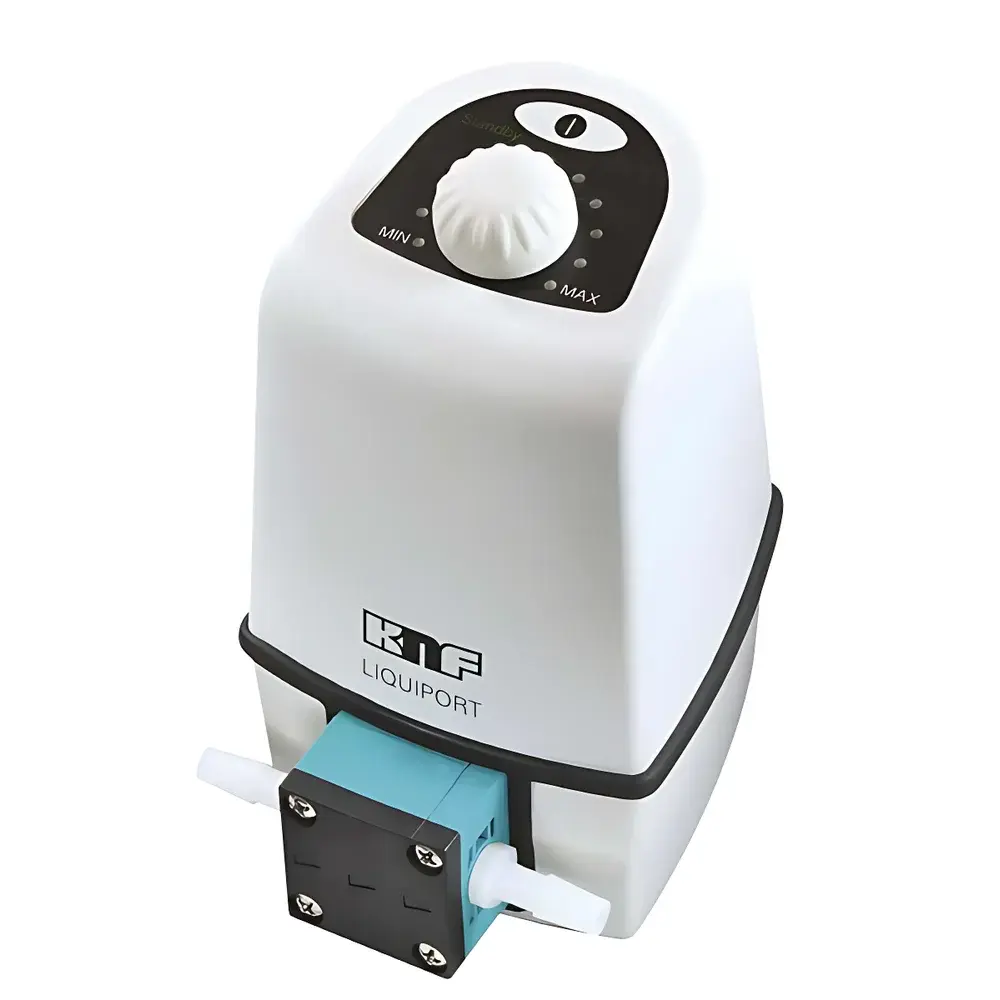
KNF LIQUIPORT NF1.300 Diaphragm Liquid Transfer Pump
| Brand | KNF |
|---|---|
| Origin | Germany |
| Model | NF1.300 |
| Flow Rate | 0.5–3.0 L/min |
| Self-Priming Height | 3 mWg |
| Max Discharge Head | 10 mWg |
| Inlet/Outlet Port | ID 12 mm |
| Pump Head Material | PP (KT), PVDF (TT), or PTFE (FT) |
| Diaphragm Coating | PTFE |
| Valve Material | FFKM |
| Operating Liquid Temp. | 5–80 °C |
| Ambient Temp. | 5–40 °C |
| IP Rating | IP65 |
| Power Supply | 100–230 VAC, 50–60 Hz |
| Weight | 1.5 kg |
| Accuracy | ±2% |
| Control Interface | 0–10 V analog input (RC variant) |
| Dry-Run Capable | Yes |
| Max Fluid Viscosity | 150 cSt |
Overview
The KNF LIQUIPORT NF1.300 is a precision-engineered diaphragm liquid transfer pump designed for continuous, pulse-free fluid handling in demanding laboratory and analytical environments. Unlike peristaltic or syringe-based systems, the NF1.300 employs a reciprocating elastomeric diaphragm actuated by an eccentric cam mechanism—eliminating tubing fatigue, pulsation artifacts, and volumetric drift inherent in rotary compression systems. Its sealed, oil-free architecture ensures contamination-free operation and long-term stability across aggressive chemical media, including strong acids, bases, oxidizers, and organic solvents. The pump is engineered for integration into automated workflows requiring repeatable flow delivery, closed-loop circulation, or precise reagent dosing—where reliability, material compatibility, and low total cost of ownership are critical operational parameters.
Key Features
- True pulse-free flow output with <±2% volumetric accuracy across the full 0.5–3.0 L/min range
- Robust dry-run capability—no priming required and no damage sustained during temporary air transport
- Modular wetted path construction: configurable pump head materials (PP, PVDF, or PTFE) matched to process chemistry; diaphragms coated with chemically inert PTFE; valves fabricated from FFKM fluoroelastomer for broad solvent resistance
- Self-priming up to 3 mWg and capable of generating discharge heads up to 10 mWg—enabling vertical lift and pressure-driven distribution without auxiliary boost stages
- Compact footprint (160 × 188 × 104 mm L/H/W) and lightweight design (1.5 kg) facilitate benchtop mounting, rack integration, or OEM system embedding
- Analog 0–10 V control interface (RC variant) supports seamless integration with PLCs, DAQ systems, or LabVIEW-controlled platforms; includes TTL logic inputs for remote start/stop and real-time fault code reporting via LED display
- IP65-rated enclosure ensures protection against dust ingress and low-pressure water jets—suitable for humid or washdown-prone lab environments
Sample Compatibility & Compliance
The NF1.300 meets the material compatibility requirements of ISO 10993-5 (cytotoxicity) and ASTM D471 (fluid resistance of elastomers) when configured with appropriate wetted-path options. Its PTFE-coated diaphragm and FFKM valve assembly provide validated resistance to >95% of common laboratory reagents—including concentrated HNO₃, H₂SO₄, NaOH (up to 50%), acetone, THF, and chlorinated solvents. The pump operates within GLP-compliant workflows when paired with audit-trail-capable controllers and is routinely deployed in USP verified analytical instrument fluid paths (e.g., HPLC mobile phase delivery, ICP-MS sample introduction, and automated titrator rinsing cycles). No lubricants contact the fluid path, eliminating risk of extractables and ensuring compliance with ISO/IEC 17025 method validation criteria for trace-level analysis.
Software & Data Management
While the NF1.300 is a standalone electromechanical device without embedded firmware or network connectivity, its analog 0–10 V control interface enables deterministic flow regulation under external supervision. When integrated with certified data acquisition hardware (e.g., National Instruments USB-6009 or Keysight 34972A), the pump supports time-stamped flow logging, closed-loop PID adjustment, and event-triggered error capture (e.g., stall detection, overtemperature alerts). All RC variants include built-in status LEDs and serial error codes aligned with KNF’s global service documentation—facilitating rapid root-cause diagnosis during 21 CFR Part 11–compliant audit reviews. Optional footswitch (Order No. 155872) and mounting kits (160473, 160474) further support ergonomic, GMP-aligned workstation configurations.
Applications
- Automated sample preparation: metered transfer of standards, diluents, or digestates into ICP-OES, AAS, or IC systems
- Continuous-flow reactor feed and recirculation—particularly where pulsation-induced mixing inefficiencies compromise reaction kinetics
- On-line cleaning-in-place (CIP) for microfluidic cartridges, sensor housings, or electrochemical cells
- Reagent delivery in photometric and enzymatic assays requiring stable baseline conditions
- Mobile phase supply for preparative HPLC and SFC systems operating below 15 bar backpressure
- Calibration fluid circulation in conductivity, pH, and DO sensor verification rigs
FAQ
Can the NF1.300 handle viscous fluids such as glycerol or silicone oil?
Yes—up to 150 cSt at 20 °C. Performance curves must be consulted for flow reduction factors above 50 cSt; temperature stabilization is recommended for high-viscosity operation.
Is the pump suitable for sterile or biopharmaceutical applications?
Not as supplied. While wetted-path materials meet USP Class VI requirements, the standard unit lacks cleanroom-compatible surface finish, autoclavability, or single-use certification. Custom validation packages and electropolished PVDF/PTFE variants are available upon request.
What maintenance intervals are recommended for continuous 24/7 operation?
Diaphragm lifetime exceeds 10,000 hours under nominal load (≤2 L/min, 20 °C water). KNF recommends quarterly visual inspection of inlet/outlet fittings and annual replacement of the diaphragm assembly if operating with aggressive solvents or elevated temperatures.
Does the RC variant support 4–20 mA control signals?
No—only 0–10 V analog input is natively supported. External signal converters (e.g., Phoenix Contact MINI MCR-SL-U-I-UI) may be used to interface with 4–20 mA field buses.
Can multiple NF1.300 pumps be synchronized for parallel flow control?
Yes—via master-slave analog voltage cascading or discrete TTL triggering. Synchronization accuracy depends on controller jitter (<5 ms typical) and is sufficient for multi-stream blending applications meeting ISO 5725 repeatability criteria.



