
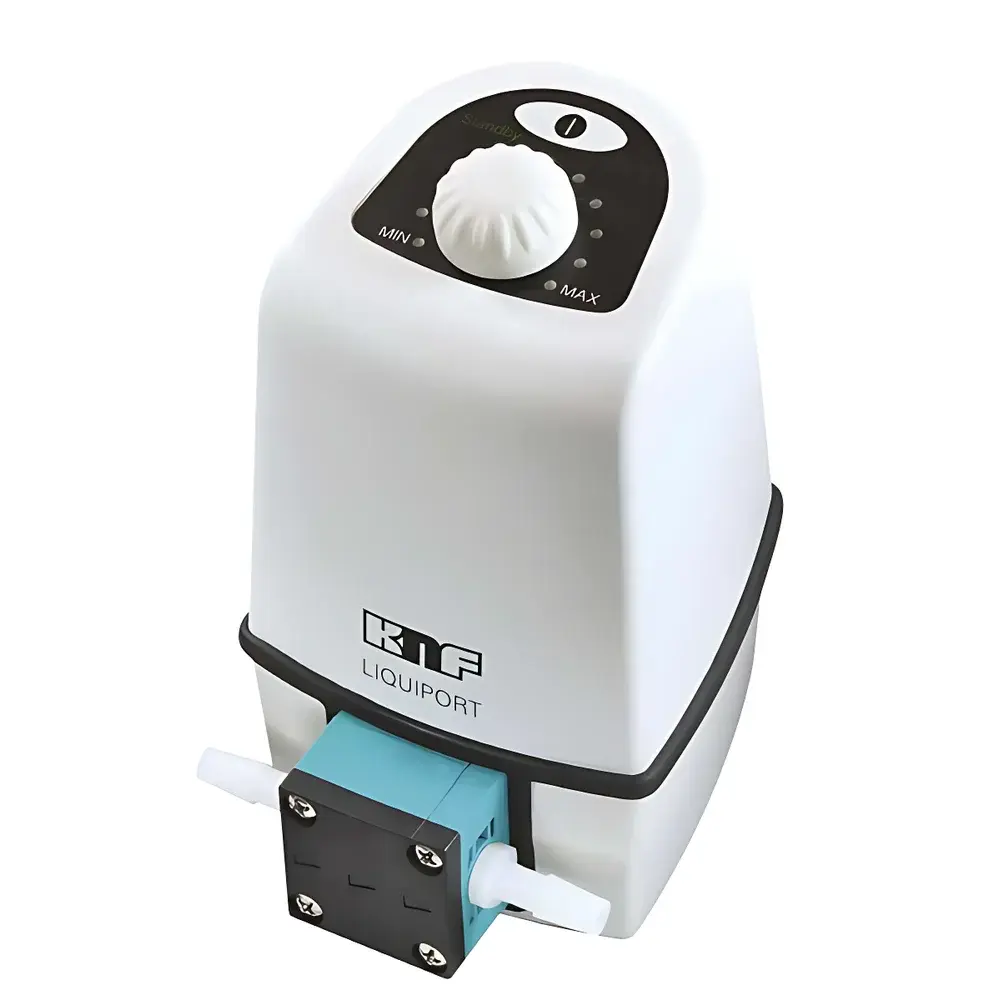
KNF LIQUIPORT NF100 Diaphragm Liquid Transfer Pump
| Brand | KNF |
|---|---|
| Origin | Germany |
| Model | NF100 |
| Flow Rate | 0.2–1.3 L/min |
| Self-Priming Height | 3 mWg |
| Max Discharge Head | 10 mWg |
| Inlet/Outlet Port | ID 8 mm |
| Pump Head Material | PP (KT), PVDF (TT), or PTFE (FT) |
| Diaphragm | PTFE-coated |
| Valves | FFKM |
| Ambient Temp. | 5–40 °C |
| Fluid Temp. | 5–80 °C |
| IP Rating | IP65 |
| Dimensions (L×H×W) | 130 × 90 × 177 mm |
| Weight | 1.5 kg |
| Power Supply | 100–230 VAC, 50–60 Hz |
| Accuracy | ±2% |
| Control Interface | 0–10 V analog (RC variants) |
| Max Fluid Viscosity | 150 cSt |
Overview
The KNF LIQUIPORT NF100 is a compact, chemically resistant diaphragm liquid transfer pump engineered for precision fluid handling in analytical, laboratory, and process-critical environments. Unlike peristaltic or syringe-based systems, the NF100 employs a reciprocating PTFE-coated diaphragm actuated by an eccentric cam mechanism—eliminating pulsation, tubing wear, and contamination risks associated with elastomeric compression. Its positive displacement architecture delivers consistent volumetric flow across variable backpressures up to 10 mWg (≈0.1 bar), while maintaining dry-run capability and stable performance with aggressive solvents, acids, bases, and oxidizing agents. Designed and manufactured in Freiburg, Germany, the NF100 meets stringent European quality and safety standards, including CE marking and RoHS compliance. It serves as a robust, low-maintenance alternative to peristaltic pumps in applications demanding long-term reliability, chemical inertness, and repeatable dosing without consumable tubing replacement.
Key Features
- Chemical compatibility across broad pH range (–2 to +14) and organic solvent exposure, enabled by configurable wetted materials: PP (KT), PVDF (TT), or fully fluorinated PTFE (FT) pump heads; PTFE-coated diaphragms; and FFKM (perfluoroelastomer) valves.
- Continuous, pulse-free flow delivery—critical for UV-Vis spectrophotometry, HPLC mobile phase delivery, and electrochemical cell feeding where pressure fluctuations compromise signal stability.
- Self-priming capability up to 3 mWg (≈0.3 m H2O), enabling reliable startup from elevated reservoirs or siphon-interrupted configurations without manual venting.
- Integrated analog control (0–10 V DC) on RC variants supports closed-loop integration with PLCs, DAQ systems, or LabVIEW-based automation platforms—enabling real-time flow modulation and synchronized start/stop via TTL logic signals.
- IP65-rated housing ensures protection against dust ingress and low-pressure water jets, supporting deployment in shared lab spaces, fume hoods, or semi-industrial wash-down environments.
- ±2% full-scale flow accuracy under steady-state conditions, validated per ISO 5167-derived calibration protocols using gravimetric measurement traceable to national metrology institutes.
Sample Compatibility & Compliance
The NF100 accommodates liquids with viscosities up to 150 cSt and temperatures between 5 °C and 80 °C. Its wetted-path design excludes elastomers, metals, or adhesives that could leach or degrade—making it suitable for USP Class VI–compliant fluid paths when configured with FT (PTFE-only) construction. The pump complies with IEC 61000-6-2 (EMC immunity) and IEC 61000-6-4 (EMC emissions), and its electrical safety conforms to EN 61010-1 for laboratory equipment. While not inherently 21 CFR Part 11 compliant, audit trails and electronic record integrity can be achieved when integrated with validated third-party SCADA or LIMS software that implements user authentication, change control, and electronic signatures.
Software & Data Management
The NF100 operates as a standalone hardware module but integrates seamlessly into automated workflows via its 0–10 V analog interface. RC-series models provide proportional flow control (0–100% of max rated flow), digital status outputs (e.g., fault codes, run state), and TTL-compatible start/stop triggers. No proprietary driver or firmware update is required—control logic resides entirely at the host system level. For GLP/GMP-aligned deployments, users commonly pair the NF100 with validated data acquisition systems (e.g., National Instruments CompactDAQ or Siemens Desigo CC) that log timestamped flow setpoints, actual current draw (as a proxy for load), and error events with immutable audit trails.
Applications
- Automated reagent dispensing in ICP-MS, AAS, and colorimetric analyzers requiring stable, low-pulsation delivery.
- Circulation loops for temperature-controlled reaction monitoring (e.g., in-situ FTIR or Raman cells).
- Waste fluid evacuation and rinse cycles in autosamplers, microplate washers, and cleaning-in-place (CIP) modules.
- Low-flow calibration standard delivery in gravimetric or volumetric verification setups per ISO/IEC 17025 requirements.
- Mobile phase supply in preparative and analytical HPLC systems where solvent compatibility and baseline noise minimization are essential.
FAQ
Can the NF100 handle abrasive suspensions or particulates?
No. The NF100 is designed exclusively for clean, non-abrasive, non-particulate liquids. Solid content >10 ppm or particles >50 µm may damage the PTFE diaphragm or seat against FFKM valves.
Is explosion-proof certification available for NF100 variants?
Standard NF100 units are not ATEX or IECEx certified. For hazardous area use, consult KNF’s custom engineering group regarding intrinsically safe (IS) barrier integration or pneumatic drive alternatives.
What maintenance intervals are recommended under continuous operation?
With chemically compatible fluids and ambient temperatures ≤35 °C, diaphragm service life exceeds 10,000 hours. KNF recommends annual visual inspection of diaphragm integrity and valve seating—no scheduled lubrication or recalibration is required.
Does the ±2% accuracy specification include linearity, hysteresis, and repeatability components?
Yes. This figure represents total error band (TEB) under ISO 5725-defined conditions: 23 °C ±2 °C, 45–55% RH, and stabilized power supply. It encompasses linearity deviation, hysteresis, and 3σ repeatability over five consecutive cycles at 25%, 50%, 75%, and 100% of maximum flow.
Can multiple NF100 pumps be synchronized for parallel flow control?
Yes—via master-slave analog cascading. One pump’s 0–10 V output can serve as the setpoint input for others, ensuring matched flow profiles across multi-channel systems without external controllers.



