
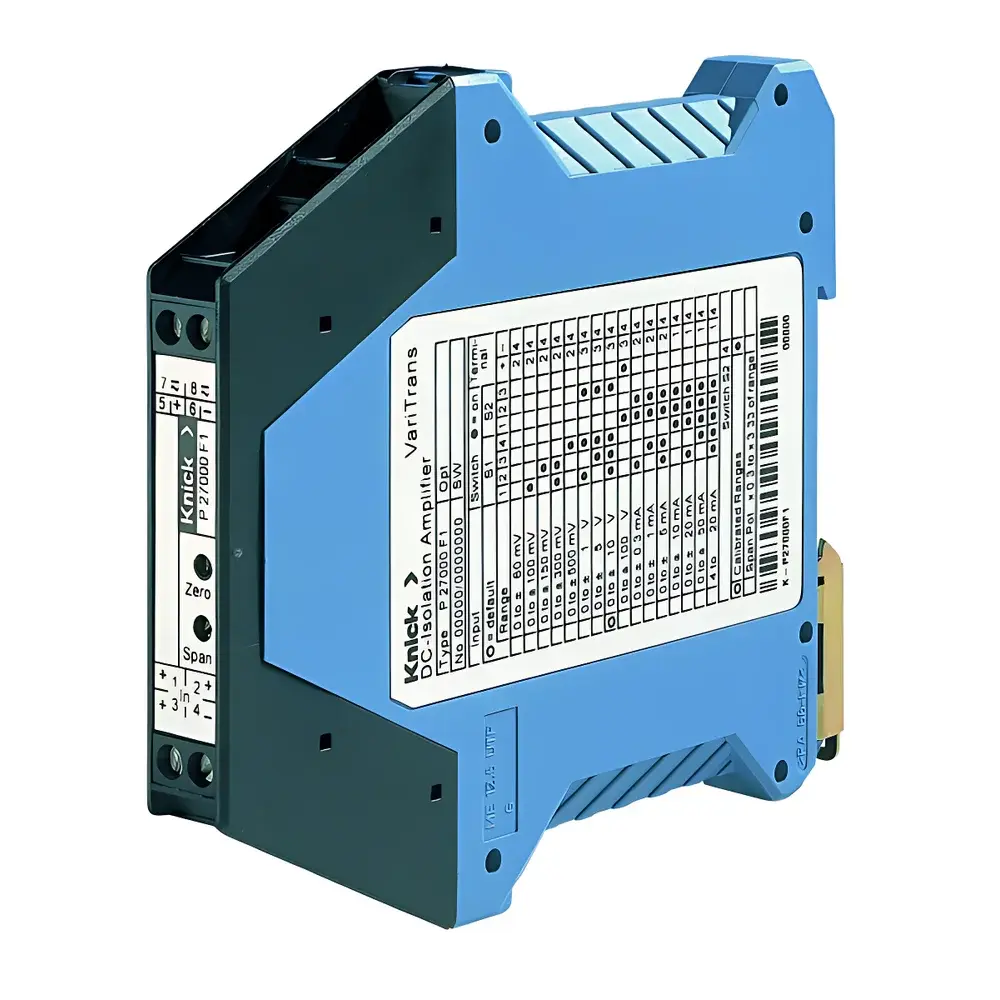
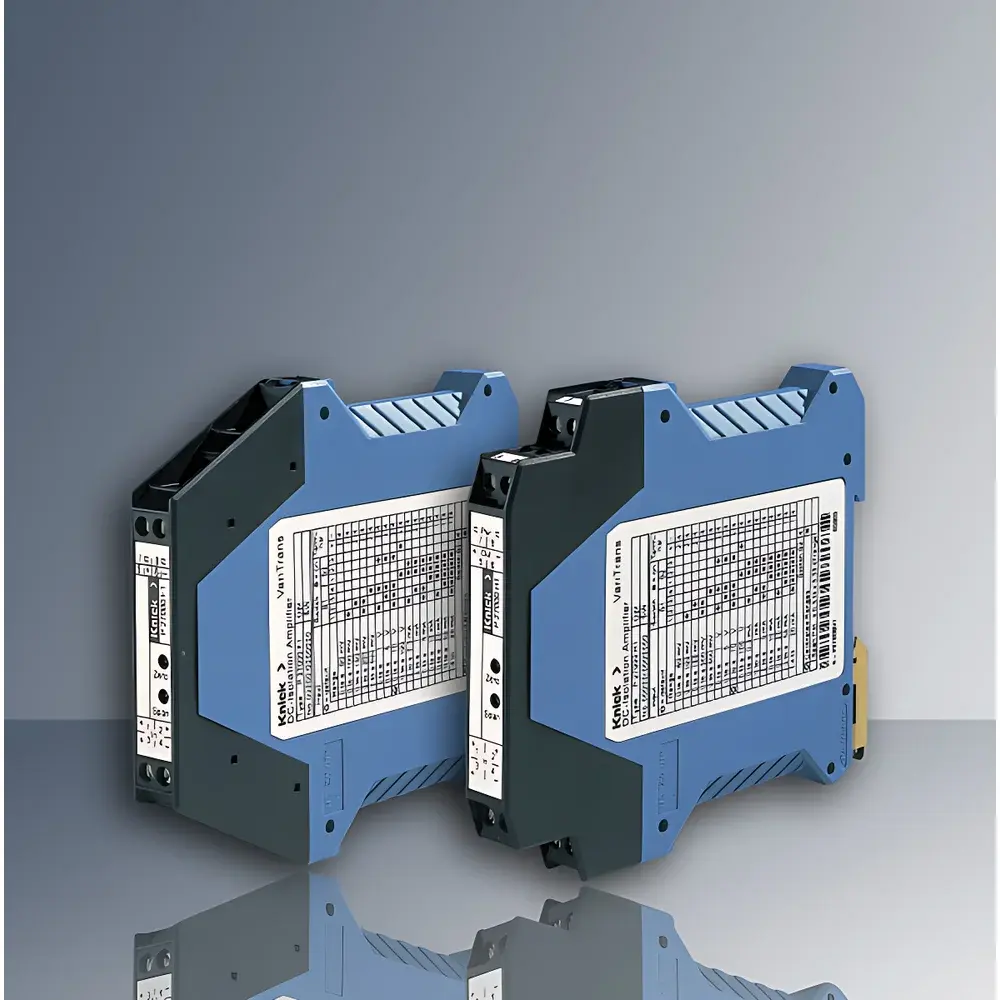
Knick VariTrans P27000 Universal Isolation Amplifier
| Brand | Knick |
|---|---|
| Origin | Germany |
| Manufacturer Type | Manufacturer |
| Origin Category | Imported |
| Model | Knick VariTrans P27000 |
| Voltage Range | Configurable from 20 mV to 200 V |
| Switchable calibration increments | 60 mV, 100 mV, 150 mV, 300 mV, 500 mV, 1 V, 5 V, 10 V, 100 V (unipolar/bipolar) |
| Measurement Accuracy | Gain error < 0.08 % of reading (DC) |
| Current Output Options | ±10 V / 20 mA, 5 V, 10 V (unipolar/bipolar), and 4–20 mA, 1–5 V, 2–10 V selectable via calibration switch |
| Isolation | Reinforced galvanic isolation per EN 61140 |
| Bandwidth | >10 kHz (–3 dB) |
| Housing | 12.5 mm modular DIN-rail mountable design |
| Power Supply | 20–253 V AC/DC (VariPower™ wide-range) |
Overview
The Knick VariTrans P27000 Universal Isolation Amplifier is a high-precision, DIN-rail mounted signal conditioning device engineered for critical measurement integrity in lithium-ion battery manufacturing, battery management system (BMS) validation, and high-voltage energy storage test environments. It implements reinforced galvanic isolation—compliant with EN 61140—to safely decouple sensitive control and monitoring circuits from hazardous potentials encountered during cell voltage monitoring, module-level current sensing, and pack-level thermal-voltage correlation studies. Unlike conventional fixed-range isolators, the P27000 operates on a universal input principle: it accepts any analog DC signal between ±20 mV and ±200 V or ±0.1 mA and ±100 mA without hardware modification. Its core architecture leverages precision op-amp circuitry with low-drift components and thermally stabilized gain stages, ensuring stable transfer characteristics across ambient temperatures ranging from –25 °C to +65 °C—conditions typical in battery cycling chambers and production line test cells.
Key Features
- 480 programmable calibration ranges accessible via front-panel DIP switches—eliminating recalibration downtime during BMS channel reconfiguration or multi-cell stack testing;
- VariPower™ wide-range power supply (20–253 V AC/DC) enables direct integration into both low-voltage lab benches and industrial 230 V AC mains-powered test racks;
- 12.5 mm ultra-compact modular housing supports up to 80 active units per meter of DIN rail—optimized for space-constrained battery EOL (end-of-line) testers and modular rack-mounted BMS validation systems;
- Reinforced isolation barrier rated for transient overvoltages up to 6 kVpeak (per EN 61140), essential for safe differential voltage measurement across series-connected Li-ion cells under fault conditions;
- Bandwidth exceeding 10 kHz (–3 dB) ensures faithful reproduction of fast transients during pulse discharge characterization and SOC/SOH algorithm verification;
- Gain error limited to < 0.08 % of reading (DC), verified per EN 10204 Type 2.3 material test certificate—supporting GLP-compliant calibration traceability in regulated battery development labs.
Sample Compatibility & Compliance
The P27000 interfaces directly with standard BMS analog front-end outputs—including shunt-based current sensors (e.g., ±50 mV, ±100 mV), isolated voltage dividers (e.g., ±10 V scaled from 0–500 V packs), and thermistor-conditioned signals (e.g., 1–5 V linearized temperature). Its input impedance exceeds 1 MΩ for voltage modes and < 10 Ω for current modes—minimizing loading effects on high-impedance sensor sources common in battery cell monitoring ICs. The device conforms to IEC 61000-6-2 (immunity) and IEC 61000-6-4 (emission) for industrial environments, and its reinforced insulation meets the requirements of UL 61010-1 and CSA C22.2 No. 61010-1 for use in functional safety subsystems (up to SIL 2 when integrated into certified architectures). All units ship with EN 10204 2.3 inspection documentation, enabling audit-ready traceability for ISO 9001 and IATF 16949 quality management systems.
Software & Data Management
While the P27000 is a hardware-configured analog isolator (no embedded firmware or USB interface), its deterministic signal path integrates seamlessly into automated test systems via standardized analog I/O modules (e.g., National Instruments PXIe-4309, Keysight 34972A). Configuration settings are mechanically encoded via DIP switches—ensuring immunity to electromagnetic interference and eliminating configuration drift over time. For laboratories requiring full 21 CFR Part 11 compliance, the device supports audit-trail-capable data acquisition when paired with validated SCADA or LabVIEW-based test executive software that logs calibration switch positions, timestamped measurements, and operator IDs. Its consistent gain stability and low THD (< 0.01 %) reduce post-processing uncertainty in statistical process control (SPC) applications used for battery grading and binning.
Applications
- Real-time cell voltage isolation and scaling in multi-channel battery cyclers (e.g., Arbin, Digatron, Neware);
- Safe current signal transmission from high-side shunts in 400 V / 800 V EV battery packs during HIL (hardware-in-the-loop) BMS testing;
- Galvanically isolated feedback loops for active cell balancing controller validation;
- Conditioning of thermocouple or RTD signals in thermal runaway propagation studies;
- Signal normalization across heterogeneous sensor vendors in battery digital twin calibration workflows;
- Legacy system modernization—replacing obsolete isolation modules in aging battery formation equipment while maintaining existing wiring and PLC I/O mapping.
FAQ
Does the P27000 support digital communication protocols such as Modbus or CAN?
No—it is an analog-only isolation amplifier with no onboard microcontroller or serial interface. Signal digitization must occur downstream in the DAQ or PLC layer.
Can it be used for AC signal isolation (e.g., ripple voltage measurement)?
The device is specified for DC and slowly varying signals only. Its >10 kHz bandwidth permits measurement of low-frequency AC components (e.g., 1 kHz switching noise), but it is not designed for true RMS AC coupling or high-frequency spectral analysis.
Is third-party calibration certification available?
Yes—Knick-certified calibration reports (EN 10204 3.1) and accredited lab certificates (e.g., DAkkS) can be ordered at time of purchase or scheduled annually for metrological continuity in GMP-aligned battery development facilities.
What is the maximum working voltage between input and output circuits?
The reinforced isolation barrier is rated for continuous working voltages up to 1000 VAC rms (or 1414 VDC) per EN 61140, with impulse withstand capability of 6 kVpeak.
How does it handle common-mode voltage transients during cell short-circuit events?
Its high CMRR (>120 dB at 50 Hz) and fast-acting internal clamping suppress transients up to ±4 kV (1.2/50 µs wave) without latch-up or parameter shift—critical for maintaining signal fidelity during fault injection testing.






