
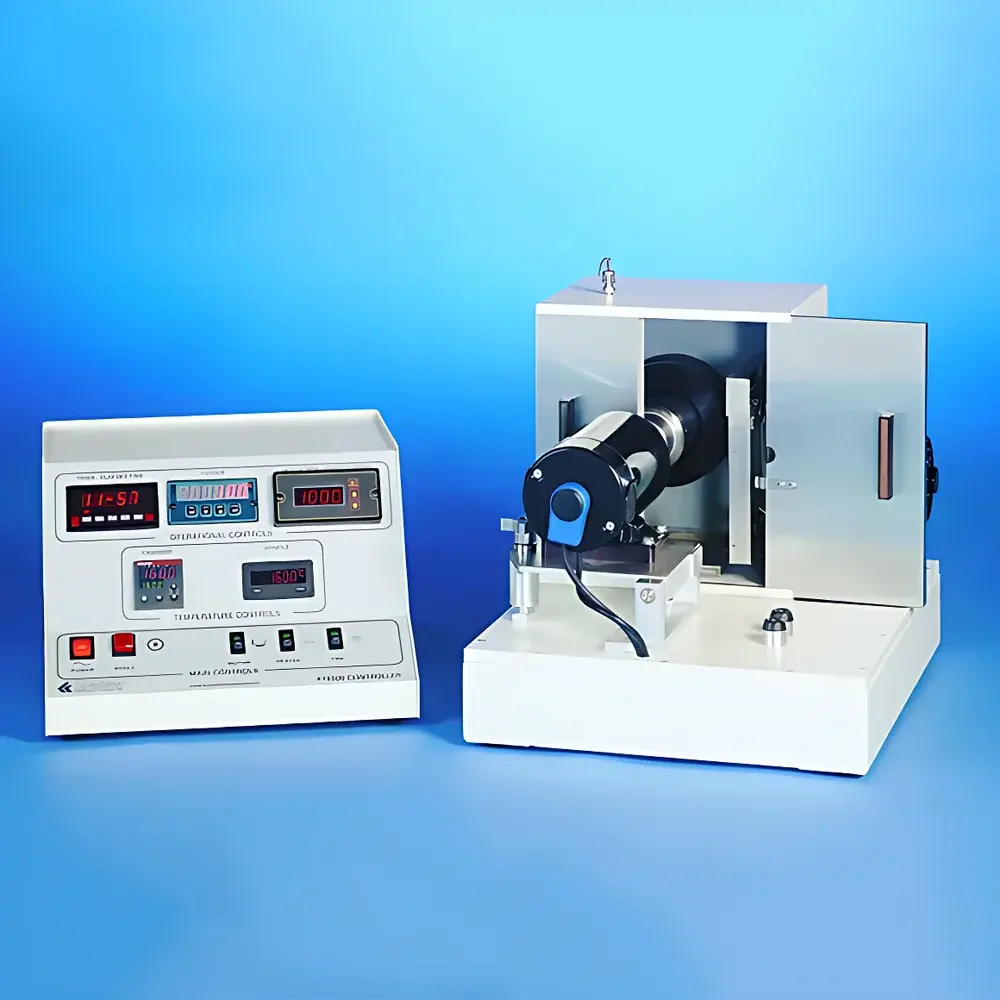
Koehler K18595 High-Temperature Automotive Wheel Bearing Grease Life Tester
| Brand | Koehler |
|---|---|
| Origin | USA |
| Manufacturer Status | Authorized Distributor |
| Origin Category | Imported |
| Model | K18595 |
| Pricing | Upon Request |
| Product Type | Laboratory Instrument |
| Test Parameter | Grease Life & Accelerated Leakage |
| Compliance | ASTM D3527, ASTM D4290, ASTM D4950 |
| Speed Range | 0–1725 rpm |
| Temperature Range | Ambient to 177 °C |
| Lifetime Limit Setting | 0.1–9999.9 hr |
| Timer | Programmable Start/Stop + Real-Time Elapsed Time Display |
| Heating Power | 1200 W |
| Circulation Fan | 1/20 hp |
| Test Chamber Dimensions (W×D×H) | 41 × 51 × 40 cm |
| Control Unit Dimensions | 41 × 36 × 41 cm |
| Net Weight | 65.8 kg |
| Power Supply | 220–240 V, 50 Hz, Single-Phase, 7 A |
| Thermal Uniformity | Insulated Constant-Temperature Furnace with Forced-Air Circulation |
| Torque Monitoring | Digital Motor Torque Sensor with 30-Second Delay Circuit to Suppress Transient Startup Peaks |
Overview
The Koehler K18595 High-Temperature Automotive Wheel Bearing Grease Life Tester is a purpose-built laboratory instrument engineered for the accelerated evaluation of grease performance under severe thermal and mechanical stress conditions typical of modern automotive wheel hub bearing systems. It operates on the principle of controlled accelerated aging—subjecting a standardized wheel hub–spindle–bearing assembly, packed with test grease, to sustained high-temperature rotation under axial load. The system continuously monitors motor torque, rotational speed (rpm), bearing temperature, chamber temperature, and elapsed operational time. Failure is objectively defined as the point at which torque exceeds a user-defined threshold due to grease degradation—manifested as loss of structural integrity, oxidation-induced hardening, or excessive oil separation—leading to increased friction and mechanical resistance. This failure endpoint directly correlates with functional service life under field-representative conditions. Designed specifically to replicate the thermomechanical environment of front-wheel hub assemblies, the K18595 delivers reproducible, comparative lifetime data essential for formulation development, quality control, and specification compliance in OEM and lubricant manufacturing environments.
Key Features
- Fully automated test execution with real-time digital monitoring of motor torque, rotational speed (0–1725 rpm), test chamber temperature (ambient to 177 °C), spindle temperature, and cumulative runtime.
- Dual-mode operation: supports both standardized lifetime testing per ASTM D3527 and accelerated leakage assessment per ASTM D4290 and D4950 within a single platform.
- Programmable test parameters—including target speed, axial load (fixed at 111 N per ASTM), temperature setpoint (160 °C standard), cycle duration (e.g., 20 h run / 4 h rest), and torque trip threshold—enabling adaptation to internal or regional specifications.
- Thermally insulated constant-temperature furnace with 1200 W heating capacity and a 1/20 hp forced-air circulation fan ensures uniform thermal distribution across the test assembly, minimizing radial and axial temperature gradients.
- Dedicated control unit with independent housing facilitates ergonomic operation and unobstructed visual monitoring; features intuitive interface for parameter entry, status feedback, and immediate fault diagnostics.
- Integrated 30-second delay circuit prevents false termination triggered by transient torque spikes during motor startup, enhancing measurement robustness and test repeatability.
Sample Compatibility & Compliance
The K18595 accommodates standard automotive front-wheel hub assemblies modified per ASTM requirements, including spindle, tapered roller bearing, and hub cap configurations. Grease samples are loaded directly into the bearing cavity using standardized packing procedures. The instrument is rigorously validated for conformance to three core industry standards: ASTM D3527 (Standard Test Method for Determining the Life of Lubricating Greases in Wheel Bearings Under High-Temperature Conditions), ASTM D4290 (Standard Test Method for Determining the Accelerated Leakage Characteristics of Lubricating Greases), and ASTM D4950 (Standard Classification and Specification for Automotive Service Greases). Its design supports GLP-aligned documentation workflows, with timestamped digital logs suitable for audit trails required under ISO/IEC 17025-accredited laboratories.
Software & Data Management
While the K18595 operates via embedded microcontroller-based firmware without external PC dependency, all measured variables—including torque (N·m), rpm, temperatures (°C), and elapsed time (hr)—are continuously digitized and displayed on the front-panel LCD. Data output is available via analog voltage signals (0–10 V) for integration into third-party data acquisition systems or LIMS platforms. Optional RS-232 or USB-to-serial adapters enable ASCII-formatted time-stamped data streaming for post-test analysis in Excel, MATLAB, or statistical process control (SPC) software. All parameter settings and runtime events are stored in non-volatile memory, supporting traceability and regulatory review per FDA 21 CFR Part 11 when paired with appropriate electronic record controls.
Applications
- Comparative lifetime ranking of wheel bearing greases during R&D and supplier qualification.
- Verification of batch-to-batch consistency in high-temperature stability and shear resistance.
- Supporting OEM specification validation for extended-service-interval (ESI) greases.
- Failure mode analysis—correlating torque rise profiles with grease chemistry (e.g., thickener type, base oil volatility, antioxidant depletion).
- Accelerated leakage quantification for evaluating seal compatibility and oil bleed behavior under thermal cycling.
- Training and method transfer in lubricant technical service laboratories.
FAQ
What is the primary failure criterion in ASTM D3527 testing?
Failure is defined as the point at which motor torque exceeds a pre-set threshold due to progressive grease degradation, resulting in measurable increases in bearing friction.
Can the K18595 be used for non-automotive greases?
While optimized for wheel bearing applications, the instrument may be adapted for other high-load, high-temperature grease evaluations provided sample geometry and loading conditions are appropriately re-engineered and method equivalence is technically justified.
Is temperature calibration traceable to NIST standards?
Yes—integrated PT100 sensors are factory-calibrated against NIST-traceable references; users may perform periodic verification using certified dry-block calibrators.
Does the system support unattended overnight operation?
Yes—the programmable timer, automatic shutdown on torque exceedance, and thermal safety cutoffs (180 °C hardware limit) enable secure multi-cycle, long-duration testing without operator presence.
What maintenance is required for routine operation?
Monthly inspection of heater elements and fan operation, biannual verification of torque sensor zero drift, and annual recalibration of temperature sensors are recommended per Koehler’s Maintenance Schedule K18595-MS-2023.





