
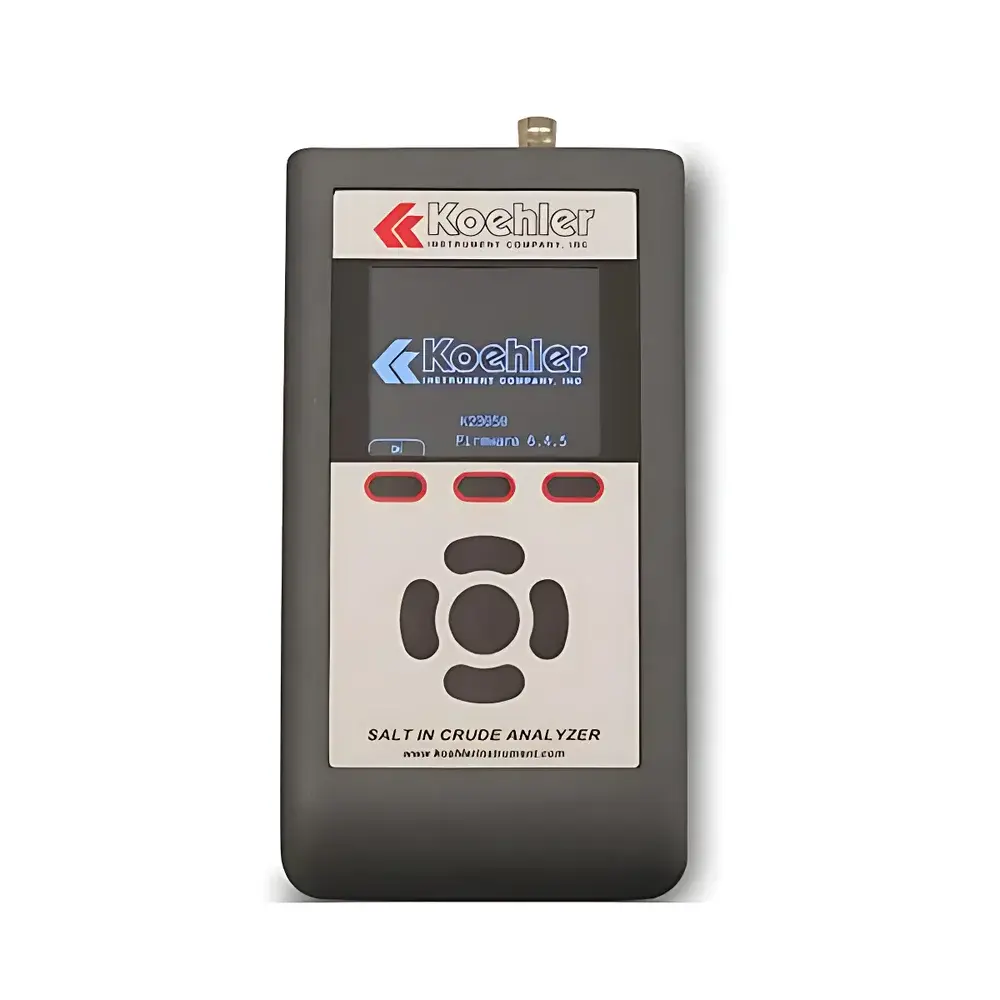
Koehler K23060 Crude Oil Salt Content Analyzer
| Brand | Koehler |
|---|---|
| Origin | USA |
| Model | K23060 |
| Standards Compliance | ASTM D3230, IP 265 |
| Measurement Range | 0–150 PTB (pounds per thousand barrels) |
| Temperature Range | −5 °C to 55 °C |
| Display | 2.6-inch TFT-LCD |
| Power Supply | Internal rechargeable Li-ion battery |
| AC adapter input | 230 V, 50/60 Hz, single-phase |
| Dimensions (W×D×H) | 9 × 4.25 × 2.5 in (23 × 10.8 × 6.5 cm) |
| Net Weight | 2 lb (1 kg) |
| Sample Volume | 100 mL |
Overview
The Koehler K23060 Crude Oil Salt Content Analyzer is a field-deployable, portable electrochemical instrument engineered for rapid, on-site quantification of inorganic salt content—primarily sodium chloride—in crude oil streams. It operates on the fundamental principle that dissolved ionic species (e.g., Na⁺, Cl⁻) impart measurable electrical conductivity to otherwise non-conductive hydrocarbon matrices. By applying low-voltage alternating current across a calibrated electrode cell immersed in a representative crude oil sample, the analyzer measures bulk solution conductivity and simultaneously records temperature via an integrated high-precision thermistor. Using empirically validated algorithms derived from ASTM D3230 and IP 265, the device automatically compensates conductivity readings to a reference temperature of 25 °C and calculates salt concentration directly in PTB (pounds per thousand barrels), eliminating manual interpolation or external lookup tables. This real-time, single-step measurement supports upstream production monitoring, custody transfer verification, and refinery feedstock qualification without reliance on laboratory-based titration or distillation methods.
Key Features
- Compliance-certified operation per ASTM D3230 and IP 265—fully traceable to international petroleum testing protocols
- Integrated dual-sensor architecture: platinum alloy conductivity cell + NTC thermistor for simultaneous, synchronized measurement of conductivity and temperature
- Self-calibrating algorithm that corrects for thermal drift without requiring user-input temperature compensation curves
- 2.6-inch high-contrast TFT-LCD display supporting customizable quad-parameter view—including salt content (PTB), raw conductivity (µS/cm), temperature-compensated conductivity at 25 °C, pH, mV potential, ambient temperature (°C/°F), battery status, date/time, and system diagnostics
- Rechargeable lithium-ion battery enabling >8 hours of continuous field use; AC adapter included for benchtop operation or battery recharging
- Ruggedized, compact housing (23 × 10.8 × 6.5 cm) with IP54-rated ingress protection against dust and incidental water exposure
- Pre-configured calibration verification kit (K23060-6) and certified reference standards support routine performance verification and audit readiness
Sample Compatibility & Compliance
The K23060 is validated for use with stabilized, desalted, and emulsified crude oils meeting API gravity ranges of 10–45°API and water cut levels up to 30% v/v. It accommodates heterogeneous samples containing suspended solids ≤50 µm and is insensitive to common hydrocarbon fractions (paraffins, naphthenes, aromatics). All measurements are performed under ambient pressure and require no solvent dilution or phase separation prior to analysis. The instrument’s firmware embeds regulatory logic aligned with ASTM D3230 Section 8 (Precision and Bias), ensuring repeatability within ±2.5% RSD for triplicate determinations across the 0–150 PTB range. Data output meets GLP/GMP documentation requirements, with timestamped records stored internally and exportable via micro-USB for integration into LIMS or ERP systems. Full compliance documentation—including Certificate of Conformance, factory calibration report, and standard operating procedure templates—is provided with each unit.
Software & Data Management
The K23060 operates autonomously without external software dependency; however, its embedded firmware supports full data traceability through internal memory storage of ≥500 test records. Each entry includes operator ID (user-defined), sample ID, measurement timestamp (YYYY-MM-DD HH:MM:SS), raw conductivity, temperature, calculated PTB value, and pass/fail flag relative to user-set acceptance limits. Micro-USB connectivity enables secure, encrypted data export in CSV format compatible with Microsoft Excel, LabArchives, and Thermo Fisher SampleManager LIMS. Audit trail functionality satisfies FDA 21 CFR Part 11 requirements for electronic records and signatures when used in regulated environments, including validation-ready event logs for power cycles, calibration events, and parameter modifications.
Applications
- Real-time salt monitoring at wellhead, pipeline manifold, and tank farm locations to prevent downstream corrosion and desalter inefficiency
- Custody transfer verification between producers, shippers, and refiners per contractual salt content specifications
- Refinery feedstock screening to optimize desalting unit settings and minimize chemical demulsifier consumption
- Quality assurance during crude blending operations where salt heterogeneity may impact processing stability
- Field service and third-party inspection agencies conducting API MPMS Chapter 10.8-compliant audits
- Research laboratories evaluating novel desalting technologies or emulsion-breaking agents
FAQ
What sample preparation is required prior to analysis?
No filtration, centrifugation, or solvent addition is necessary. A representative 100 mL aliquot of homogenized crude oil is introduced directly into the supplied sample cup.
Does the instrument require periodic recalibration using certified standards?
Yes—ASTM D3230 mandates verification using traceable NaCl-in-kerosene standards at least daily or per batch, using the included K23060-6 calibration kit.
Can the K23060 measure salinity in produced water or refined products?
No—it is specifically designed and validated for crude oil matrices only. Use of the instrument outside its specified scope invalidates ASTM D3230 compliance.
How is temperature compensation applied during measurement?
The device applies a second-order polynomial correction based on the measured temperature and the intrinsic temperature coefficient of NaCl conductivity in hydrocarbon media, as defined in ASTM D3230 Annex A1.
Is the internal battery replaceable by the end user?
Battery replacement requires authorized Koehler service; field-accessible battery swapping is not supported to maintain IP54 integrity and calibration stability.




