
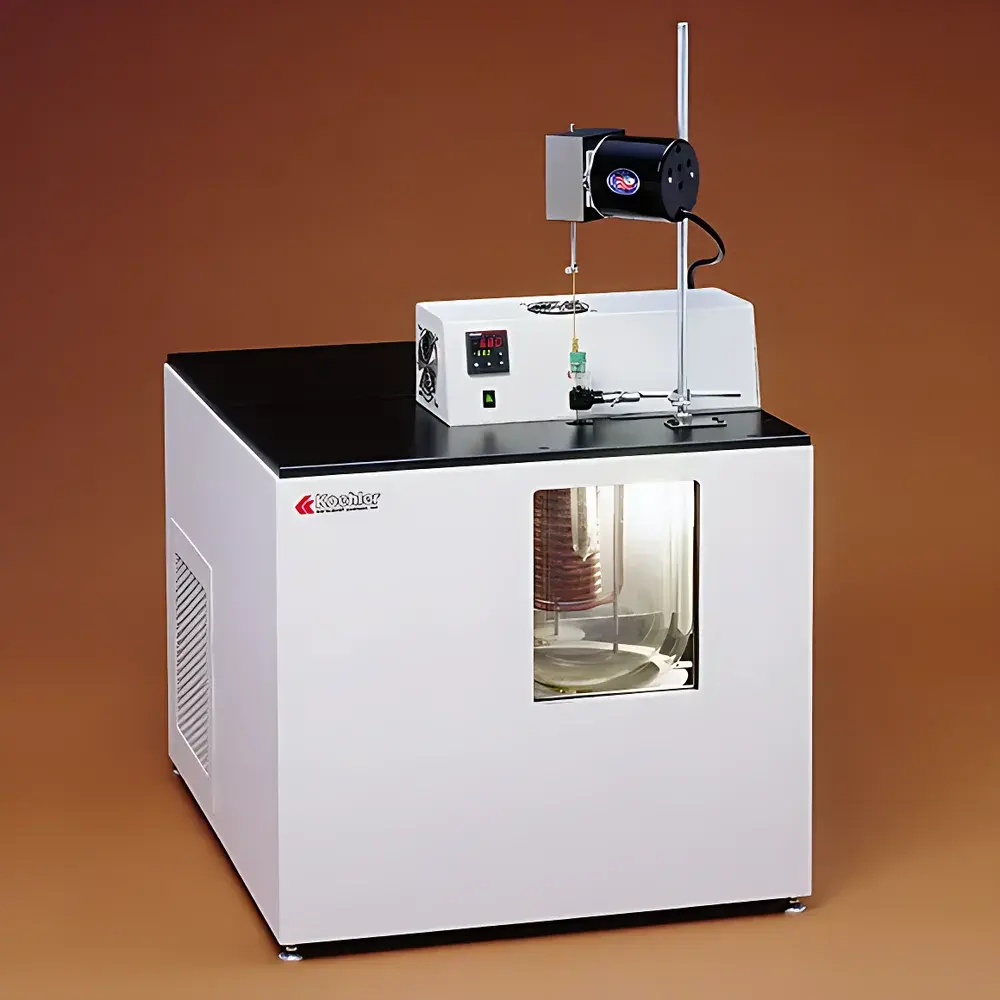
Koehler K29795 Aviation Fuel Freezing Point Tester
| Brand | Koehler |
|---|---|
| Origin | USA |
| Manufacturer Status | Authorized Distributor |
| Origin Category | Imported |
| Model | K29795 |
| Price Range | USD 14,000 – 70,000 |
| Temperature Range | Ambient to –73°C (–100°F) |
| Resolution | 0.1°C / 0.1°F |
| Accuracy & Uniformity | Exceeds ASTM D2386 requirements across full operational range |
| Power Supply | 220–240 V, 50 Hz, Single Phase, 10 A |
| Dimensions | 89 × 66 × 78.75 cm |
| Weight | 117.75 kg |
| Cooling Method | Air-cooled, CFC-free refrigeration |
| Display | Dual digital PID controller with selectable °C/°F scale |
| Safety Features | Enhanced enclosure design, transparent observation window with integrated LED illumination, adjustable leveling feet |
Overview
The Koehler K29795 Aviation Fuel Freezing Point Tester is a precision-engineered instrument designed specifically for the determination of the freezing point of aviation turbine fuels (e.g., Jet A, Jet A-1, JP-5, JP-8) in accordance with internationally recognized standard test methods—including ASTM D2386, IP 16, ISO 3013, DIN 51421, FTM 791-1411, and NF M 07-048. The freezing point is defined as the lowest temperature at which hydrocarbon crystals—formed during controlled cooling—disappear upon gradual reheating. This thermodynamic transition is critical for flight safety, as crystallization in fuel lines or filters can impair engine performance at high altitudes. The K29795 implements a standardized dual-phase thermal protocol: first, controlled cooling of a 25 mL sample in a double-walled test tube under continuous mechanical agitation until visible crystal formation; second, slow, uniform warming while maintaining agitation until complete crystal dissolution. Its robust architecture ensures reproducible thermal gradients and precise endpoint detection, essential for compliance-driven laboratories operating under FAA, EASA, or military fuel certification programs.
Key Features
- Compliance-certified design validated against ASTM D2386 and equivalent international standards for aviation fuel freezing point analysis
- Wide operational temperature range from ambient down to –73°C (–100°F), enabling testing of both conventional and synthetic aviation fuels with extended low-temperature specifications
- Microprocessor-based PID temperature controller with dual digital display—simultaneously showing setpoint and actual bath temperature—with user-selectable °C or °F units
- Integrated air-cooled, CFC-free refrigeration system eliminating reliance on hazardous or regulated coolants, supporting environmental compliance and long-term operational sustainability
- Optimized mechanical stirring mechanism ensuring consistent sample homogeneity and minimizing supercooling artifacts during crystallization detection
- Front-mounted transparent observation window with built-in LED lighting for real-time visual confirmation of crystal formation and disappearance without opening the chamber
- Stable mechanical platform with adjustable leveling feet to maintain vertical alignment of the double-walled test tube assembly—critical for accurate thermal conduction and phase transition timing
Sample Compatibility & Compliance
The K29795 is optimized for use with aviation turbine fuels meeting ASTM D1655, DEF STAN 91-91, and MIL-DTL-83133 specifications. It accommodates standard 25 mL samples in ASTM D2386-compliant double-walled glass test tubes (Koehler P/N K29795-TT). The instrument’s thermal control profile, agitation rate, and observation methodology are fully aligned with the procedural rigor required for regulatory acceptance by aviation authorities and refinery quality assurance departments. Data generated using this system supports traceability under ISO/IEC 17025-accredited testing environments and satisfies documentation requirements for GLP and GMP-aligned fuel release protocols.
Software & Data Management
While the K29795 operates as a standalone benchtop instrument with analog-digital hybrid controls, its temperature logging interface supports optional integration with Koehler’s K-Link™ data acquisition software (sold separately). When connected via RS-232 or USB-to-serial adapter, the system enables time-stamped recording of bath temperature, setpoint, and operator-annotated phase transition events. All recorded data comply with FDA 21 CFR Part 11 requirements when deployed with appropriate electronic signature and audit trail configurations—making it suitable for regulated QA/QC laboratories subject to FAA Advisory Circular 150/5370-10 or EASA Part-21G audits.
Applications
- Freezing point verification of batch-certified aviation turbine fuels prior to distribution or aircraft refueling
- Research and development of alternative jet fuels (SAF), including hydroprocessed esters and fatty acids (HEFA), Fischer–Tropsch (FT), and alcohol-to-jet (ATJ) pathways
- Quality control in fuel blending facilities where cold flow properties must be verified after additive treatment (e.g., cold flow improvers)
- Third-party certification testing for fuel suppliers seeking EN 2282 or DEF STAN 91-91 compliance
- Academic and government laboratory studies on hydrocarbon crystallization kinetics and nucleation behavior under controlled thermal cycling
FAQ
What standards does the K29795 explicitly support?
ASTM D2386, IP 16, ISO 3013, DIN 51421, FTM 791-1411, and NF M 07-048—all verified through Koehler’s factory calibration and method validation documentation.
Is external coolant required?
No—the system uses an integrated, maintenance-optimized air-cooling circuit with non-ozone-depleting refrigerant; no liquid nitrogen, dry ice, or brine baths are needed.
Can the instrument be used for diesel or biodiesel freezing point testing?
No—it is engineered exclusively for aviation fuel specifications per ASTM D2386; for diesel cloud point or pour point, Koehler recommends models K25300 or K25400.
Does the unit include test tubes and accessories?
Standard configuration includes one set of ASTM-compliant double-walled test tubes, stirrer assembly, calibrated thermometer holder, and insulated transport case; additional consumables are available under Koehler P/N K29795-ACC.
What electrical infrastructure is required for installation?
A dedicated 220–240 V, 50 Hz, single-phase 10 A circuit with proper grounding is mandatory; voltage fluctuations exceeding ±5% require an external line conditioner.





