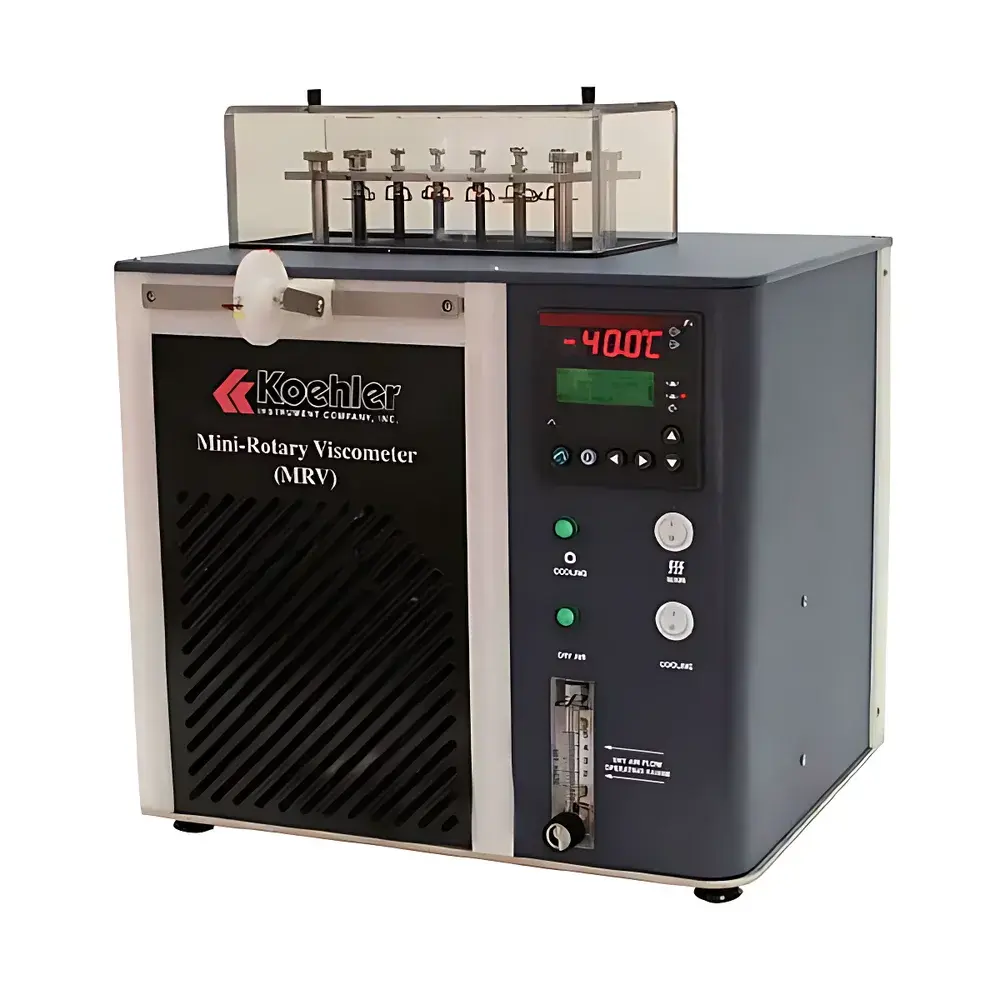
Koehler K38590 Engine Oil Borderline Pumping Temperature (BPT) and Low-Temperature Performance Tester
| Brand | Koehler |
|---|---|
| Origin | USA |
| Model | K38590 |
| Sample Capacity | 10 positions |
| Temperature Range | +80 °C to –40 °C |
| Temperature Control Accuracy | ±0.1 °C |
| Refrigeration Rate | up to 5.0 °C/min |
| Refrigerant | R-507 |
| Compressor Power | 1/3 hp |
| Heating Power | 600 W |
| Power Supply | 220 V, 50/60 Hz, 7 A |
| Dimensions | 39 × 32 × 34 cm |
| Weight | 47.6 kg |
| Construction | Stainless steel housing and durable thermoplastic components |
| Compliance | ASTM D4684, D3829, D6896, D6821*, SAE J300, ILSAC GF-3/GF-4 |
Overview
The Koehler K38590 Engine Oil Borderline Pumping Temperature (BPT) and Low-Temperature Performance Tester is a fully integrated, benchtop laboratory instrument engineered for precise determination of the lowest temperature at which engine oil can be pumped by an engine’s oil pump under cold-start conditions. It operates on the principle of controlled shear rheometry within a solid thermal bath, measuring torque resistance of lubricating oil as temperature is ramped downward under standardized mechanical stress—directly simulating the boundary pumping behavior defined in ASTM D4684. Unlike conventional cold-cranking simulators or mini-rotary viscometers, the K38590 employs direct thermoelectric and compressor-assisted cooling to achieve stable, reproducible sub-zero thermal profiles without reliance on hazardous liquid cryogens (e.g., methanol–dry ice baths). Its solid test bath architecture eliminates fluid handling, contamination risk, and thermal gradient inconsistencies inherent in liquid-bath systems—ensuring high inter-laboratory reproducibility required for OEM specification compliance and API licensing.
Key Features
- Integrated dual-mode refrigeration system combining R-507 compressor cooling and advanced thermoelectric elements for rapid, stable cooling at rates up to 5.0 °C/min and precise hold accuracy of ±0.1 °C across the full –40 °C to +80 °C range
- 10-position sample carousel enabling unattended sequential testing—critical for batch validation of multi-grade oils and additive package development
- Patented rotor geometry with sealed bearing assembly and optimized vane profile, eliminating interference from condensation, frost, or ice formation during extended low-temperature dwell cycles
- Internal dry-gas purge system (N₂ or dry air) maintaining dew point < –40 °C inside the test chamber to prevent moisture-induced crystallization artifacts in paraffinic base stocks
- Microprocessor-based controller with non-volatile memory storing complete method parameters—including ramp rate, soak duration, torque threshold criteria, and pass/fail logic per ASTM D4684 Annex A1
- Automatic safety interlocks for overpressure, overtemperature, and refrigerant circuit fault detection; compliant with UL 61010-1 and IEC 61000-6-3 electromagnetic compatibility requirements
- Energy-resilient architecture: maintains thermal setpoint and resumes interrupted tests after brief power loss (< 5 min), minimizing downtime in regulated environments
Sample Compatibility & Compliance
The K38590 accommodates standard ASTM-specified sample cups (15 mL volume) and is validated for all conventional and synthetic engine oils meeting SAE J300 viscosity classification—ranging from 0W-8 to 25W-60. It supports full execution of ASTM D4684 (BPT), D3829 (low-temperature viscosity correlation), D6896 (yield stress determination), and D6821* (low-temperature torque testing, when equipped with optional drive module). The instrument’s mechanical design and thermal calibration traceability align with ISO/IEC 17025 requirements for accredited lubricant testing laboratories. Structural materials—including 316 stainless steel bath housing and chemically resistant thermoplastic manifolds—are compatible with aggressive additives (e.g., pour point depressants, VI improvers) and do not catalyze oxidation during prolonged thermal cycling.
Software & Data Management
An optional Koehler Data Acquisition and Reporting Software Suite (sold separately) provides GLP-compliant functionality including user access control, electronic signatures, audit trail logging per FDA 21 CFR Part 11, and automated report generation in PDF or CSV format. Raw torque vs. temperature curves, BPT inflection point detection, yield stress interpolation, and statistical summaries (mean, SD, %RSD across replicates) are computed using NIST-traceable algorithms. All data files include embedded metadata: instrument ID, calibration certificate expiry, operator ID, ambient lab conditions, and timestamped method version—supporting full traceability in GMP-regulated product release workflows.
Applications
- Determination of borderline pumping temperature (BPT) for API SP, ILSAC GF-6A/B, and ACEA C-series engine oil formulations
- Low-temperature yield stress profiling during base oil selection and additive treat rate optimization
- Verification of cold-weather performance claims for heavy-duty diesel and gasoline passenger car motor oils
- Root-cause analysis of filter plugging or oil pump starvation incidents linked to wax crystallization or gelation onset
- Supporting ASTM round-robin interlaboratory studies and OEM engineering qualification protocols requiring D4684 repeatability ≤ ±0.5 °C
FAQ
Does the K38590 require external coolant or cryogenic liquids?
No—the system uses a closed-loop R-507 refrigerant circuit combined with solid-state thermoelectric modules. No methanol, ethanol, or liquid nitrogen is needed.
Can it perform ASTM D6821 testing without modification?
ASTM D6821 requires higher-torque actuation and specialized rotor geometry; this capability is available only with the optional K38590-D6821 Drive Module.
Is calibration verification supported per ASTM D4684 Annex A3?
Yes—the instrument includes built-in reference check routines using certified NIST-traceable temperature sensors and torque calibration standards.
What maintenance intervals are recommended for the refrigeration system?
Compressor oil and filter replacement every 24 months; annual verification of refrigerant charge and leak integrity per ASHRAE Standard 15.
How is data integrity ensured during power interruption?
The controller retains active test state in non-volatile RAM and resumes from the last valid measurement point upon power restoration—no data loss occurs for interruptions under 5 minutes.