
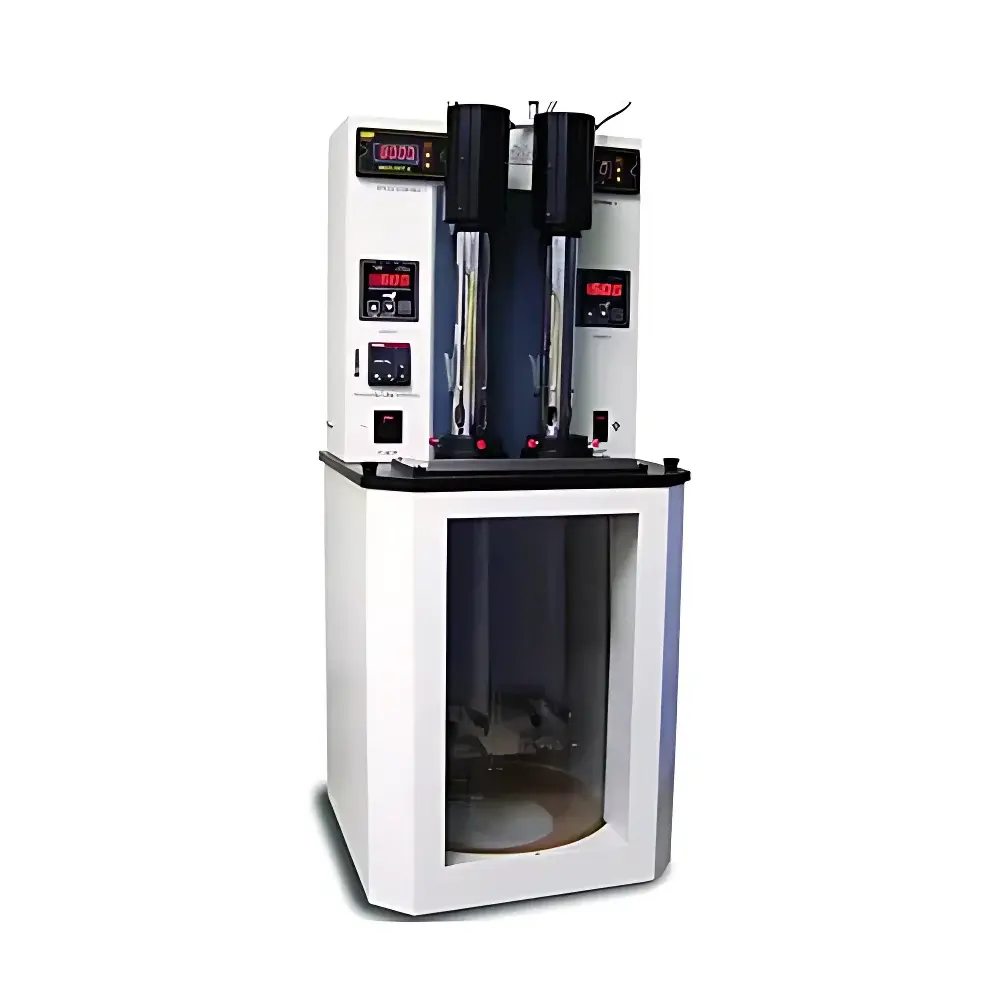
Koehler K39199 Petroleum Demulsibility Tester
| Brand | Koehler |
|---|---|
| Origin | USA |
| Model | K39199 |
| Standards Compliance | ASTM D2711, DIN 51353 |
| Temperature Control | Microprocessor-based digital bath control with dual LED display (setpoint & actual) |
| Bath Volume | 38.5 L |
| Dimensions (W×D×H) | 39 × 38 × 94 cm |
| Net Weight | 32.6 kg |
| Shipping Weight | 60.3 kg |
| Shipping Volume | 25.4 cu. ft. |
| Stirring Assembly | Dual independent motor-driven stainless-steel impellers with precision speed adjustment (LED speed display), ASTM D2711-compliant geometry including top/center/bottom bearings, stainless-steel shaft and mounting plate |
| Sample Configuration | Two parallel test positions with two K39103 stirrers and two K39120 separation funnels |
| Construction | All wetted parts stainless steel |
| Illumination | Integrated bath interior lighting for visual monitoring |
Overview
The Koehler K39199 Petroleum Demulsibility Tester is a precision-engineered instrument designed to quantify the ability of lubricating oils and other petroleum-based fluids to separate from water under controlled thermal and mechanical conditions. This measurement—commonly referred to as “demulsibility” or “anti-emulsification performance”—is critical for evaluating fluid stability in industrial systems where water ingress, condensation, or process contamination may occur. The instrument operates on the principle of standardized agitation followed by gravitational phase separation, directly implementing the methodology prescribed in ASTM D2711 *Standard Test Method for Determining the Demulsibility Characteristics of Steam Turbine Oils* and DIN 51353 *Testing of Mineral Oil-Based Lubricants – Determination of Demulsibility*. During testing, a defined volume of oil is mixed with distilled water in a calibrated separation funnel, agitated for five minutes at a specified temperature and rotational speed, then allowed to settle for a predetermined duration (typically 30, 60, or 120 minutes). The degree of separation is quantified by measuring the volume (mL) and percentage of residual water remaining in the oil layer, as well as the volume of free water and the volume of emulsion interphase—providing a complete three-phase demulsibility profile.
Key Features
- Dual independent test stations enable simultaneous evaluation of two samples under identical thermal and mechanical conditions, improving laboratory throughput and inter-sample comparability.
- ASTM D2711-compliant stirring assembly includes two high-precision, variable-speed motors driving stainless-steel helical impellers mounted on corrosion-resistant shafts with top, center, and bottom support bearings—ensuring consistent shear input and geometric repeatability across tests.
- Microprocessor-controlled digital temperature bath maintains setpoint accuracy within ±0.1 °C over the standard operating range (typically 54 °C or 82 °C per ASTM D2711), with dual LED display showing both setpoint and real-time bath temperature.
- All fluid-contact components—including stirrer shafts, separation funnels (K39120), mounting plates, and bath interior surfaces—are constructed from electropolished stainless steel to prevent catalytic degradation and ensure long-term chemical compatibility with hydrocarbon and additive-containing lubricants.
- Integrated bath illumination allows unambiguous visual assessment of phase boundaries and emulsion layer formation during settling—critical for accurate manual reading of separation volumes per ASTM requirements.
- Adjustable stirring speed via calibrated dial with LED readout enables precise replication of specified shear rates (e.g., 1500 rpm per ASTM D2711), supporting method flexibility for non-standard or research-grade investigations.
Sample Compatibility & Compliance
The K39199 is validated for use with mineral-, synthetic-, and semi-synthetic-based lubricants, including turbine oils, hydraulic fluids, gear oils, and compressor oils exhibiting kinematic viscosities up to 300 mm²/s at 40 °C. It accommodates standard 400-mL separation funnels (K39120) and supports both single- and dual-funnel configurations. The system meets full regulatory alignment with ASTM D2711 (2023 edition), DIN 51353 (2019), and IP 174 (Institute of Petroleum). Its construction, calibration traceability, and operational documentation support GLP-compliant environments and are compatible with internal quality assurance protocols requiring audit-ready instrumentation records.
Software & Data Management
While the K39199 operates as a standalone benchtop instrument without embedded data logging software, its analog and digital interfaces—including stable temperature setpoint retention, repeatable motor speed control, and illuminated visual readouts—are engineered to support integration into laboratory information management systems (LIMS) via external recording devices. Users may document test parameters (temperature, agitation time, settling duration, observed volumes) using Koehler’s optional K39199 Test Log Template (PDF/Excel), which aligns with FDA 21 CFR Part 11 principles for handwritten or electronic record integrity when used with institutional SOPs. All calibration procedures follow NIST-traceable references, and maintenance logs comply with ISO/IEC 17025 documentation expectations for accredited testing laboratories.
Applications
- Quality control of new turbine oils prior to commissioning in power generation facilities.
- Monitoring in-service oil degradation in steam and gas turbine systems where water ingress compromises film strength and oxidation resistance.
- Formulation development of demulsifier additives and base stock selection for enhanced water shedding performance.
- Comparative analysis of OEM-specified lubricants against aftermarket alternatives under standardized demulsibility stress conditions.
- Root cause investigation of bearing failures linked to water-induced sludge formation or hydrolytic breakdown of ester-based synthetics.
- Third-party certification testing for API RP 686 or ISO 8573-2 compliance in critical rotating equipment lubrication programs.
FAQ
What standards does the K39199 fully support?
The instrument is configured and verified for ASTM D2711, DIN 51353, and IP 174. Optional accessories allow adaptation to modified test durations or temperatures beyond standard specifications.
Can the K39199 be used for non-lubricant petroleum products?
Yes—users have successfully applied it to transformer oils, circulating oils, and certain fuel system fluids, provided viscosity and density fall within the validated operational envelope of the K39120 funnel geometry and stirring dynamics.
Is calibration verification required before each test?
Per ASTM D2711 Section 7.2, temperature bath uniformity and stirrer speed must be verified at least daily using NIST-traceable thermometers and tachometers; Koehler provides recommended calibration checklists and certificate templates.
How is operator variability minimized during visual volume readings?
The integrated bath lighting, vertical alignment of funnels via precision-machined mounting plates, and standardized meniscus reading protocol (per ASTM D2711 Section 10.2) collectively reduce inter-operator deviation to <±0.5 mL across trained personnel.
Does the system support automated data capture?
No native digital output is provided; however, analog signals (e.g., temperature sensor outputs) can be interfaced externally, and Koehler offers technical guidance for integrating third-party data acquisition modules compliant with IEC 61000-4 EMC standards.






