
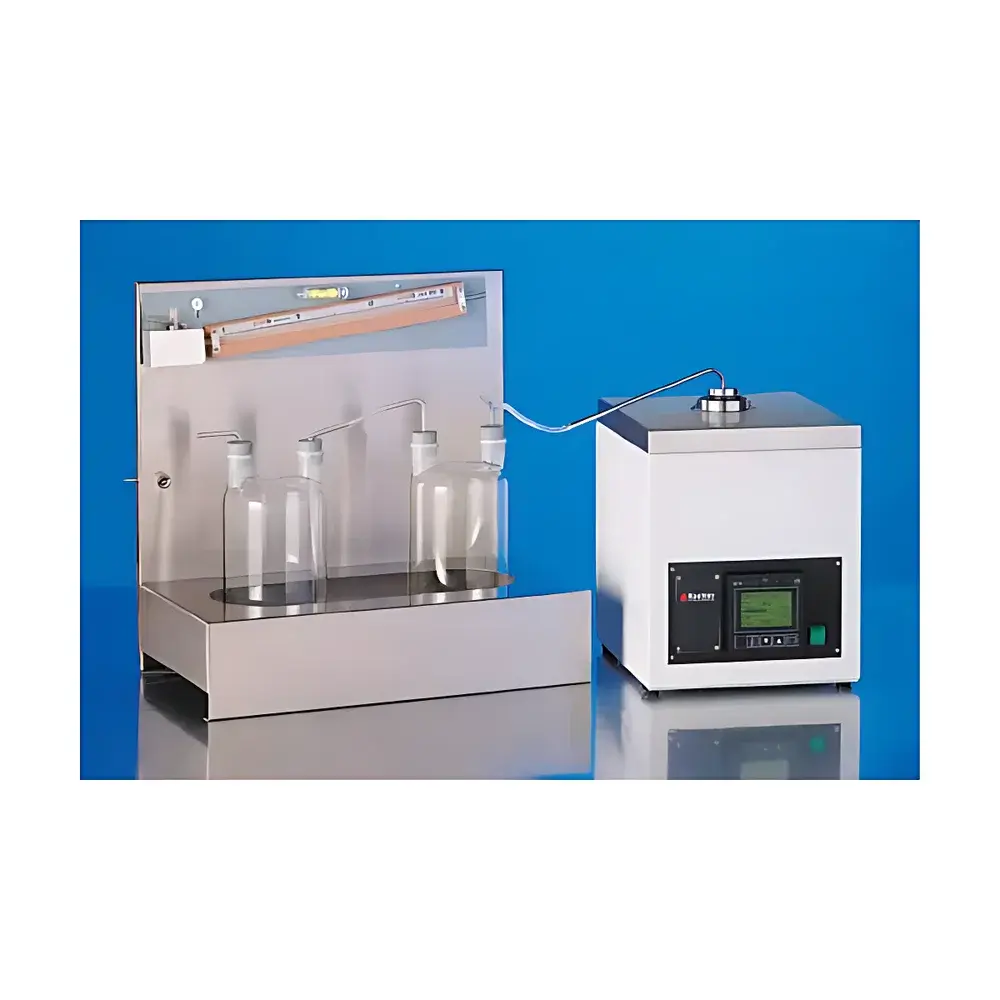
Koehler K44090/K44091 NOACK Volatility Tester
| Brand | Koehler |
|---|---|
| Origin | USA |
| Model | NOACK |
| Standard Compliance | ASTM D5800, DIN 51581 |
| Temperature Range | 150–350 °C (±0.1 °C accuracy) |
| Heating Medium Options | Aluminum block (non-Wood’s alloy) or Wood’s alloy bath |
| Power Supply | 230 V, 50 Hz, 5.8 A |
| Dimensions (K44090) | 59 × 35 × 68 cm |
| Weight (K44090) | 26.7 kg |
| Dimensions (K44091) | 54 × 38 × 37 cm |
| Weight (K44091 with accessories) | 38.2 kg |
| Sample Mass | 65 g |
| Test Duration | 60 min at specified temperature |
| Air Flow Control | Manual (incl. inclined-tube manometer, 0–30 mm H₂O) or optional automated pressure regulation |
Overview
The Koehler K44090 and K44091 NOACK Volatility Testers are precision-engineered laboratory instruments designed to quantify the evaporation tendency of lubricating oils under controlled high-temperature conditions. Based on the fundamental principle of dynamic air-flow volatilization, these systems operate in strict accordance with ASTM D5800 and DIN 51581—the internationally recognized standard test methods for determining the volatility of engine oils and other petroleum-based lubricants. During testing, a precisely weighed 65 g sample is introduced into a stainless-steel evaporation crucible mounted within a thermally insulated aluminum heating block. The system heats the sample to a user-selectable temperature between 150 °C and 350 °C, maintaining thermal stability within ±0.1 °C throughout the 60-minute exposure period. A regulated stream of ambient air carries volatile components out of the crucible, where they are swept through an exhaust path—enabling gravimetric determination of mass loss as a percentage of the original sample weight. This methodology provides a reproducible, quantitative metric critical for evaluating base oil volatility, additive package stability, and formulation robustness in engine oil development and quality assurance.
Key Features
- Microprocessor-controlled digital temperature regulation with real-time display of both temperature and system pressure (K44090 variant)
- Thermally optimized aluminum heating block with full insulation—designed for uniform heat distribution and minimal thermal drift
- Dual configuration options: non-Wood’s alloy aluminum block (K44090) or traditional Wood’s alloy bath (K44091), both compliant with ASTM D5800 requirements
- Integrated inclined-tube manometer (0–30 mm H₂O range) and bleed valve for manual air flow calibration and stabilization
- Stainless-steel evaporation crucibles engineered for repeated high-temperature use and dimensional consistency across test cycles
- CE-compliant power architecture (230 V, 50 Hz, 5.8 A) suitable for global laboratory infrastructure
- Modular accessory support—including certified reference thermometers, vacuum pumps, crucible handling tools, and glassware kits—for method flexibility and traceability
Sample Compatibility & Compliance
The NOACK tester accommodates a broad spectrum of lubricant formulations—including conventional, synthetic, and semi-synthetic engine oils; gear oils; hydraulic fluids; and greases (after appropriate solvent dilution and recovery). Its design ensures compatibility with samples exhibiting viscosities ranging from SAE 0W to 60-grade oils. All operational parameters—including temperature setpoint accuracy, thermal ramp rate, air flow linearity, and crucible geometry—are validated against the procedural constraints defined in ASTM D5800 and DIN 51581. The instrument supports GLP-aligned workflows: temperature controllers retain calibration logs, and optional pressure automation modules can be configured to meet FDA 21 CFR Part 11 data integrity requirements when integrated with compliant LIMS platforms. Certified reference materials (CRMs) for NOACK volatility are available for routine performance verification and inter-laboratory comparison.
Software & Data Management
While the base K44090/K44091 systems operate via embedded microcontroller interfaces, Koehler offers optional PC-based software (Koehler NOACK DataLink v3.x) for enhanced data capture and reporting. This application enables time-stamped logging of temperature, pressure, and elapsed test duration; automated calculation of % mass loss per ASTM D5800 Annex A1; generation of PDF test reports with digital signatures; and export to CSV or XML formats for integration with enterprise QA databases. Audit trails record all parameter modifications, user logins, and calibration events—supporting ISO/IEC 17025 accreditation and internal GMP audit readiness. Raw sensor outputs are timestamped at 1 Hz resolution, ensuring sufficient granularity for root-cause analysis of thermal excursions or airflow anomalies.
Applications
- Formulation screening of base oil volatility during engine oil development
- Quality control release testing for OEM-specified lubricants (e.g., API SP, ACEA C5, ILSAC GF-6)
- Stability assessment of additive packages under high-temperature shear conditions
- Comparative evaluation of evaporative emissions profiles for low-SAPS and fuel-efficient lubricants
- Regulatory compliance verification for OEM specifications requiring NOACK volatility limits (e.g., <13% mass loss at 250 °C)
- Technical service support for field failure analysis involving oil thickening or deposit formation
FAQ
What is the primary purpose of the NOACK volatility test?
It quantifies the percentage mass loss of a lubricating oil after exposure to elevated temperature under controlled airflow—serving as a key indicator of evaporative stability and potential oil consumption in internal combustion engines.
Can the K44090 be used interchangeably with the K44091?
No—the K44090 employs a solid aluminum heating block with digital pressure monitoring, while the K44091 uses a molten Wood’s alloy bath with manual timing and analog pressure control. Method equivalence is maintained, but procedural execution differs.
Is third-party calibration certification available?
Yes—Koehler provides NIST-traceable calibration certificates for temperature sensors and manometers, valid for 12 months, upon request at time of purchase or service.
What vacuum pump specifications are recommended for optional automation?
A two-stage rotary vane pump capable of sustaining ≤5 kPa absolute pressure and delivering ≥15 L/min free air displacement is recommended for seamless integration with Koehler’s optional pressure control module.
How often should the stainless-steel crucible be replaced?
Under normal usage (≤5 tests/day), crucibles exhibit no measurable degradation for ≥2,000 cycles; visual inspection for pitting or warping is advised every 500 runs.






