
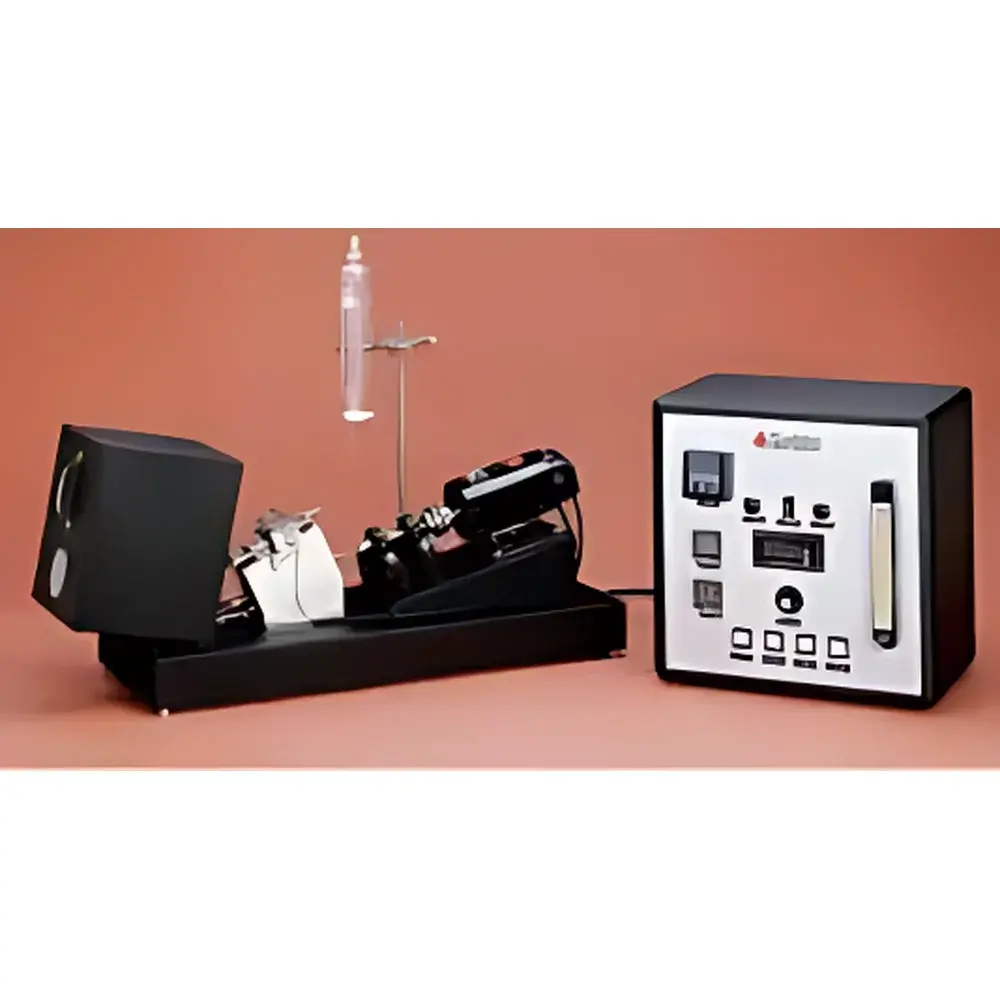
Koehler K50119 Coking Plate Tester
| Brand | Koehler |
|---|---|
| Origin | USA |
| Model | K50119 |
| Test Plate Temperature Range | Up to 400 °C |
| Sample Oil Temperature Range | Up to 210 °C |
| Spray Speed | 0–1800 rpm (digital display) |
| Timer Range | 0–99.9 hours (adjustable countdown) |
| Acid Gas Flow Rate | 0.2–1.0 L/h |
| Oil Capacity | 0.35 L |
| Power Supply | 220–240 V, 50/60 Hz, 5 A |
| Test System Dimensions | 81 × 46 × 53 cm, 22.7 kg |
| Control Unit Dimensions | 46 × 30 × 46 cm, 11.3 kg |
| Temperature Display Units | °C or °F selectable |
| Compliance | FTM 791-3462 |
Overview
The Koehler K50119 Coking Plate Tester is a precision-engineered laboratory instrument designed to evaluate the thermal stability and coking tendency of finished lubricating oils under controlled, accelerated oxidative conditions. It operates on the principle of rapid thermal exposure: a defined volume of oil is mechanically sprayed onto a preheated aluminum test plate maintained at high temperature (up to 400 °C), simulating localized overheating scenarios encountered in internal combustion engines and high-load mechanical systems. The resulting carbonaceous deposit—commonly referred to as “coke”—is quantified gravimetrically after the test cycle, providing a direct, reproducible metric for comparative coking resistance across formulations. This method is fundamentally aligned with the U.S. Department of Defense test specification FTM 791-3462, which defines standardized procedures for assessing lubricant performance in engine pre-test simulations. Unlike oven-based oxidation tests, the K50119 replicates dynamic thermal stress combined with mechanical shear and controlled gas-phase interaction—critical factors influencing real-world deposit formation.
Key Features
- Dual independent digital temperature controllers: one for the aluminum test plate (0–400 °C) and another for the sample oil bath (0–210 °C), both with selectable °C/°F display and ±1 °C stability.
- Digitally regulated mechanical spray rotor: delivers consistent, repeatable oil dispersion at speeds from 0 to 1800 rpm, enabling precise control over droplet size distribution and impingement energy.
- Integrated corrosion-resistant mass flow controller: supports introduction of acidic gases (e.g., SO₂ or HCl) at calibrated rates between 0.2 and 1.0 L/h to accelerate oxidative degradation pathways relevant to sulfur-containing base stocks or contaminated operating environments.
- Programmable digital timer with adjustable countdown function (0–99.9 hours), supporting both fixed-duration and multi-stage test protocols.
- Hinged safety enclosure with integrated exhaust port and electromagnetic interlock switch: automatically de-energizes the spray motor and heater circuits when the lid is opened, meeting OSHA-compliant machine safeguarding requirements.
- Modular architecture: separates test chamber (22.7 kg) from control unit (11.3 kg), facilitating installation in fume hoods or dedicated testing bays while minimizing electromagnetic interference with adjacent instrumentation.
Sample Compatibility & Compliance
The K50119 accommodates standard ASTM D2272-compatible oil samples up to 0.35 L per test cycle. Its design permits evaluation of mineral, synthetic, and semi-synthetic lubricants—including turbine oils, hydraulic fluids, and engine oils—with viscosity ranges spanning ISO VG 10 to VG 150. All operational parameters adhere strictly to FTM 791-3462 methodology, including plate heating ramp profiles, spray dwell time, and post-test cooling intervals. While not certified to ISO/IEC 17025 by default, the system supports GLP-compliant documentation workflows when paired with validated electronic lab notebooks (ELNs) and audit-trail-enabled data loggers. Optional calibration certificates traceable to NIST standards are available upon request for metrological assurance.
Software & Data Management
The K50119 operates as a stand-alone hardware platform without embedded firmware or proprietary software. All parameter inputs (temperature setpoints, rpm, timer duration, gas flow rate) are configured via front-panel membrane switches and LED displays. Real-time values are logged manually or via external data acquisition systems interfaced through analog voltage outputs (0–10 V DC) for temperature and rpm signals. For laboratories requiring electronic record integrity, the instrument is compatible with 21 CFR Part 11-compliant SCADA platforms when integrated with third-party I/O modules and timestamped logging servers. Raw gravimetric coke mass data is entered post-test into LIMS or statistical analysis tools (e.g., JMP, Minitab) for trend monitoring and formulation optimization.
Applications
- Formulation screening of anti-coking additives (e.g., detergents, dispersants, and oxidation inhibitors) in R&D laboratories.
- Batch release testing for military-grade lubricants subject to DoD procurement specifications.
- Root-cause analysis of field failures linked to piston ring sticking, valve train deposits, or turbocharger coking.
- Correlation studies between coking plate results and high-temperature oxidation bench tests (e.g., TOST, RBOT, or PDSC).
- Supporting ASTM WK72813 development efforts toward harmonizing coking tendency metrics across engine oil categories.
FAQ
What test standard does the K50119 specifically implement?
The instrument is engineered to execute FTM 791-3462 exclusively; it is not configured for ASTM D3231, D6443, or other coking-related methods.
Can the K50119 be used with non-acidic inert gases such as nitrogen or air?
Yes—gas flow calibration is linear across the 0.2–1.0 L/h range and supports any non-reactive or reactive gas compatible with the stainless-steel flow path and Viton seals.
Is the aluminum test plate replaceable, and what is its typical service life?
Each plate is precision-machined from 6061-T6 aluminum and rated for ≥200 test cycles under nominal conditions; replacement plates (P/N K50119-PLATE) are supplied with NIST-traceable dimensional certification.
Does Koehler provide installation qualification (IQ) or operational qualification (OQ) documentation?
Factory-verified IQ/OQ protocols are available as optional deliverables; these include temperature uniformity mapping, rpm linearity verification, and interlock response timing validation reports.
How is calibration traceability maintained for temperature and flow measurements?
Primary calibration uses Fluke 729 auto-pressure calibrators and Hart 2555 dry-block calibrators, with all reference instruments recalibrated annually per ISO/IEC 17025-accredited providers.
Related Products




