
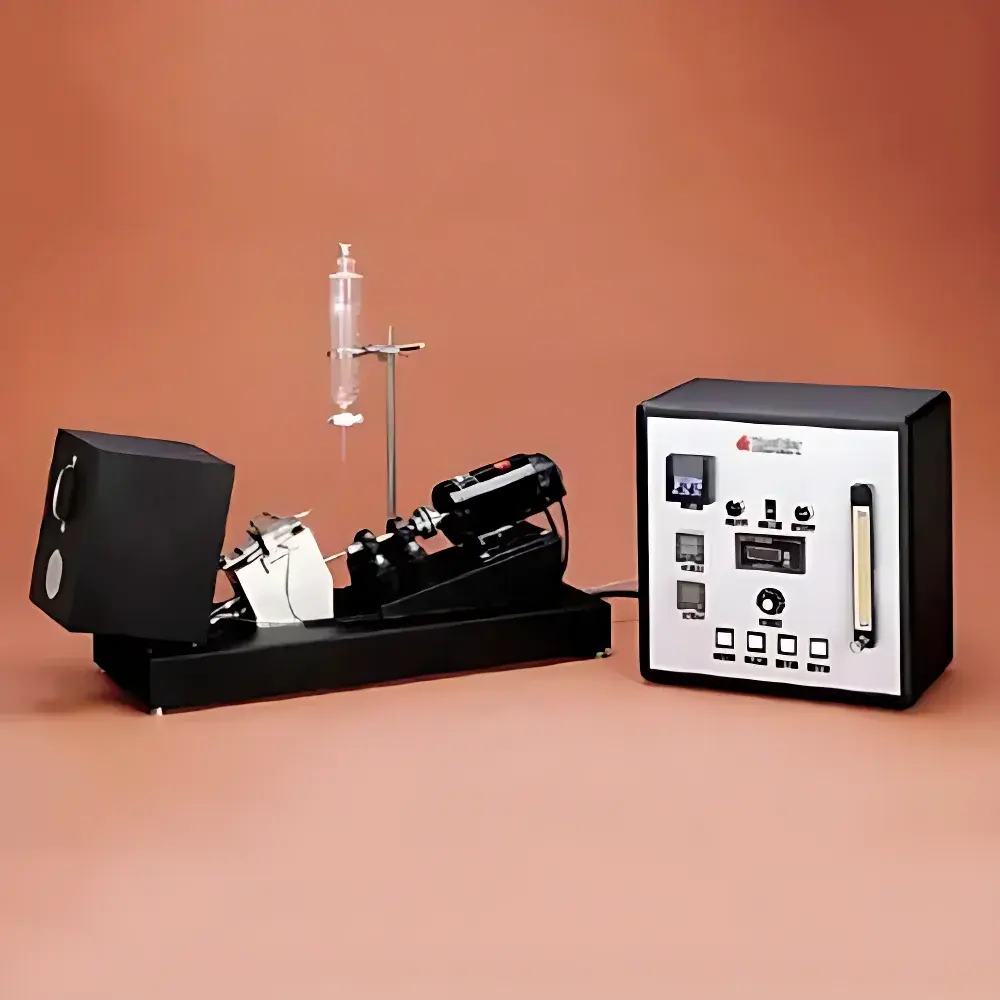
Koehler K50119 Coking Plate Tester
| Brand | Koehler |
|---|---|
| Origin | USA |
| Model | K50119 |
| Compliance | FTM 791-3462 |
| Sample Volume | 0.35 L |
| Temperature Control Range | 310–320 °C (plate), independent oil bath control |
| Spray Speed | 0–1800 rpm (digital display) |
| Timer Range | 0–99.9 h |
| Gas Flow Rate | 0.2–1.0 L/h |
| Power Supply | 220 VAC, single-phase |
| Control Unit Dimensions | 46 × 30 × 46 cm, 11.3 kg |
| Test System Dimensions | 81 × 46 × 53 cm, 22.7 kg |
Overview
The Koehler K50119 Coking Plate Tester is a precision-engineered laboratory instrument designed to evaluate the thermal oxidative stability and coking tendency of lubricating oils under controlled high-temperature conditions. It operates on the principle of simulating localized overheating events encountered in internal combustion engines—specifically, the contact between hot metal surfaces and circulating lubricants. In accordance with U.S. Department of Defense test method FTM 791-3462, the instrument subjects a defined volume (0.35 L) of oil to rapid mechanical splashing onto a preheated aluminum plate maintained at 310–320 °C. The resulting carbonaceous deposit—commonly referred to as “coke”—is quantified gravimetrically after a prescribed exposure duration. This method provides critical insight into an oil’s resistance to thermal degradation, sludge formation, and valve train fouling—parameters directly relevant to engine durability, maintenance intervals, and OEM specification compliance.
Key Features
- Full conformance to FTM 791-3462, ensuring traceable, standardized test execution for defense and industrial lubricant qualification.
- Dual-zone digital temperature control system: independent microprocessor-based controllers regulate both the aluminum test plate (310–320 °C) and the oil reservoir, with selectable °C/°F display and ±1 °C stability.
- Digitally calibrated mechanical splashing mechanism with speed range 0–1800 rpm, enabling precise replication of shear-induced oil dispersion dynamics observed in high-RPM engine components.
- Integrated corrosion-resistant mass flow controller (0.2–1.0 L/h) for optional introduction of acidic gases (e.g., SO₂ or NOₓ surrogates), enhancing simulation fidelity for severe-duty applications such as marine diesel or gas turbine lubricants.
- High-resolution digital timer (0–99.9 hours, 0.1-hour resolution) synchronized with motor activation and safety interlocks.
- Hinged safety enclosure with integrated exhaust port and hardware-enforced interlock: lifting the lid immediately de-energizes the drive motor and heating elements, meeting IEC 61010-1 requirements for laboratory electrical safety.
Sample Compatibility & Compliance
The K50119 accommodates standard-grade mineral, synthetic, and semi-synthetic lubricating oils—including engine oils (SAE 0W–60), hydraulic fluids, and turbine oils—as specified in FTM 791-3462. Test plates are supplied in two configurations: reusable anodized aluminum (K50101) and high-temperature stainless steel (Type 321, K50102), the latter suitable for extended-cycle testing or aggressive formulations containing sulfated ash additives. All operational parameters—including temperature ramp profiles, dwell times, and gas injection protocols—are fully documented and auditable, supporting GLP-compliant data integrity. The instrument satisfies essential elements of ASTM D3945 (Standard Practice for Evaluating Lubricant Deposit Formation), ISO 13702 (Petroleum products — Determination of coking tendency), and serves as a functional analog to portions of USP for thermal stability assessment of pharmaceutical excipients used in high-temperature processing.
Software & Data Management
While the K50119 operates as a standalone benchtop unit with embedded digital controls, its modular architecture supports external data logging via RS-232 or optional USB interface (available through Koehler-approved accessories). Time-stamped temperature, rpm, and timer values can be exported to CSV-compatible spreadsheets for statistical process control (SPC) analysis. When deployed within regulated environments—including those subject to FDA 21 CFR Part 11—users may integrate the instrument into validated laboratory information management systems (LIMS) using third-party middleware that enforces electronic signature, audit trail, and user access control protocols. Calibration records, maintenance logs, and test reports are retained per ISO/IEC 17025 clause 7.7 requirements.
Applications
- Pre-qualification screening of new base oil blends and additive packages for military-spec (MIL-PRF-2104G, MIL-PRF-46167) and commercial engine oils.
- Root-cause analysis of field failures linked to piston ring sticking, turbocharger coking, or EGR valve deposits.
- Comparative benchmarking of antioxidant package efficacy across competing formulations.
- Supporting OEM development programs requiring correlation between bench-scale coking metrics and full-engine dynamometer results (e.g., Sequence IIIG, Sequence VE).
- Quality assurance testing in lubricant manufacturing facilities operating under ISO 9001 or API Q1 quality management systems.
FAQ
What standards does the K50119 explicitly comply with?
The instrument is engineered and verified to meet all procedural, dimensional, and performance criteria outlined in U.S. DoD Federal Test Method Standard FTM 791-3462.
Can stainless steel test plates be substituted for aluminum during routine testing?
Yes—K50102 Type 321 stainless steel plates are certified for use per FTM 791-3462 Annex A and offer superior dimensional stability under repeated thermal cycling.
Is the gas flow system compatible with reactive or corrosive gases beyond air?
The calibrated flow path is constructed from 316 stainless steel and PTFE-sealed components, rated for continuous operation with SO₂, NO, CO₂, and dry N₂; wet or halogenated gases require prior consultation with Koehler Technical Support.
How is calibration traceability maintained?
Temperature sensors are NIST-traceable Class A RTDs; rotational speed is verified using optical tachometry; mass flow meters are factory-calibrated against primary standards and include certificate-of-calibration with uncertainty budgets.
Does the K50119 support automated reporting for regulatory submissions?
While native reporting is manual, the instrument’s serial output enables integration with validated LIMS or ELN platforms capable of generating 21 CFR Part 11-compliant audit trails and electronic signatures.






