
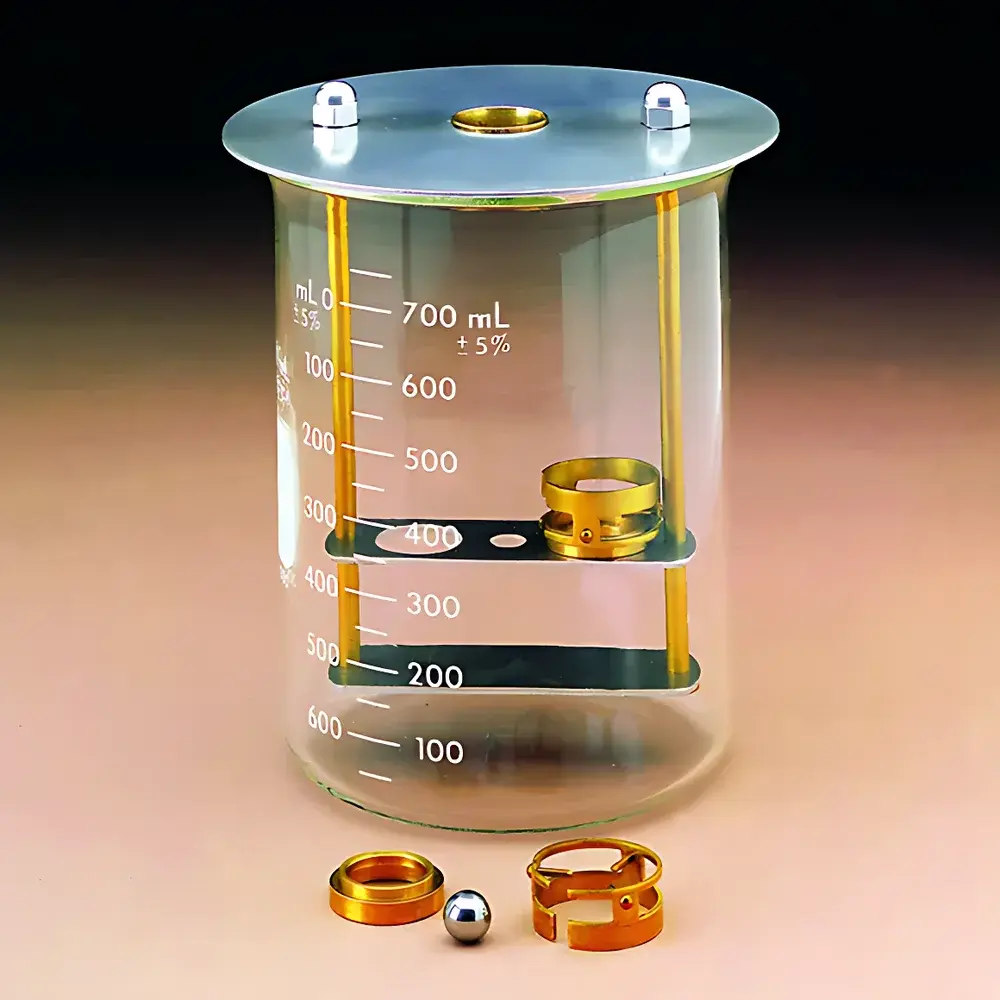
Koehler K80000 Ring-and-Ball Softening Point Tester
| Brand | Koehler |
|---|---|
| Origin | USA |
| Model | K80000 |
| Temperature Range | 30–157°C (86–315°F) |
| Heating Power | 1500 W |
| Bath Media Compatibility | Distilled Water (30–80°C), Glycerin (80–157°C), Ethylene Glycol (30–110°C) |
| Standard Accessories | 800 mL Beaker, Two ASTM-Compliant Steel Balls, Brass Ring Molds (Shoulder-Type), Ball Centering Device, Ring Support Stand, Base Plate, Beaker Cover with Support Rod |
| Compliance | ASTM D36, ISO 4625, EN 1427, DIN 52011, IP 58, AFNOR T66-008, NF EN 1427 |
Overview
The Koehler K80000 Ring-and-Ball Softening Point Tester is a precision-engineered instrument designed for the standardized determination of the softening point of bituminous materials—including paving asphalts, roofing asphalts, coal tar pitches, and polymer-modified bitumens—according to the classical ring-and-ball method. This gravimetric thermal transition test measures the temperature at which a standardized asphalt specimen, constrained within a brass ring and loaded with a 3.5 g steel ball, deforms under controlled heating until the ball descends a defined vertical distance (typically 25.4 mm) through the softened material and contacts the bottom plate. The principle relies on thermally induced viscoelastic yield under constant load, providing a reproducible, comparative indicator of thermoplastic behavior critical for specification compliance, quality control, and formulation development in petroleum refining, road construction, and roofing material manufacturing.
Key Features
- Robust, laboratory-grade construction with corrosion-resistant stainless steel housing and precision-machined brass ring molds conforming to ASTM D36 dimensional tolerances.
- Programmable digital temperature controller with ±0.1°C resolution and ramp rate stability of ≤0.5°C/min over the full operating range (30–157°C).
- Dual-bath media flexibility: compatible with distilled water (30–80°C), USP-grade glycerin (80–157°C), and ethylene glycol (30–110°C), enabling broad applicability across standard-compliant temperature domains without hardware modification.
- Integrated mechanical ball centering device ensures consistent 3.5 g steel ball placement directly above the center of the asphalt disk—minimizing lateral deviation and improving inter-laboratory reproducibility.
- Modular support assembly includes a rigid base plate, adjustable ring support stand, and beaker cover with vertical support rod—designed to maintain alignment and suppress convection disturbances during heating.
- Pre-calibrated 800 mL borosilicate glass beaker included; all consumables (rings, balls, centering tool) meet ASTM E29 roundness and mass tolerance requirements.
Sample Compatibility & Compliance
The K80000 accommodates standard 12.7 mm inner-diameter shoulder-type brass rings per ASTM D36 and EN 1427. It supports specimens prepared from unaged or RTFOT/TFOT-aged binders, cutback asphalts, and emulsified residues after evaporation. The system fully complies with international standards including ASTM D36, ISO 4625, EN 1427, DIN 52011, IP 58, AFNOR T66-008, and NF EN 1427. Its design facilitates GLP-aligned operation: all critical parameters (bath medium, heating rate, ball mass, ring geometry, and drop distance) are traceably documented and verifiable per ISO/IEC 17025 requirements. No software-based audit trail is embedded, but procedural adherence enables full traceability in regulated QC environments where manual logbooks or LIMS-integrated reporting are employed.
Software & Data Management
The K80000 operates as a standalone analog-digital hybrid instrument with no embedded firmware or proprietary software. Temperature readings are displayed via a high-contrast LED digital panel calibrated to NIST-traceable references. Data recording is performed manually or integrated into external laboratory information management systems (LIMS) via optional RS-232 or 4–20 mA analog output modules (sold separately). While the base unit does not support FDA 21 CFR Part 11 electronic signatures or automated report generation, its mechanical simplicity and deterministic thermal response make it suitable for environments requiring minimal validation burden—particularly in ISO 9001-certified asphalt production labs and third-party testing facilities performing routine specification checks.
Applications
- Quality assurance of asphalt binders prior to hot-mix asphalt (HMA) production.
- Comparative evaluation of polymer-modified asphalt (PMB) thermal stability versus conventional grades.
- Specification verification for Department of Transportation (DOT) submittals per AASHTO M 226 and ASTM D3381.
- Research into aging effects (e.g., PAV, RTFOT) on bitumen softening behavior.
- Roofing membrane binder qualification per ASTM D312 and D449.
- Technical support for pavement performance modeling, particularly in relation to rutting susceptibility at elevated service temperatures.
FAQ
What bath medium should I use for testing asphalt with a softening point above 100°C?
Glycerin (USP grade) is required for measurements between 80°C and 157°C. Ensure viscosity remains stable throughout the test; preheat glycerin to ~70°C before loading to minimize thermal shock.
Can the K80000 be used for coal tar pitch testing?
Yes—the instrument meets ASTM D36 requirements for both asphalt and coal tar pitch. Verify that sample preparation follows D36 Annex A1 for tar-derived materials.
Is calibration certification included with shipment?
Each unit ships with a factory calibration certificate referencing NIST-traceable temperature standards. Annual recalibration using certified reference thermometers (e.g., platinum resistance thermometers per ASTM E77) is recommended.
How many samples can be tested simultaneously?
The K80000 supports dual-ring configuration (two independent tests per run), each with dedicated ball and ring assembly, enabling parallel determination for improved throughput and statistical confidence.
Does the system require ventilation or fume hood installation?
Glycerin heating above 120°C may generate low-level vapors; operation in a well-ventilated area or under local exhaust is advised per OSHA 1910.1200 guidelines.






