
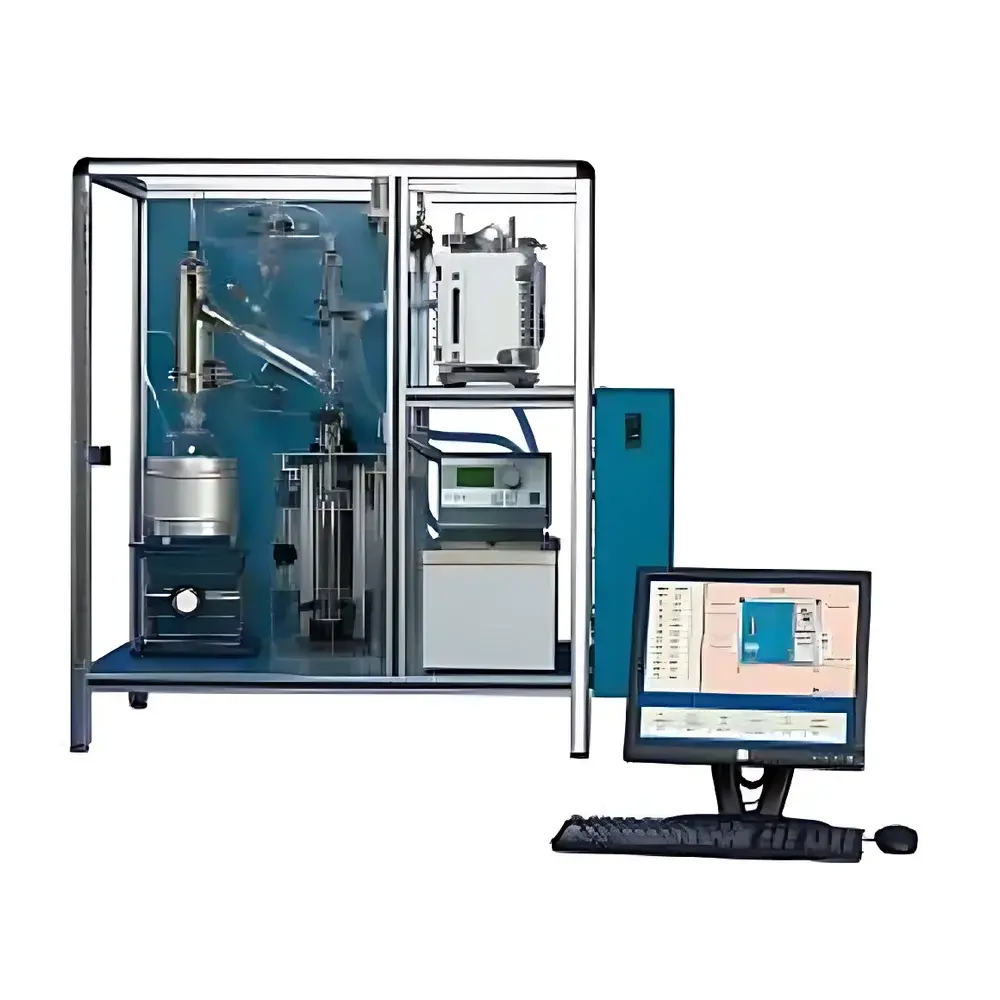
Koehler K87170 Automated Vacuum Distillation Apparatus for Petroleum Products
| Brand | Koehler |
|---|---|
| Origin | USA |
| Manufacturer Status | Authorized Distributor |
| Origin Category | Imported |
| Model | K87170 |
| Price Range | USD 14,000–70,000 (est.) |
| Distillation Mode | Vacuum (Reduced-Pressure) |
| Condenser Temperature Range | Ambient +5°C to 150°C |
| Distillation Temperature Range | Ambient to 400°C |
| Vacuum Range | 1.0–50 mmHg (0.13–6.7 kPa) |
| Electrical Supply | 120 or 220/240 VAC, 50/60 Hz |
| Dimensions | 91.5 × 94 × 53 cm |
| Weight | 91 kg |
Overview
The Koehler K87170 Automated Vacuum Distillation Apparatus is a precision-engineered system designed to determine the boiling point distribution of petroleum products under controlled reduced-pressure conditions, in strict accordance with ASTM D1160 (“Standard Test Method for Distillation of Petroleum Products at Reduced Pressure”). This method is essential for characterizing high-boiling fractions—such as lubricating oils, vacuum gas oils, and residual fuels—that decompose or thermally degrade under atmospheric distillation. The instrument employs a single-theoretical-plate fractional distillation configuration, where sample vaporization, condensation, and collection occur under dynamically regulated vacuum and temperature gradients. Unlike manual or semi-automated setups, the K87170 integrates real-time pressure stabilization, programmable heating ramps, and closed-loop condenser temperature control to ensure repeatability across multiple runs and operators. Its architecture eliminates operator-dependent variables—including manual vacuum adjustment, timing errors, and subjective endpoint judgment—thereby improving inter-laboratory reproducibility and supporting GLP-compliant workflows.
Key Features
- Fully automated distillation sequence—from initial vacuum establishment and pre-heating to final cut collection and system cooldown—executed via embedded Windows® OS on an integrated industrial PC
- Integrated safety enclosure with interlocked safety door and transparent polycarbonate shield, compliant with IEC 61010-1 for laboratory electrical equipment safety
- Vacuum-induced foam suppression mechanism that actively monitors and adjusts pressure during boiling to prevent carryover and column flooding
- Modular design enabling tool-free access to all critical components: distillation flask, fraction receiver, condenser, and vacuum sensor
- Self-cleaning cycle utilizing solvent flush and thermal bake-out protocols between runs to minimize cross-contamination and reduce maintenance downtime
- Detachable, calibrated volumetric receivers with quick-release fittings for rapid changeover and traceable volume measurement per ASTM D1160 Section 8.2
- Real-time graphical interface displaying live process status—including current pressure (mmHg), bath temperature (°C), distillate volume (%), and atmospheric-equivalent boiling point (°C)—with dynamic trend visualization
Sample Compatibility & Compliance
The K87170 is validated for use with petroleum-based samples having initial boiling points above 250°C and final boiling points up to 400°C under reduced pressure. It accommodates standard 100 mL or 200 mL distillation flasks and supports both narrow- and wide-cut feedstocks, including vacuum residues, deasphalted oils, and hydroprocessed fractions. All operational parameters—including vacuum setpoints, heating rate profiles, and condenser cooling schedules—are programmable to align with ASTM D1160 Annex A1 (Precision Statements) and ISO 3405 (Petroleum products — Determination of distillation characteristics). The system meets requirements for audit readiness under FDA 21 CFR Part 11 when configured with electronic signature-enabled software modules and secure user-access controls. Data integrity is maintained through immutable timestamped records, automatic checksum validation, and tamper-evident file logging.
Software & Data Management
The proprietary Windows®-based application provides step-by-step procedural guidance, context-sensitive help, and configurable method templates aligned with ASTM D1160 test conditions. Each distillation run generates a structured dataset comprising time-stamped temperature/pressure/volume triples, calculated atmospheric-equivalent boiling points using the ASTM D1160 correction algorithm, and full-resolution distillation curves (volume % vs. °C). Export formats include CSV (compatible with Excel, MATLAB, and LIMS platforms), PDF reports with embedded chromatogram-style plots, and XML for enterprise integration. Data can be retrieved via USB 3.0 port, Gigabit Ethernet (supporting DHCP and static IP), or optional CD/DVD writer module. Audit trails record all user actions—including parameter modifications mid-run—with operator ID, timestamp, and reason-for-change fields.
Applications
- Determination of boiling range distributions for vacuum tower side-streams in refinery process optimization
- Quality assessment of base oil fractions prior to additive blending
- Specification compliance testing for ASTM D2887, D6352, and D7169 when adapted with appropriate accessories
- Research-scale evaluation of thermal stability and volatility behavior in heavy hydrocarbon mixtures
- Supporting API RP 2510 and ISO 8503-2 corrosion modeling through precise vapor-phase composition inference
- Regulatory reporting for EPA Method 8270D (semivolatile organics) sample preparation where distillative fractionation is required
FAQ
What standards does the K87170 comply with?
ASTM D1160 is the primary reference method; additional alignment includes ISO 3405, IP 140, and DIN 51581.
Can the instrument operate without continuous PC supervision?
No—the integrated PC is required for real-time control, data acquisition, and safety interlock management; it is not a standalone microprocessor unit.
Is calibration traceable to NIST standards?
Yes—temperature sensors are supplied with individual NIST-traceable calibration certificates; vacuum transducers are certified to ISO/IEC 17025 by Koehler’s accredited metrology lab.
How is data security ensured during network transfer?
All Ethernet communications use TLS 1.2 encryption; local storage employs AES-256 disk encryption when enabled via Group Policy.
What maintenance intervals are recommended?
Vacuum pump oil change every 500 hours; condenser cleaning and O-ring inspection every 100 runs; annual full-system verification per Koehler Service Bulletin SB-K87170-03.
Related Products






