
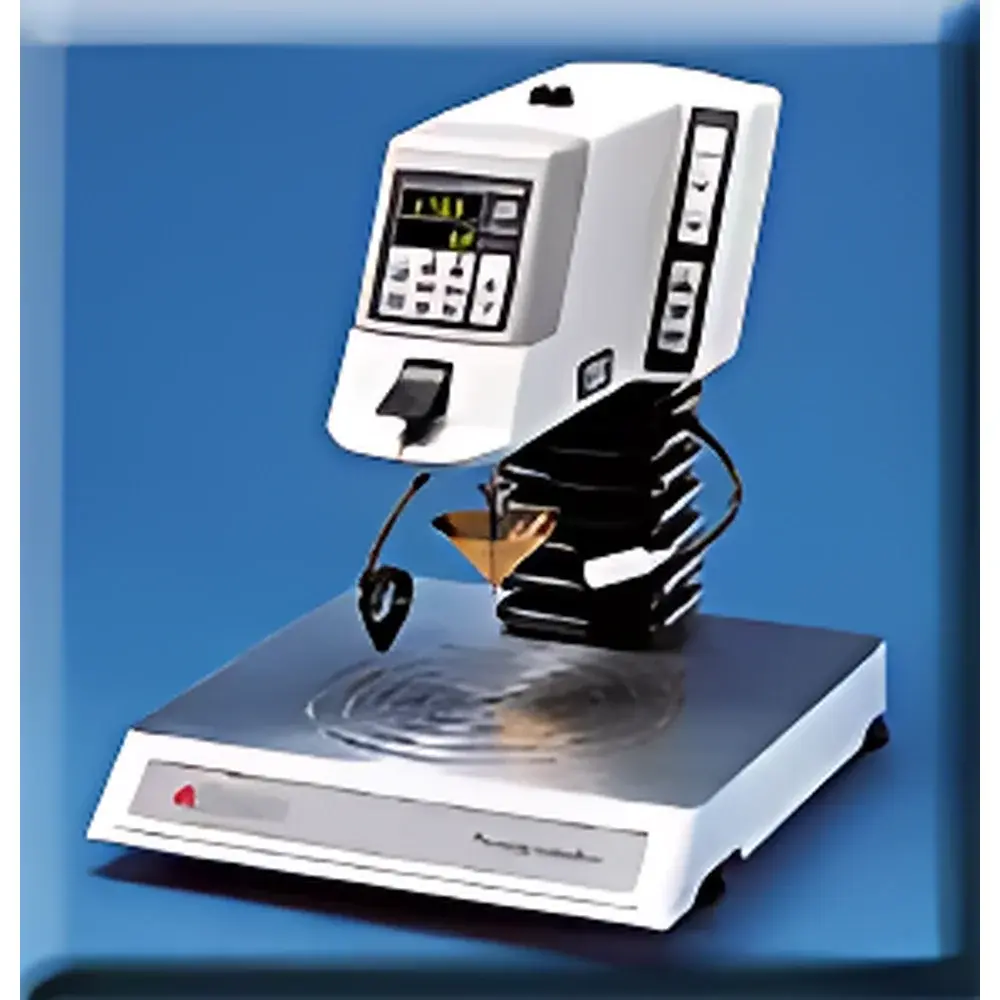
Koehler K95590 Automatic Cone Penetrometer
| Brand | Koehler |
|---|---|
| Origin | USA |
| Model | K95590 |
| Penetration Range | 0–62.0 mm (0–620 penetration units) |
| Resolution | 0.1 mm or 0.01 mm |
| Penetration Time | 0.1–9999.9 s (default: 5.0 s) |
| Dimensions | 31.7 × 35.6 × 45.7 cm |
| Weight | 9.5 kg |
| Power Supply | 220–240 V, 50/60 Hz |
| Compliance | ASTM D5, D217, D937, D1321, D1403, D2884, D4950 |
Overview
The Koehler K95590 Automatic Cone Penetrometer is a microprocessor-controlled, fully automated instrument engineered for precise and repeatable determination of consistency in semi-solid petroleum products—including greases, waxes, asphalt, pastes, ointments, and other viscoelastic materials. Based on the fundamental principle of cone penetration—where a standardized conical probe is allowed to descend into a sample under controlled load and time—the K95590 delivers quantitative depth-of-penetration measurements in accordance with internationally recognized test standards. Its design adheres strictly to the mechanical and procedural requirements of ASTM D217 (standard test method for penetration of lubricating grease), ASTM D2884 (yield stress calculation from penetration data), and ISO 2137 (petroleum products—determination of penetration). The instrument’s closed-loop control system ensures consistent probe deployment, dwell timing, and retraction—minimizing operator influence and maximizing inter-laboratory reproducibility.
Key Features
- Fully automated operation with four user-programmable presets for rapid method recall and standardized test execution.
- High-resolution digital display (LCD) showing real-time penetration depth, elapsed time, and status indicators—supporting both 0.1 mm and 0.01 mm resolution modes.
- Integrated RS232 serial interface for direct connection to printers or laboratory PCs; supports ASCII output and bidirectional communication for remote parameter configuration.
- Onboard data logging and post-test analysis: automatic calculation of mean penetration, standard deviation, repeatability per ASTM D217, and yield stress per ASTM D2884.
- Modular base platform accommodating ASTM D217 grease cups (140 mL), IP-standard containers, or custom vessels—enabling flexibility across sample forms and regulatory frameworks.
- Rechargeable battery option alongside AC power operation (220–240 V, 50/60 Hz), facilitating mobility within QC labs or field deployment at refinery sites.
- Self-diagnostic firmware with audible and visual alerts when measured penetration falls outside preconfigured acceptance limits—enhancing quality gatekeeping during routine QC workflows.
Sample Compatibility & Compliance
The K95590 is validated for use across a broad spectrum of petroleum-derived and pharmaceutical-grade semi-solids. It accommodates standard ASTM D217 grease cups, IP 50 cylindrical tins, ISO 2137 sample holders, and non-standard containers up to 100 mm in diameter. Calibration traceability follows NIST-traceable reference standards, and all firmware logic implements exact procedural sequences mandated by ASTM D1403 (penetration of grease after storage at elevated temperature), ASTM D937 (petroleum jelly), and ASTM D1321 (penetration of asphalt). Full compliance documentation—including calibration certificates, software validation reports, and audit trails—is maintained internally and exportable for GLP/GMP-regulated environments. The system satisfies FDA 21 CFR Part 11 requirements for electronic records when used with validated PC-based data acquisition software.
Software & Data Management
The embedded firmware operates independently of external computers but integrates seamlessly with Windows-based Koehler PenTest™ software (included on CD with USB-to-RS232 cable). The software provides guided workflow navigation, method selection by standard (e.g., “ASTM D217 – Standard Penetration”), auto-population of default parameters, and real-time graphing of penetration vs. time. All raw sensor data—including motor encoder counts, thermal drift compensation values, and timestamped actuation events—are logged with metadata (operator ID, sample ID, ambient temperature, humidity). Reports are exportable in CSV, PDF, and XML formats, conforming to ISO/IEC 17025 documentation requirements. No additional hardware is required for basic operation; optional wireless modules (IEEE 802.11n) support secure LAN integration in modern LIMS environments.
Applications
- Quality control of lithium-complex, calcium-sulfonate, and polyurea greases during manufacturing and incoming inspection.
- Consistency verification of oxidized and polymer-modified asphalts prior to paving operations.
- Stability assessment of petroleum jellies and topical ointments under accelerated aging protocols (ASTM D937 + D1321).
- Yield stress profiling of drilling muds and fracturing fluids using ASTM D2884 correlation models.
- Inter-laboratory round-robin testing programs requiring strict adherence to IP 49/50 and ISO 2137 reporting conventions.
- Research applications involving temperature-dependent penetration kinetics (when paired with Koehler temperature-controlled sample chambers).
FAQ
What standards does the K95590 support out-of-the-box?
ASTM D5, D217, D937, D1321, D1403, D2884, D4950; IP 49, 50, 179, 310; ISO 2137; DIN 51579, 51580, 51804; FTM 791-311/312/313; AOCS Cc 16-60; AACC 58-14; NFT 60-119/123/132/66-004.
Can the instrument operate without a connected computer?
Yes—the K95590 functions autonomously with full local display, data storage, and pass/fail evaluation. PC connectivity is optional for advanced reporting and long-term archiving.
Is calibration verification performed automatically?
The system includes built-in mechanical zero-check routines and prompts for periodic verification using NIST-traceable depth gauges; calibration history is stored and exportable.
How is temperature variation accounted for during testing?
While the base unit does not include active temperature control, it supports integration with Koehler’s K97500 series thermostatic baths via TTL-triggered synchronization, ensuring compliant conditioning per ASTM D217 Section 7.3.
What is the maximum sample height the instrument can accommodate?
The adjustable vertical travel allows measurement of samples up to 65 mm deep in standard ASTM D217 cups; extended-depth accessories are available for non-standard geometries.




