
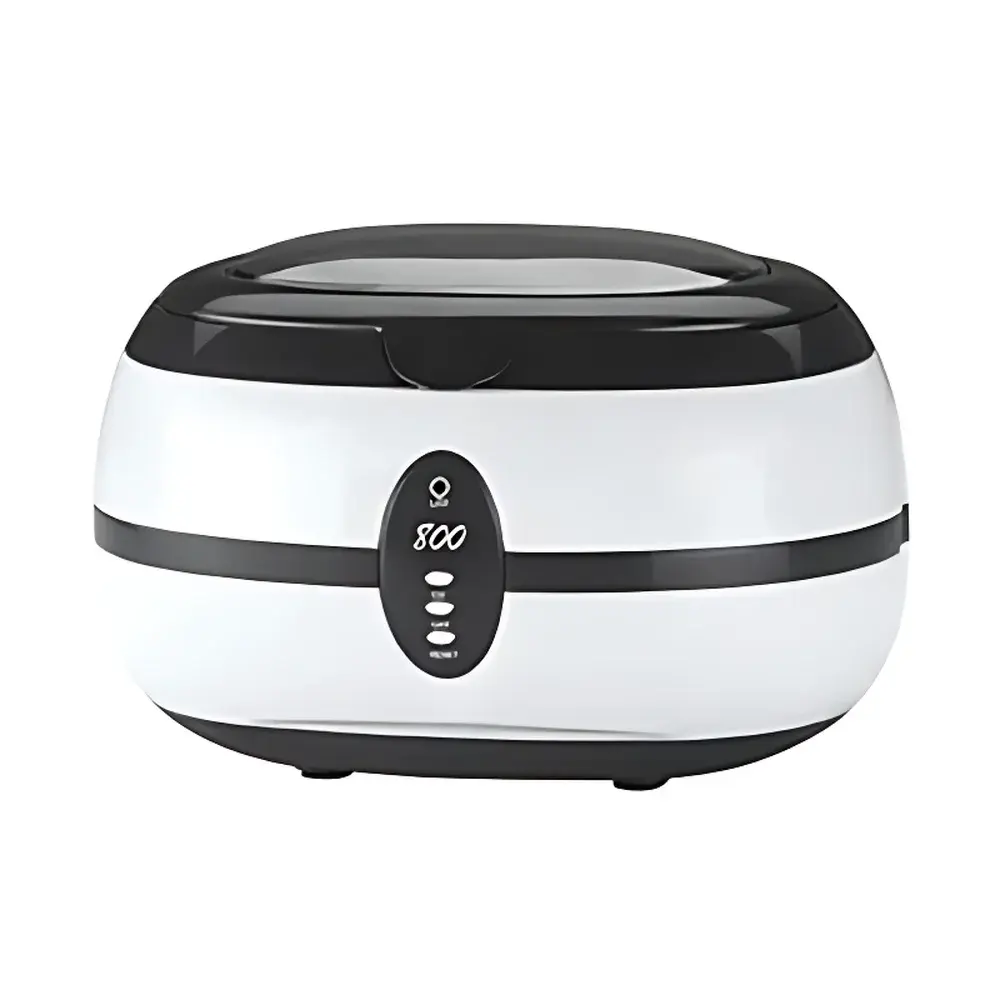
KoJin VGT-800 Ultrasonic Cleaner
| Brand | KoJin |
|---|---|
| Model | VGT-800 |
| Tank Capacity | 600 mL |
| Power Input | AC 220–240 V, 50/60 Hz |
| Operating Frequency | 42 kHz |
| Rated Power | 35 W |
| Dimensions (L×W×H) | 20 × 14 × 12.5 cm |
| Net Weight | 0.89 kg |
| Certification | CE, FCC |
| Timer | Fixed 180 s with reset function |
| Lid | Hinged transparent cover |
Overview
The KoJin VGT-800 Ultrasonic Cleaner is a compact, benchtop ultrasonic cleaning system engineered for precision cleaning and surface decontamination of delicate and geometrically complex objects in laboratory, workshop, and light industrial environments. It operates on the principle of high-frequency acoustic cavitation—generating controlled micro-bubbles in a liquid medium (e.g., water, aqueous detergents, or low-viscosity solvents such as isopropyl alcohol or petroleum ether) that collapse near solid surfaces, producing localized high-pressure shockwaves and microstreaming. This physical mechanism effectively dislodges particulate contaminants—including dust, polishing residues, oils, biofilms, and organic debris—without mechanical abrasion or manual scrubbing. Designed for reproducible, non-destructive cleaning, the VGT-800 delivers consistent energy distribution across its stainless steel tank, making it suitable for routine maintenance of optical components, small instrumentation parts, jewelry, dental appliances, and analytical labware.
Key Features
- Hinged transparent acrylic lid for real-time process monitoring and operator safety—prevents aerosol dispersion while enabling visual verification of cleaning activity.
- Fixed-duration ultrasonic cycle (180 seconds) with immediate reset capability—ensures standardized treatment time across users and applications; eliminates variability from manual timer operation.
- Stainless steel ultrasonic tank (600 mL capacity) with corrosion-resistant construction, optimized for uniform transducer coupling and acoustic field homogeneity.
- 42 kHz piezoelectric transducer array delivering stable, low-noise cavitation output—ideal for fine-detail cleaning without risk of surface pitting or erosion on soft metals, glass, or polymers.
- Compact footprint (20 × 14 × 12.5 cm) and lightweight design (0.89 kg net) facilitate integration into fume hoods, glove boxes, or shared lab benches with limited space.
- Compliant with CE (EN 61000-6-3, EN 61000-6-1) and FCC Part 15 Subpart B electromagnetic compatibility standards—validated for safe co-location with sensitive electronic instrumentation.
Sample Compatibility & Compliance
The VGT-800 accommodates a broad range of sample types, including but not limited to: spectrophotometer cuvettes, pipette tips, watch movements, surgical forceps, gemstone settings, printed circuit board (PCB) assemblies, and reusable lab glassware (e.g., volumetric flasks, burettes). Its 42 kHz frequency provides an optimal balance between cleaning efficacy and substrate safety—sufficiently energetic to remove sub-micron particulates yet gentle enough for fragile optics or thin-walled ceramics. While not intended for sterilization per ISO 17664 or AAMI ST79, the device supports validated cleaning protocols aligned with ISO 15883-1 (washer-disinfectors) and ASTM F3127 (standard guide for ultrasonic cleaning validation). Users must select compatible cleaning solutions based on material compatibility charts and avoid halogenated solvents unless operated in ventilated enclosures per OSHA 1910.1200 (Hazard Communication Standard).
Software & Data Management
The VGT-800 is a standalone analog-controlled instrument with no embedded software, firmware, or digital interface. All operational parameters are fixed at manufacture: frequency (42 kHz), duration (180 s), and power (35 W). This architecture ensures deterministic behavior, eliminates firmware update dependencies, and supports long-term calibration stability—critical for GLP-compliant laboratories where procedural consistency and audit trail simplicity are prioritized over programmability. For traceable cleaning workflows, users may integrate external timers or log entries in electronic lab notebooks (ELNs) referencing batch numbers, solution lot IDs, and post-cleaning inspection results. No data export, remote control, or 21 CFR Part 11 compliance features are provided, aligning with its role as a basic utility device rather than a regulated processing unit.
Applications
- Quality Control Laboratories: Pre-analysis cleaning of sampling probes, syringe filters, and HPLC vial inserts to prevent cross-contamination and baseline drift.
- Dental & Orthodontic Practices: Removal of proteinaceous residue and cement remnants from retainers, impression trays, and orthodontic instruments prior to autoclaving.
- Jewelry & Precision Manufacturing: Debridement of polishing compound residues from intricate filigree, bezel settings, and micro-machined metal components.
- Academic Teaching Labs: Student-safe demonstration of cavitation physics, surface tension effects, and solvent–contaminant interaction principles.
- Maintenance of Optical Equipment: Gentle cleaning of microscope slides, grating mounts, and laser collimator lenses without scratching or coating damage.
FAQ
What cleaning solutions are compatible with the VGT-800?
Aqueous alkaline or neutral pH detergents, ethanol, isopropanol, and petroleum ether are commonly used. Avoid strong acids, chlorine-based solutions, or undiluted acetone unless verified for compatibility with stainless steel and transducer materials.
Can the VGT-800 be used for sterilization?
No. It performs cleaning and limited bioburden reduction via physical removal and mild disinfection—not microbial kill validation. Sterilization requires validated thermal, ethylene oxide, or hydrogen peroxide plasma processes per ISO 14937.
Is the 180-second cycle adjustable?
No. The timer is hardware-fixed and non-programmable. For variable-duration protocols, external timing devices or manual interruption (followed by restart) are required.
Does the unit include a degassing function?
No. Degassing must be performed manually by operating the unit empty for 30–60 seconds before loading samples—ensuring optimal cavitation onset.
What maintenance is required?
Regular tank rinsing after each use, periodic inspection of the transducer mounting surface for adhesive integrity, and replacement of cleaning solution per batch or contamination threshold—not per calendar schedule.



