
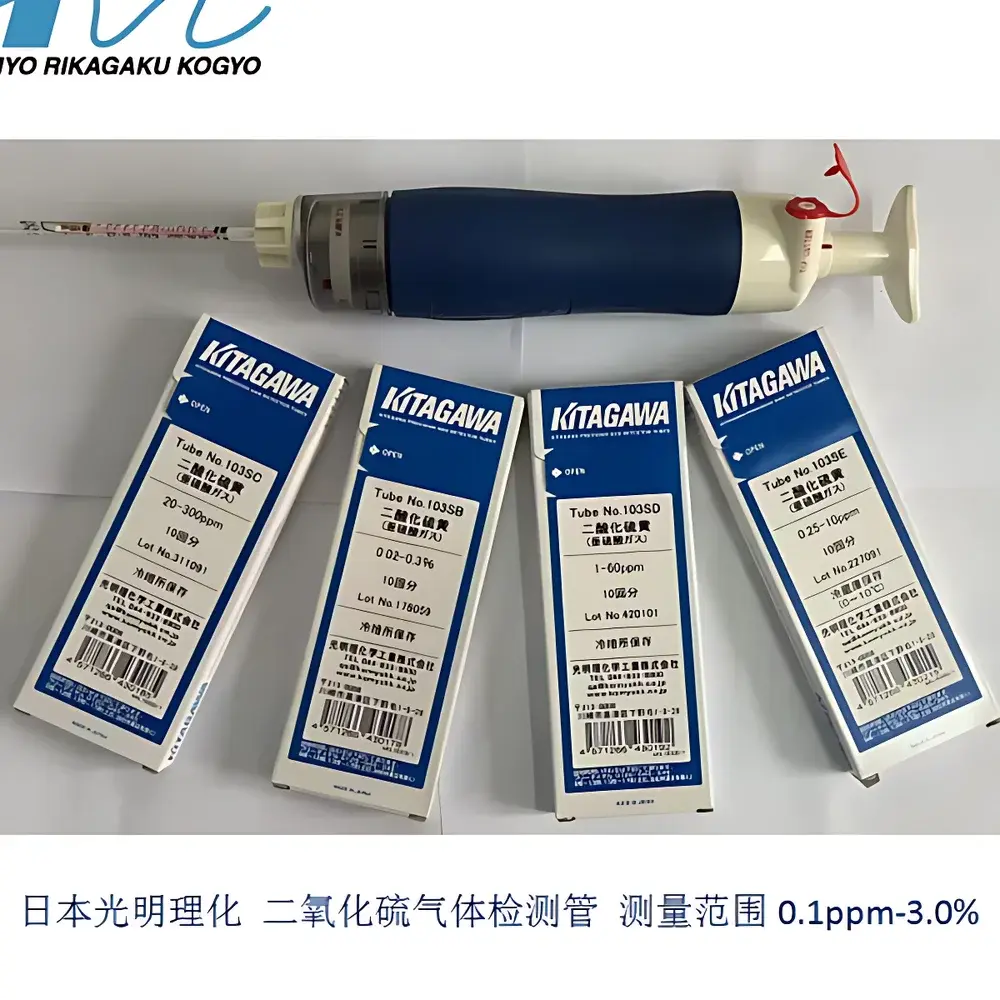
KOMYO RIKAGAKU 103SA High-Concentration Sulfur Dioxide (SO₂) Colorimetric Detection Tube
| Brand | KOMYO RIKAGAKU |
|---|---|
| Origin | Japan |
| Model | 103SA |
| Measurement Range | 0.1–3% SO₂ (2,857–85,710 mg/m³) |
| Compliance | JIS K 0321, ISO 8573-6 (for sampling system interface), GLP-aligned usage protocol |
Overview
The KOMYO RIKAGAKU 103SA is a calibrated, single-use colorimetric detection tube engineered for rapid, field-deployable quantification of high-concentration sulfur dioxide (SO₂) in industrial exhaust streams, combustion flue gases, and emergency response scenarios. Based on the established North-Kawakami (Kitagawa-type) diffusion-reaction principle, the tube contains a solid-phase reagent bed—typically iodate-starch or pararosaniline-based chemistry—designed to undergo stoichiometric oxidation-reduction or diazotization reactions upon exposure to SO₂. The resulting color front advances linearly along a calibrated glass capillary in proportion to gas concentration and standardized sampling volume (100 mL per stroke, using the AP-20 dual-stroke hand pump). This method delivers direct visual readout without electronics, power, or calibration gases—making it intrinsically suitable for Zone 1/2 hazardous areas and environments where real-time digital instrumentation is impractical or unavailable.
Key Features
- Validated measurement range of 0.1–3% v/v SO₂ (equivalent to 2,857–85,710 mg/m³ at 25°C and 1 atm), optimized for stack and duct monitoring where electrochemical sensors saturate or drift.
- Integrated humidity mitigation option: paired use with a dedicated pre-filter dehydration tube (sold separately) removes water vapor prior to SO₂ analysis—critical for accurate readings in wet flue gas (up to 90% RH) without chemical interference or false attenuation.
- Consistent batch calibration traceable to NMIJ (National Metrology Institute of Japan) reference standards; each production lot includes certificate of conformity with stated accuracy (±15% of full scale, per JIS K 0321 Annex B).
- Robust borosilicate glass construction with laser-etched graduation scale (0.1–3% in 0.1% increments), hermetically sealed with flame-fused end caps to ensure shelf life ≥24 months when stored at 5–30°C.
- Interchangeable platform compatibility: functions exclusively with the AP-20 manual piston pump (stroke volume: 100 ± 2 mL), enabling identical operational workflow across KOMYO’s 300+ gas-specific detection tubes.
Sample Compatibility & Compliance
The 103SA tube is validated for use with ambient air, diluted process gases, and non-corrosive flue streams containing particulates 100 ppm chlorine, hydrogen sulfide, or nitrogen oxides—compounds known to cross-react with the SO₂-specific reagent matrix. Regulatory alignment includes adherence to Japanese Industrial Standard JIS K 0321 (“Method for Determination of Gaseous Pollutants Using Indicator Tubes”), supporting data integrity requirements under ISO/IEC 17025-accredited laboratories when deployed as part of a documented sampling procedure. While not a replacement for CEMS-grade analyzers, its results are admissible for preliminary compliance screening, leak verification, and OSHA PEL/TWA spot checks when used per manufacturer-specified protocols.
Software & Data Management
As an analog, consumable-based measurement device, the 103SA requires no firmware, drivers, or software integration. All quantitative interpretation is performed visually against the printed scale, eliminating cybersecurity vulnerabilities, firmware obsolescence, or validation overhead associated with digital platforms. For regulated environments (e.g., EPA Method 30B support, ISO 14001 internal audits), users may document results manually in logbooks or integrate readings into LIMS via structured entry templates. Traceability is maintained through batch-number recording, AP-20 pump calibration logs (per ISO 5800), and retention of used tubes for up to 30 days post-analysis—satisfying basic GLP documentation expectations for field qualitative/semi-quantitative assessment.
Applications
- Emergency response triage of SO₂ releases from sulfuric acid plants, coal-fired boiler outages, or railcar incidents—providing actionable concentration data within 90 seconds.
- Pre-startup safety verification in confined-space entry (e.g., scrubber vessels, desulfurization ducts) where portable electrochemical sensors exhibit slow recovery or poisoning.
- Field validation of continuous emission monitoring systems (CEMS) during QA/QC audits—used as a reference method per EPA PS-1 guidance for relative accuracy testing.
- Educational laboratory instruction in environmental chemistry, emphasizing stoichiometric gas-solid reaction kinetics and gravimetric-to-volumetric unit conversion (mg/m³ ↔ %v/v).
- Resource-constrained municipal monitoring programs requiring low-cost, technician-operated tools compliant with national ambient air quality guidelines for short-term exposure limits.
FAQ
What is the shelf life of the 103SA tube, and how should it be stored?
Unopened tubes retain calibration for 24 months when stored in original packaging at 5–30°C, protected from direct sunlight and ambient ozone. Do not refrigerate.
Can the 103SA be used in high-temperature flue gas (>60°C)?
No. Sample gas must be cooled to ≤40°C prior to aspiration. Use a thermally insulated sampling probe with inline cooling coil or dilution air mixing to avoid reagent degradation.
Is the AP-20 pump included with the 103SA tube?
No. The AP-20 manual pump (Cat. No. AP-20) is sold separately and is required for all KOMYO detection tubes.
Does the 103SA meet FDA 21 CFR Part 11 requirements?
Not applicable—this is an analog, non-electronic measurement device with no electronic records or signatures. Its use falls outside the scope of Part 11 but remains compatible with paper-based GLP workflows.
How does humidity correction work with the optional pre-filter tube?
The dehydration tube (Model: DRY-103) contains calcium sulfate desiccant and is placed upstream of the 103SA. It reduces sample dew point to <5°C without absorbing SO₂, thereby preventing water-induced color diffusion artifacts and ensuring linearity across 10–90% RH.
Related Products







