
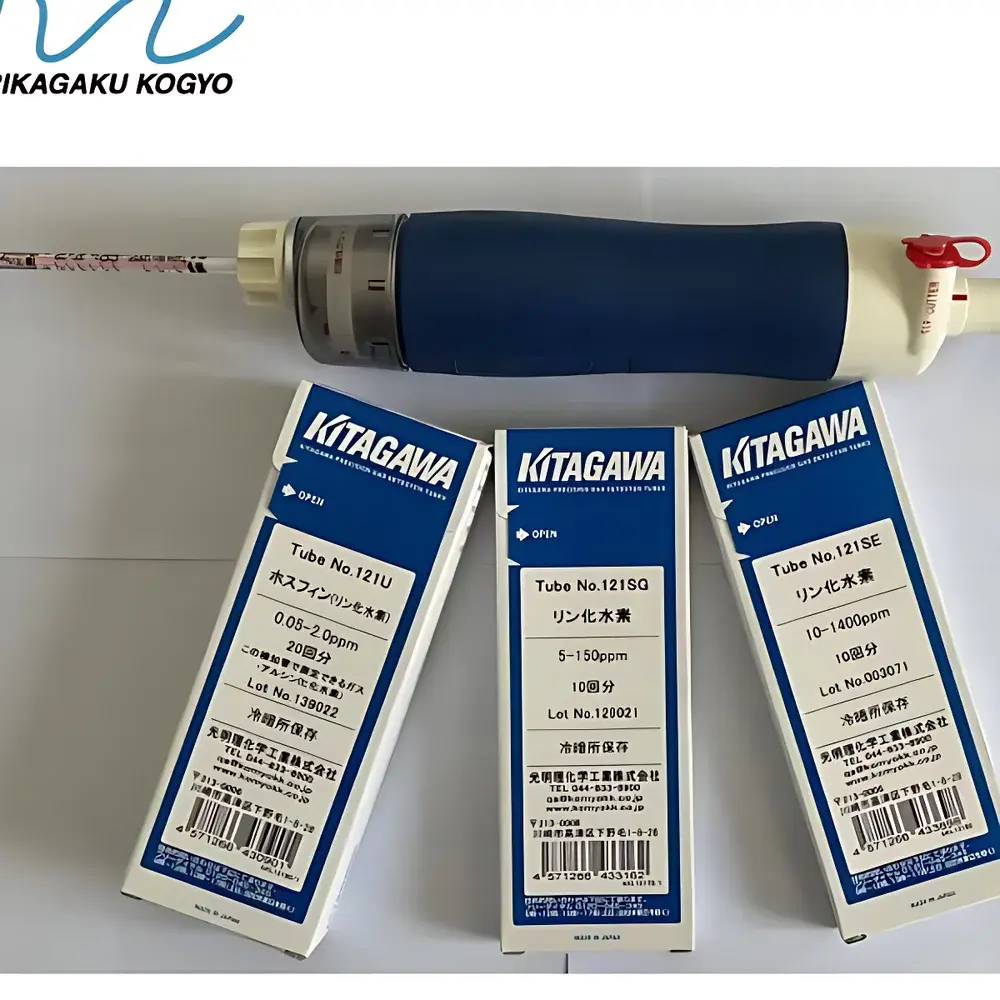
KOMYO RIKAGAKU Kitagawa Phosphine (PH₃) Gas Detection Tube
| Brand | KOMYO RIKAGAKU |
|---|---|
| Origin | Japan |
| Model Series | 121SA / 121SB / 121SC / 121SD / 121SG / 121SH / 121U |
| Detection Principle | Colorimetric Reaction with Pre-impregnated Reagent |
| Measurement Range | Varies by Model (e.g., 121SA: 0.5–10 ppm |
| 121SB | 2–40 ppm |
| 121SC | 5–100 ppm |
| 121SD | 10–200 ppm |
| 121SG | 20–500 ppm |
| 121SH | 50–1000 ppm |
| 121U | 100–2000 ppm) |
| Accuracy | ±25% of Full Scale |
| Response Time | 1–3 minutes per measurement |
| Tube Length | 100 mm |
| Internal Diameter | 4.0 mm |
| Required Sampling Device | AP-20 Hand Pump (100 mL stroke volume, calibrated for 100 mL draw) |
| Shelf Life | 24 months from manufacture date when stored at ≤30°C and <80% RH |
| Compliance | JIS K 0201, ISO 8573-6 (for compressed air testing applications), CE-marked per Directive 2014/30/EU (EMC) and 2014/35/EU (LVD) |
Overview
The KOMYO RIKAGAKU Kitagawa Phosphine (PH₃) Gas Detection Tube is a precision-engineered colorimetric indicator tube designed for rapid, on-site quantification of phosphine gas concentrations in ambient air, industrial exhaust streams, fumigation enclosures, grain storage facilities, and confined workspaces. Based on the internationally recognized Kitagawa (North River) detection principle—first developed by Dr. Kitagawa in 1947—the tube employs a fixed-length glass column pre-filled with chemically impregnated silica gel or alumina granules. Upon manual aspiration using the standardized AP-20 dual-stroke hand pump (100 mL per stroke), phosphine gas reacts stoichiometrically with lead acetate or copper(II) chloride reagents, producing a sharp, irreversible color front that advances linearly along the tube’s calibrated scale. The endpoint position directly correlates to the time-weighted average concentration (ppm·min), enabling immediate visual interpretation without external instrumentation.
Key Features
- Multi-range model selection (121SA through 121U) covering 0.5 ppm to 2000 ppm full-scale detection—ensuring optimal sensitivity and dynamic range alignment across diverse exposure scenarios.
- Pre-calibrated, factory-sealed tubes with lot-specific traceable certification; each batch undergoes rigorous inter-laboratory validation against NIST-traceable phosphine standards.
- Robust borosilicate glass construction (100 mm × 4.0 mm ID) resistant to thermal shock and mechanical stress during field deployment.
- Integrated humidity compensation layer in select models (e.g., 121SG, 121SH) mitigates interference from ambient RH up to 90%, maintaining accuracy under variable environmental conditions.
- Compatible exclusively with the AP-20 hand pump—designed with positive displacement mechanics, tactile stroke feedback, and integrated flow calibration marks to ensure consistent 100 mL draw volume per activation.
- No power, batteries, or software required—enabling operation in intrinsically safe zones, explosion-hazard areas (ATEX Zone 2/22 compliant when used with non-sparking pump housing), and remote field locations.
Sample Compatibility & Compliance
These detection tubes are validated for use in clean, dry air matrices and low-particulate industrial atmospheres. Cross-sensitivity testing confirms minimal interference from common co-existing gases including H₂S (<5% signal deviation at 50 ppm), NH₃ (<3%), CO₂ (up to 5%), and SO₂ (90% RH) or aerosol-laden environments without inline desiccant filtration. Complies with Japanese Industrial Standard JIS K 0201 “Method for Determination of Gaseous Pollutants by Indicator Tube Method”, aligns with ISO 8573-6 for compressed air purity verification where phosphine is a critical contaminant, and meets EMC/LVD safety directives for portable measuring instruments in the EU market. Documentation supports GLP-compliant recordkeeping when paired with AP-20 pump log sheets and tube lot traceability reports.
Software & Data Management
As a passive, analog measurement system, the Kitagawa phosphine detection tube requires no firmware, drivers, or proprietary software. Quantitative results are recorded manually in field notebooks or digital logs (e.g., Excel, LIMS, or EHS platforms) using standardized templates provided in KOMYO’s Technical Manual No. TM-121-EN. Each tube bears a unique lot number and expiration date laser-etched on the glass stem, enabling full audit trail reconstruction per ISO/IEC 17025 clause 7.7. Optional QR-coded lot labels (available upon request) link to downloadable PDF certificates of analysis, stability data, and interference test summaries—facilitating FDA 21 CFR Part 11–aligned electronic record retention when scanned and archived.
Applications
- Emergency response verification of phosphine leakage following fumigation operations in grain silos, shipping containers, and pest control facilities.
- Occupational hygiene monitoring for workers handling aluminum phosphide or zinc phosphide rodenticides.
- Leak detection during PH₃-based semiconductor wafer etching or thin-film deposition process maintenance.
- Post-fumigation clearance testing in pharmaceutical cold storage and archival document repositories.
- Educational laboratory demonstrations of stoichiometric gas–solid reaction kinetics and diffusion-controlled color front propagation.
- Regulatory compliance checks under OSHA 29 CFR 1910.1000 (PEL: 0.3 ppm TWA) and ACGIH TLV® (0.3 ppm STEL).
FAQ
What is the shelf life of unopened Kitagawa phosphine detection tubes?
Unopened tubes retain stated accuracy for 24 months from the date of manufacture when stored at ≤30°C and relative humidity below 80%. Lot-specific expiration dates are printed on each tube and accompanying packaging.
Can I reuse a detection tube after initial sampling?
No. Each tube is a single-use, irreversible chemical sensor. The color reaction is permanent and non-regenerable; reuse will yield inaccurate or non-reproducible readings.
Is the AP-20 pump mandatory—or can I use alternative pumps?
Yes. Only the AP-20 pump delivers the precise 100 mL ±2% draw volume and controlled aspiration rate (100 mL in 100 ±10 seconds) required for NIST-traceable calibration. Substitution invalidates certified accuracy.
How do temperature and pressure affect measurement accuracy?
Calibrations are performed at 25°C and 101.3 kPa. Deviations beyond 15–35°C or ±10 kPa require correction using the temperature/pressure adjustment factors published in KOMYO Application Note AN-121-T.
Are these tubes suitable for continuous monitoring?
No. They are intended for discrete, grab-sample measurements. For real-time phosphine monitoring, consider electrochemical or PID-based fixed gas detectors with data logging capability.







