
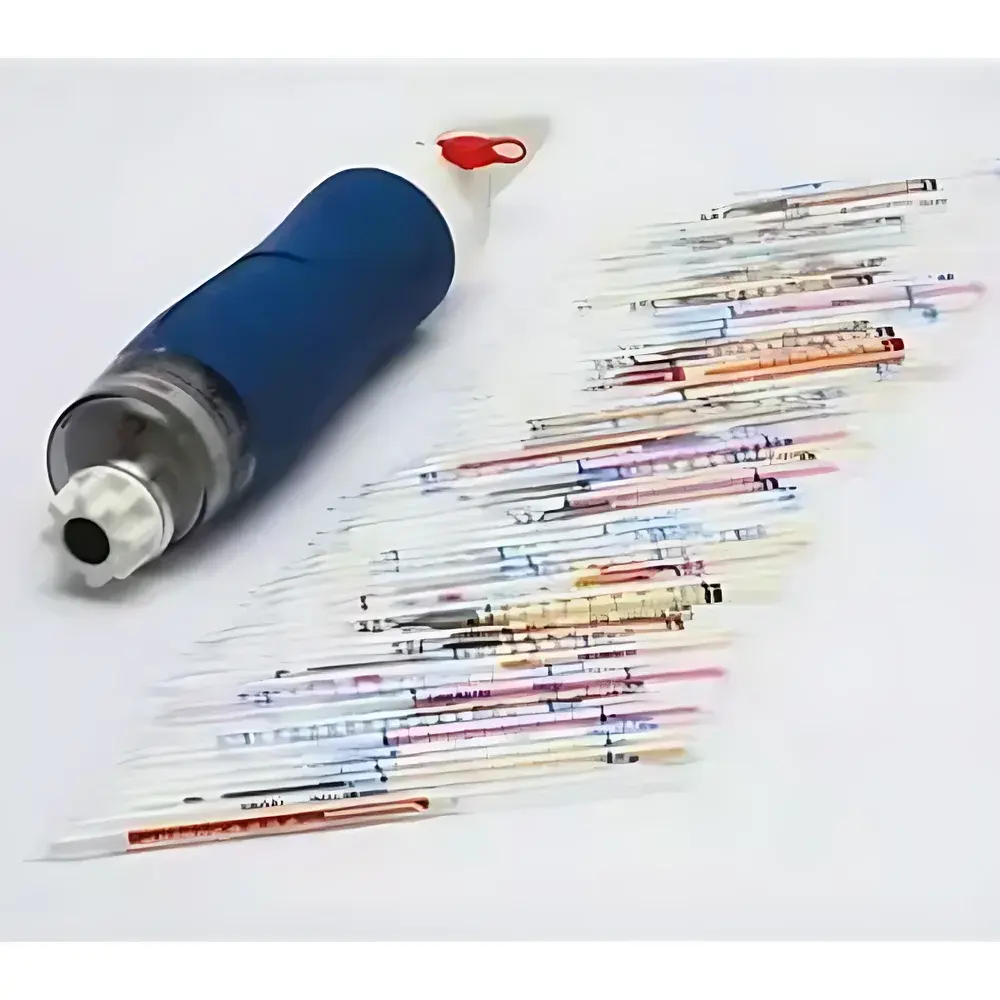
KOMYO RIKAGAKU Kitagawa-style Carbon Tetrachloride Gas Detection Tube
| Brand | KOMYO RIKAGAKU |
|---|---|
| Origin | Japan |
| Model | 147S |
| Detection Principle | Colorimetric Reaction with Pre-calibrated Scale |
| Compatible Pump | AP-20 Hand Pump |
| Target Gas | Carbon Tetrachloride (CCl₄) |
| Measurement Range | Refer to Tube-Specific Calibration Chart (Typical Range: 0.5–50 ppm for CCl₄) |
| Accuracy | ±25% of Full Scale (per JIS K 0803 and ISO 8573-5 guidelines) |
| Shelf Life | 24 months from manufacture date when stored at ≤30°C, dry, and protected from light |
| Compliance | Meets Japanese Industrial Standard JIS K 0803 for Colorimetric Gas Detection Tubes |
Overview
The KOMYO RIKAGAKU Kitagawa-style Carbon Tetrachloride Gas Detection Tube (Model 147S) is a pre-calibrated, single-use colorimetric indicator tube engineered for rapid, on-site quantification of carbon tetrachloride (CCl₄) vapor in ambient air or workplace environments. Developed under the legacy of Dr. Kitagawa’s foundational work in gas detection methodology since 1947, this tube employs a solid-phase reagent bed impregnated with chemically selective agents that undergo stoichiometric oxidation-reduction or acid-base reactions upon exposure to CCl₄. The resulting color front advances linearly along a calibrated glass capillary, enabling direct visual readout of concentration in parts per million (ppm) without electronic instrumentation. Designed for use exclusively with the standardized AP-20 double-stroke hand pump (sold separately), the system delivers field-deployable measurement within 10 seconds post-sampling—making it suitable for emergency response, industrial hygiene surveys, leak detection, and confined-space entry verification.
Key Features
- Kitagawa-style architecture: Precision-drawn borosilicate glass tube with internal diameter tolerance ≤±0.05 mm, ensuring consistent flow resistance and reproducible color front migration.
- Gas-specific chemistry: Reagent formulation optimized for selectivity against common interferents including chloroform, trichloroethylene, and dichloromethane—validated per JIS K 0803 Annex B interference testing protocols.
- Pre-calibrated linear scale: Printed directly onto the tube exterior using UV-stable ceramic ink; scale resolution supports estimation to ±0.2 ppm within its designated range.
- Integrated desiccant barrier: Prevents moisture-induced false positives during storage and sampling in high-humidity environments (>90% RH).
- Traceable batch certification: Each production lot undergoes gravimetric calibration against NIST-traceable CCl₄ permeation tubes and includes a certificate of analysis with expiration date, lot number, and calibration curve data.
Sample Compatibility & Compliance
The 147S tube is validated for use with ambient air, compressed air, and nitrogen-purged atmospheres. It is not intended for use in oxygen-deficient (10%), or highly particulate-laden environments without upstream filtration (e.g., PTFE membrane filter, 0.3 µm pore size). All KOMYO RIKAGAKU detection tubes comply with Japanese Industrial Standard JIS K 0803 “Colorimetric Gas Detection Tubes” and align with ISO 8573-5 for purity class assessment in compressed air systems. While not FDA-cleared medical devices, their application in occupational exposure monitoring adheres to OSHA Method ID-151 and NIOSH Manual of Analytical Methods (NMAM) Chapter 6000 guidance for qualitative/semi-quantitative screening.
Software & Data Management
As an analog, non-digital measurement tool, the 147S tube does not interface with software or generate electronic data streams. However, quantitative results are fully compatible with laboratory information management systems (LIMS) and electronic recordkeeping platforms when documented via standardized field forms (e.g., OSHA Form 90A) or digital capture tools such as tablet-based inspection apps. For GLP/GMP-regulated settings, users may implement audit-trail procedures—including photographing the developed tube alongside timestamped GPS metadata and annotating observer initials, pump stroke count, and environmental conditions (temperature, barometric pressure)—to satisfy traceability requirements under 21 CFR Part 11 when paired with appropriate validation documentation.
Applications
- Routine industrial hygiene monitoring of CCl₄ exposure in chemical manufacturing, solvent recycling, and metal degreasing facilities.
- Emergency response triage during accidental releases or transportation incidents involving halogenated solvents.
- Verification of abatement system performance prior to worker re-entry into maintenance zones.
- Baseline screening during indoor air quality (IAQ) assessments where historical use of CCl₄-containing cleaning agents is suspected.
- Educational demonstrations of stoichiometric gas-phase reaction kinetics and diffusion-controlled color development phenomena.
FAQ
What is the shelf life of the 147S tube, and how should it be stored?
Unopened tubes retain calibration accuracy for 24 months from the date of manufacture when stored at ≤30°C, in low-humidity conditions (<60% RH), and shielded from direct sunlight or UV sources. Refrigeration is not recommended due to condensation risk.
Can the 147S tube be reused after sampling?
No. Each tube is designed for single-use only. Reuse compromises reagent integrity, introduces carryover contamination, and invalidates calibration traceability.
Is the AP-20 pump required, or can other pumps be substituted?
Only the AP-20 pump (or its certified equivalents meeting JIS K 0803 Section 5.2 volumetric tolerance: ±5% per stroke) ensures accurate draw volume (typically 100 mL per double stroke). Substitution with uncalibrated pumps voids measurement validity.
Does this tube meet regulatory requirements for compliance reporting?
It serves as a screening-level tool per OSHA and ACGIH guidelines. For definitive compliance determination (e.g., TWA or STEL verification), confirmatory analysis by GC-FID or GC-MS per EPA Method TO-17 or NIOSH Method 1003 is required.
How is measurement uncertainty characterized for this tube?
Per JIS K 0803, total expanded uncertainty (k=2) is ±25% of full-scale value under controlled laboratory conditions; field uncertainty increases to ±40% due to temperature, humidity, and operator technique variables.







