
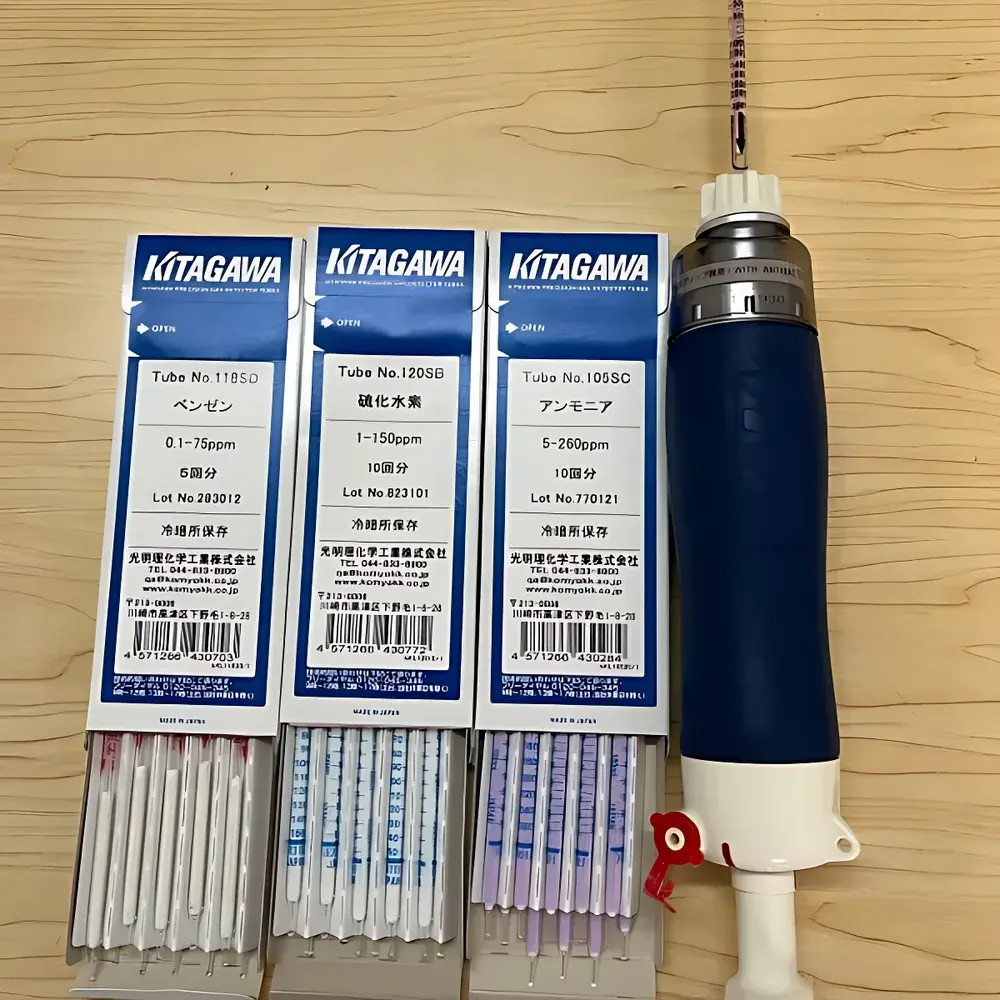
KOMYO RIKAGAKU North川-Style Acetaldehyde Gas Detection Tube
| Brand | KOMYO RIKAGAKU |
|---|---|
| Origin | Japan |
| Model | 133A / 133SB / 133SC |
| Detection Ranges | 1–30 ppm, 5–140 ppm, 40–10,000 ppm |
| Principle | Colorimetric Reaction with Pre-impregnated Reagent |
| Compatible Pump | AP-20 Hand Pump (sold separately) |
| Compliance | JIS K 0804, ISO 8573-6 (gas purity testing reference), GLP-aligned documentation support |
Overview
The KOMYO RIKAGAKU North川-Style Acetaldehyde Gas Detection Tube is a precision-engineered colorimetric sampling device designed for rapid, on-site quantification of acetaldehyde (CH₃CHO) in ambient air, workplace atmospheres, and emergency response environments. Developed under the legacy of Dr. Kitagawa’s foundational work—later refined by North川 (Kitagawa-style) methodology—the tube operates on stoichiometric reaction kinetics: acetaldehyde diffuses through a calibrated glass tube containing a solid-phase reagent (typically acidified chromotropic acid or analogous diazonium-based compounds), inducing a localized, irreversible color front progression proportional to gas concentration. The resulting chromatic band length is read directly against a pre-calibrated scale printed on the tube envelope, enabling quantitative analysis without electronic instrumentation. This principle conforms to fundamental gas-sampling standards including JIS K 0804 (Japanese Industrial Standard for gas detection tubes) and aligns with ISO 8573-6 methodologies for qualitative/semi-quantitative contaminant screening in compressed air systems.
Key Features
- Three-tiered range selection: Model 133A (1–30 ppm), 133SB (5–140 ppm), and 133SC (40–10,000 ppm) enable precise span matching for varying exposure scenarios—from low-level indoor air quality assessment to high-concentration industrial leak verification.
- Manufactured in Japan under strict batch-controlled conditions by KOMYO RIKAGAKU, a dedicated detection tube specialist since 1947; each tube carries lot-specific calibration certificates traceable to NMIJ (National Metrology Institute of Japan).
- Optimized reaction kinetics ensure <5% inter-batch coefficient of variation (CV) at mid-range concentrations, supporting reproducible field measurements compliant with OEL (Occupational Exposure Limit) verification protocols.
- Compatible exclusively with the AP-20 dual-stroke hand pump (not included), delivering consistent 100 mL draw volume per stroke with ±2% volumetric accuracy—critical for adherence to ISO 8573-6 sampling volume requirements.
- Stable shelf life of 24 months when stored at 15–25°C in original foil packaging; no refrigeration required, facilitating long-term deployment in mobile labs and emergency kits.
Sample Compatibility & Compliance
The detection tube is validated for use in dry, non-condensing air matrices at temperatures between 10–40°C and relative humidity ≤85% RH. Cross-sensitivity is minimized through selective reagent formulation: negligible interference observed from formaldehyde (<5% signal contribution at equimolar concentrations), ethanol (<2%), and acetone (<1%). Not recommended for use in high-H₂S or chlorine-rich environments without prior validation. Each production lot undergoes third-party verification per JIS K 0804 Annex B (accuracy and repeatability testing), and full technical documentation supports GLP-compliant recordkeeping—including lot numbers, expiration dates, and certified calibration curves. While not an electronic instrument, its use in occupational hygiene programs aligns with OSHA 29 CFR 1910.120 and EU Directive 2004/37/EC (CARC) exposure monitoring frameworks.
Software & Data Management
As a passive, analog measurement system, the North川-style detection tube does not interface with digital software or data acquisition platforms. However, KOMYO RIKAGAKU provides downloadable PDF-based calibration reports and lot-specific uncertainty statements (k=2) for integration into LIMS or electronic lab notebooks. Users may log readings manually using standardized templates compliant with ISO/IEC 17025 clause 7.5.2 (recording of raw data), and all tubes include scannable QR codes linking to archived metrological documentation. For regulated environments requiring audit trails, the AP-20 pump can be paired with mechanical stroke counters (e.g., AP-20-COUNT) to document sampling frequency and volume consistency.
Applications
- Workplace exposure assessment in food processing facilities (e.g., vinegar production, fruit ripening chambers), pharmaceutical synthesis lines, and resin manufacturing where acetaldehyde is a known intermediate or byproduct.
- Rapid leak detection during transportation or storage of acetaldehyde-containing solvents, monomers, or flavoring agents—particularly in confined spaces or vehicle cargo areas.
- Indoor air quality surveys following fire incidents (acetaldehyde is a major pyrolysis product of polyvinyl acetate and cellulose derivatives).
- Educational laboratory demonstrations of gas-phase stoichiometry and diffusion-limited reaction fronts in analytical chemistry curricula.
- First-responder triage during chemical spills or industrial accidents where immediate hazard classification (per GHS Category 2 acute toxicity) informs evacuation radius decisions.
FAQ
What is the shelf life of the detection tube, and how should it be stored?
Unopened tubes retain stated performance for 24 months from manufacture date when stored at 15–25°C in original aluminum pouches, away from direct sunlight and oxidizing vapors.
Can the same AP-20 pump be used for all KOMYO detection tubes?
Yes—the AP-20 is the universal pump platform for KOMYO’s full portfolio of >300 gas-specific tubes, provided the specified stroke count and draw volume are followed per tube instruction sheet.
Is this tube suitable for continuous monitoring?
No—it is a single-use, grab-sampling device intended for discrete point measurements; continuous monitoring requires electrochemical or PID-based fixed systems.
Does the tube require external power or calibration gases?
No—operation is fully manual and self-calibrating via printed scale; no field calibration or zero-gas adjustment is necessary.
How are measurement uncertainties reported for regulatory submissions?
KOMYO issues ISO/IEC 17025-aligned uncertainty budgets (k=2) with each lot, covering reagent homogeneity, volumetric draw error, observer endpoint variability, and temperature-dependent reaction rate deviation.
Related Products







