
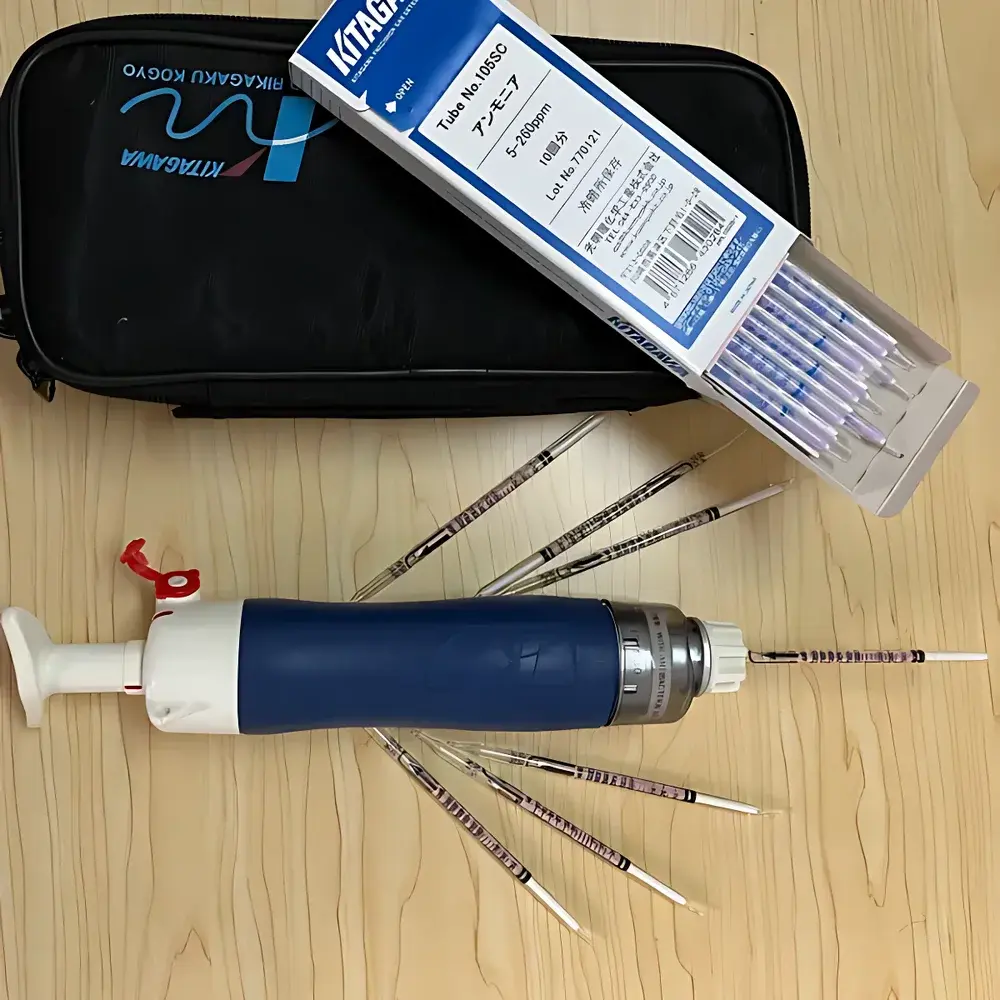
KOMYO RIKAGAKU North川-Type Hydrogen Gas Detection Tube Model 137U
| Brand | KOMYO RIKAGAKU |
|---|---|
| Origin | Japan |
| Model | 137U |
| Detection Range | 0.05–0.8% H₂ (v/v) |
| Principle | Colorimetric Reaction with Pre-impregnated Reagent |
| Calibration | Linear Graduated Scale |
| Pump Required | AP-20 Manual Aspirator (sold separately) |
| Compliance | JIS K 0321, ISO 8573-6 (gas purity testing reference), GLP-compatible usage |
Overview
The KOMYO RIKAGAKU North川-Type Hydrogen Gas Detection Tube Model 137U is a chemically calibrated, single-use colorimetric gas sampling device engineered for rapid, field-deployable quantification of hydrogen (H₂) in ambient air or confined-space atmospheres. Operating on the well-established North川 principle—first developed by Dr. Kitagawa in post-war Japan—the tube utilizes a fixed-length glass ampoule pre-filled with a solid-phase reagent (typically palladium chloride or copper oxide-based indicator chemistry) that undergoes stoichiometric oxidation upon exposure to H₂. This reaction generates a discrete, visually discernible color front that advances linearly along the tube’s calibrated scale in proportion to the integrated concentration × time (C×t) exposure during manual aspiration. The resulting endpoint position corresponds directly to the average H₂ concentration over the sampling interval (typically 100 mL at 100 mL/min, per JIS K 0321 standard protocol), delivering trace-level quantitative results without electrical components, ignition sources, or calibration gases. Its intrinsic safety profile makes it uniquely suitable for use in Class I, Division 1 hazardous locations where electronic sensors pose explosion risks.
Key Features
- Explosion-proof operation: Zero power requirement, no batteries, no electronics, no spark risk—certified for use in flammable H₂ environments per IEC 60079-0 general requirements for explosive atmospheres.
- Precision-engineered linear scale: High-contrast color development enables ±10% full-scale reading accuracy under controlled sampling conditions (23°C ±2°C, 50% RH ±10%).
- Rapid analysis cycle: Complete measurement in ≤90 seconds—including pump actuation, color development stabilization, and visual interpretation.
- Integrated compatibility: Designed exclusively for use with the KOMYO AP-20 dual-stroke manual aspirator (100 mL/stroke, ±3% volume tolerance), ensuring repeatable draw volume and minimizing operator-induced variability.
- Stable shelf life: Individually sealed in aluminum-laminated pouches; retains calibration integrity for ≥24 months when stored at 5–30°C away from direct sunlight and oxidizing vapors.
- Trace-level sensitivity: Lower detection limit of 0.05% v/v H₂ (500 ppm) supports early leak identification in PEM electrolyzer enclosures, fuel cell test benches, and semiconductor process gas lines.
Sample Compatibility & Compliance
The Model 137U is validated for direct sampling of dry, non-condensing air matrices containing hydrogen within the specified 0.05–0.8% range. It is not intended for use in high-humidity (>80% RH), high-CO₂ (>5%), or strongly acidic/alkaline gas streams, as these may interfere with reagent stability or color development kinetics. Each production lot undergoes batch certification against NIST-traceable H₂ standards and is supplied with a Certificate of Conformance referencing JIS K 0321:2019 (“Method for determination of gas concentrations using detector tubes”) and aligned with ISO 8573-6 Annex B for compressed gas purity verification workflows. While not an electronic instrument, its documented use—including aspiration volume, ambient temperature, and observer ID—is fully compatible with GLP and internal audit requirements when recorded in laboratory notebooks or LIMS-integrated digital logs.
Software & Data Management
As a passive, analog measurement system, the 137U requires no firmware, drivers, or proprietary software. However, its results integrate seamlessly into modern QA/QC workflows: digital photography of the color endpoint (with integrated scale reference) enables timestamped archiving in ELN platforms; AP-20 pump stroke counters support automated data entry via barcode-scanned tube lot numbers; and KOMYO’s free web-based Tube Selection Guide (accessible globally without registration) provides cross-referenced interference tables, shelf-life tracking, and JIS/ISO compliance documentation. For regulated environments operating under FDA 21 CFR Part 11, manual entries must include operator signature, date/time stamp, and environmental notes—practices routinely implemented in hydrogen safety programs across automotive battery manufacturing and green hydrogen infrastructure projects.
Applications
- Pre-startup leak verification in hydrogen refueling stations (HRS) and pipeline interconnection points.
- Routine monitoring of glovebox and inert-atmosphere chamber integrity in R&D laboratories handling metal hydrides or catalysts.
- Emergency response triage during H₂ transport incidents—used by Japanese Fire and Disaster Management Agency (FDMA) certified teams since 1998.
- Validation of catalytic recombiners and H₂ purge efficiency in nuclear power plant auxiliary systems.
- Educational demonstrations of stoichiometric gas reactions and industrial hygiene principles in university chemical engineering labs.
FAQ
Can the 137U be reused after one measurement?
No. Each tube is a single-use, factory-calibrated consumable. Reuse invalidates concentration linearity and introduces cross-contamination risk.
Is temperature correction required during field use?
Yes. Readings must be adjusted using the correction factor chart provided in the tube’s instruction leaflet when ambient temperature falls outside 20–25°C.
Does humidity affect accuracy?
Relative humidity above 75% may slow color front progression; samples should be dried inline using KOMYO’s optional silica-gel moisture trap (Model DRY-1) for critical applications.
How is traceability maintained across batches?
Each tube bears a unique lot number linked to a QC report detailing calibration gas source (NIST SRM 2620a), gravimetric preparation method, and shelf-life validation data.
What personal protective equipment (PPE) is recommended?
Standard lab PPE (nitrile gloves, safety goggles) is sufficient; no respiratory protection is needed unless ambient H₂ exceeds 1.0%—at which point evacuation and ventilation are mandatory per OSHA 1910.103(b)(3).







