
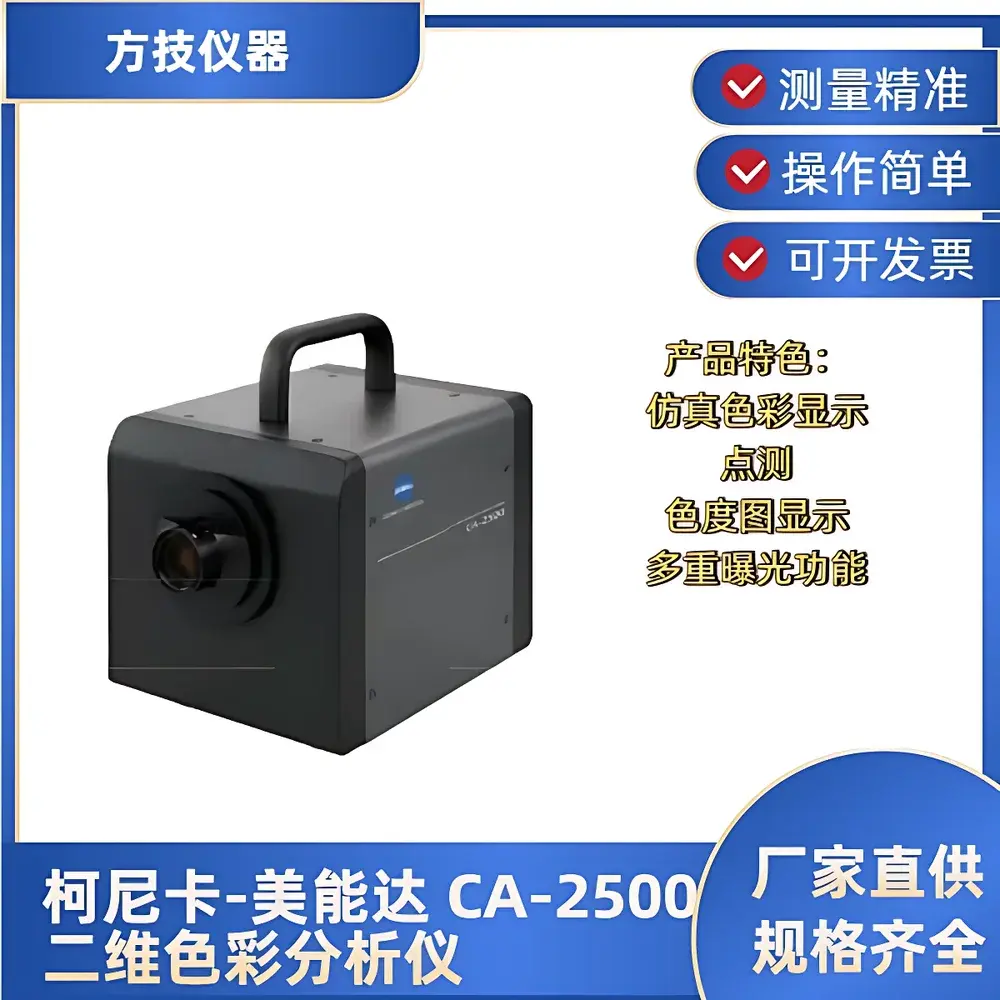
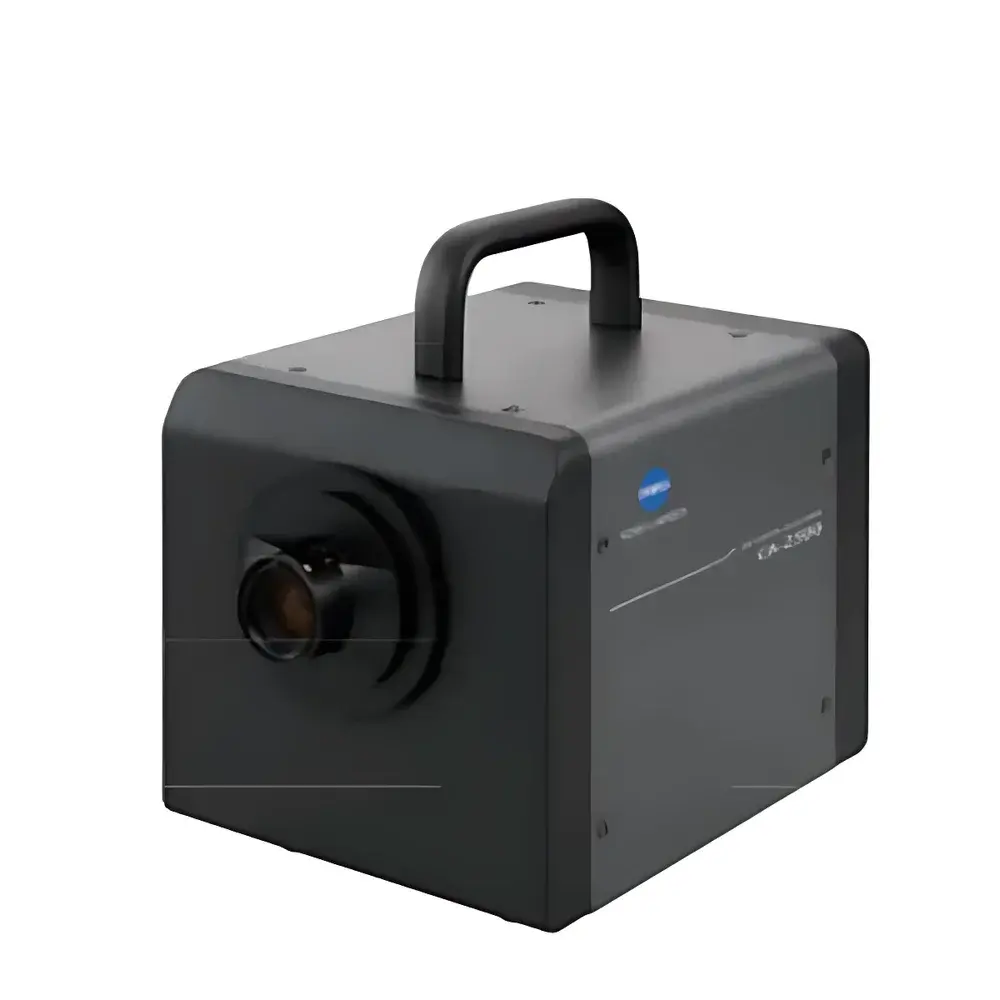
Konica Minolta CA-2500 Two-Dimensional Display Luminance and Color Analyzer
| Brand | Konica Minolta |
|---|---|
| Origin | Japan |
| Instrument Type | Benchtop |
| Model | CA-2500 |
| Sensor | Monochrome CCD (2/3", 1000 × 1000 effective pixels) |
| Filter System | CIE 1931 Standard Observer matching filters + ND filters |
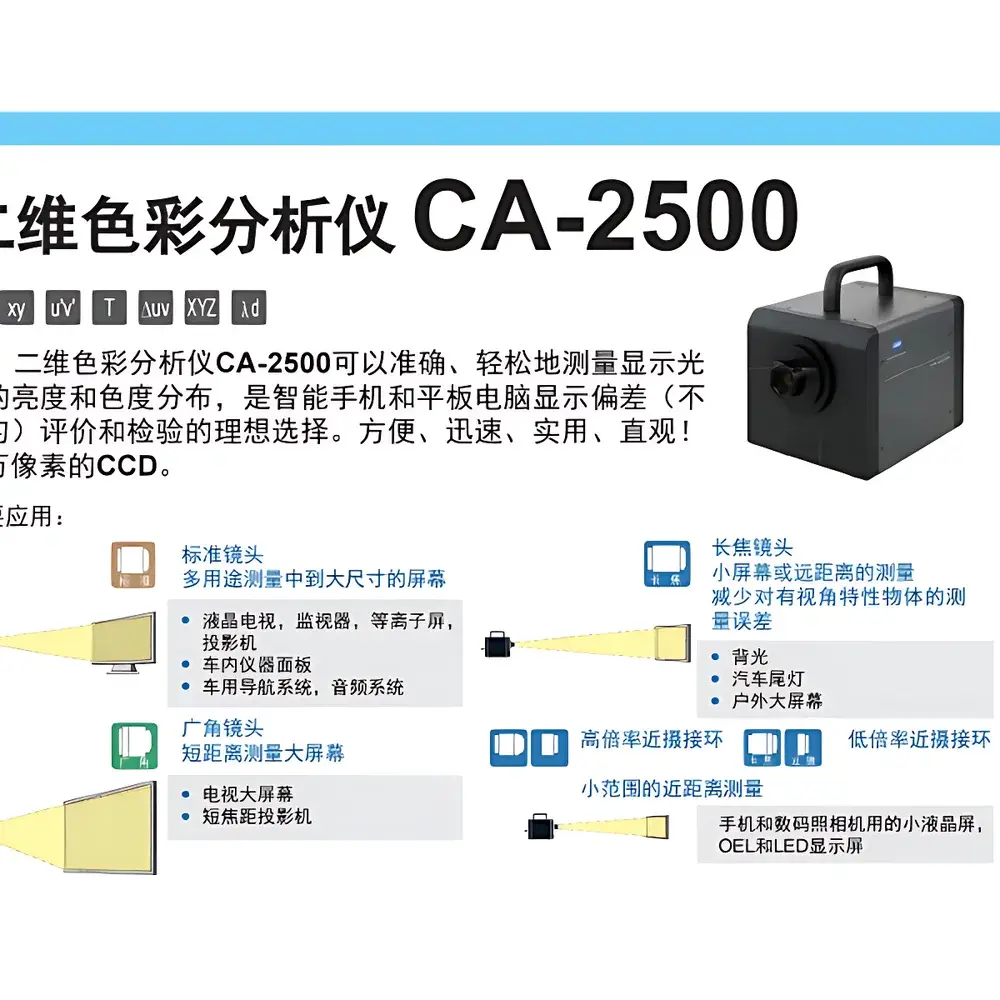
| Interchangeable Lenses | Standard, Wide-angle, Telephoto |
| Close-up Adapters | Low-magnification & High-magnification (telephoto-compatible) |
| Measurement Resolution | Up to 980 × 980 pixels (software-selectable: 490 × 490 or 196 × 196) |
| Color Spaces | XYZ, Lvxy, Lvu'v', TΔuv, Dominant Wavelength, Excitation Purity, Lv Contrast |
| Brightness Range | 0.05–100,000 cd/m² (with ND filters) |
| Luminance Accuracy | ±3% |
| Chromaticity Accuracy | ±0.005 (at 23°C ±2°C, RH 40% ±10%) |
| Luminance Repeatability | 0.5% |
| Chromaticity Repeatability | ±0.001 |
| Inter-instrument Agreement | ±2% luminance, ±0.002 chromaticity (typical) |
| Measurement Time | ~5 s (single), ~80 s (256-frame accumulation) |
| Interface | USB 2.0 or higher |
| Operating Environment | 10–30°C, ≤70% RH (non-condensing) |
| Storage Environment | 0–30°C, ≤70% RH (non-condensing) |
| Dimensions (W×H×D) | 160 × 164 × 192 mm (handle height: 211 mm) |
| Weight | ~3.5 kg (with standard lens & cap) |
| Power Supply | AC adapter, 100–240 V, 50–60 Hz |
Overview
The Konica Minolta CA-2500 is a high-precision, benchtop two-dimensional display luminance and color analyzer engineered for objective, spatially resolved photometric and colorimetric evaluation of flat-panel displays, OLEDs, microLEDs, automotive HUDs, and other emissive optical surfaces. Unlike point-measurement colorimeters or spectroradiometers, the CA-2500 employs a calibrated monochrome CCD imaging sensor (2/3-inch format, 1000 × 1000 effective pixels) coupled with CIE 1931 standard observer-matched tristimulus filters to capture full-field luminance (Lv) and chromaticity (x, y; u’, v’) distributions in a single acquisition. Its measurement principle is based on digital imaging photometry — where pixel-level radiometric calibration enables quantitative mapping of brightness uniformity, chromaticity shift across viewing angles, Mura defects, and spatial non-uniformity metrics such as ΔE₂₀₀₀ distribution or contrast ratio gradients. Designed for R&D labs, display manufacturing QA/QC lines, and third-party testing facilities, the CA-2500 supports traceable, repeatable assessment aligned with industry standards including ISO 9241-307 (display ergonomics), IEC 62341-6-3 (OLED optical measurement), and JEITA CP-3408 (LCD evaluation protocols).
Key Features
- Full 2D spatial resolution up to 980 × 980 pixels, with software-configurable subsampling (490 × 490 or 196 × 196) to balance speed and data granularity.
- Interchangeable optical system: Standard, wide-angle, and telephoto lenses — each optimized for specific working distances and field-of-view requirements; supplemented by low- and high-magnification close-up adapters for near-field micro-display analysis.
- Multi-parameter real-time display modes: Simulated color rendering, CIE 1931/1976 chromaticity diagrams with reference points, cross-sectional luminance profiles, and ΔE-based deviation heatmaps.
- High-dynamic-range luminance measurement (0.05–100,000 cd/m²) enabled by integrated neutral density (ND) filters and adaptive exposure control — ensuring fidelity across dim standby states and peak HDR white levels.
- Traceable calibration architecture: Factory-calibrated against NIST-traceable standards; supports user-initiated verification and correction via built-in reference sources and optional calibration kits.
- Benchtop mechanical stability with rigid aluminum housing (160 × 164 × 192 mm), vibration-damped base, and thermal management ensuring <±0.5% luminance drift over 8-hour continuous operation at 23°C ±2°C.
Sample Compatibility & Compliance
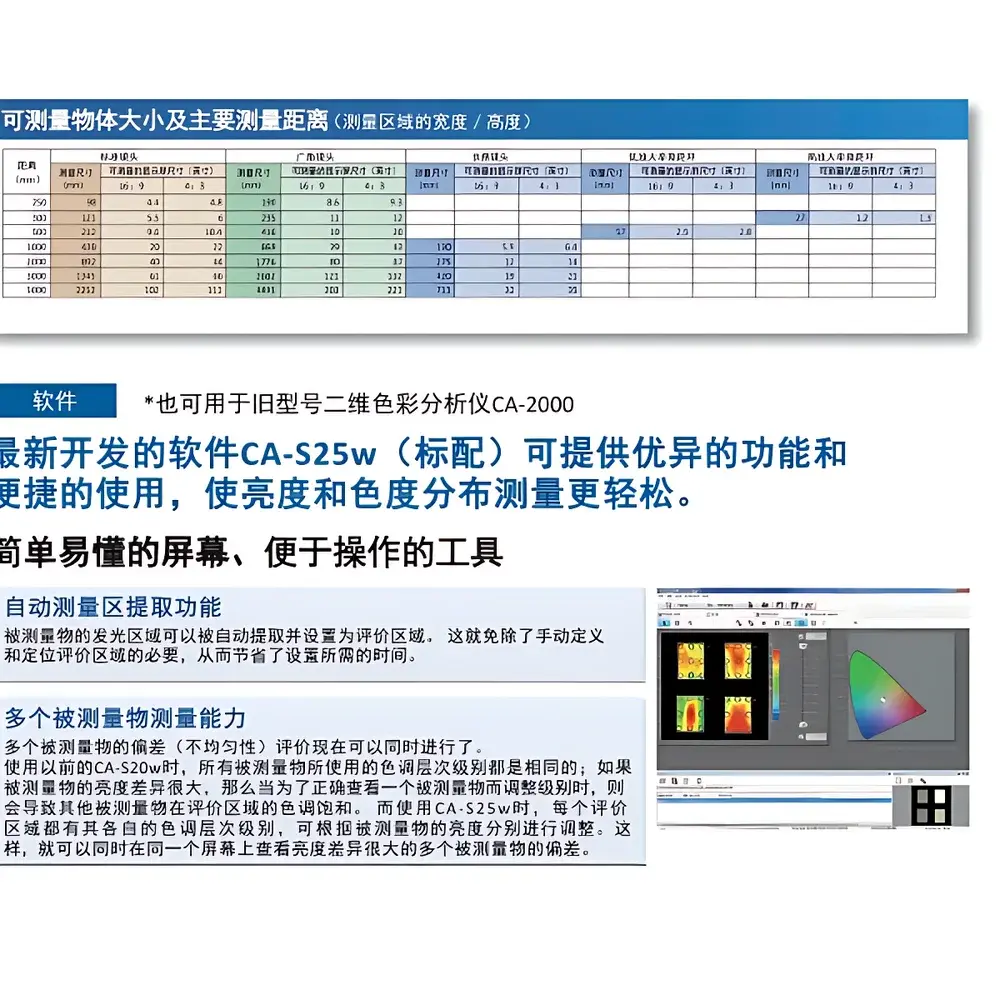
The CA-2500 accommodates emissive display samples ranging from small-format wearables (≥27 mm diagonal, using high-magnification telephoto + adapter) to large-area signage (≥850 mm diagonal, using wide-angle lens at 1 m distance). It is compatible with static and quasi-static measurements under controlled ambient conditions (≤70% RH, no condensation). All measurement data comply with GLP documentation requirements when used with CA-S25w software: audit trails record operator ID, timestamp, instrument serial number, calibration status, lens configuration, exposure settings, and environmental metadata. While not inherently FDA 21 CFR Part 11 compliant, the system supports integration into validated environments through external electronic signature workflows and secure network logging — commonly implemented in medical display validation per DICOM PS3.14 and IEC 62304.
Software & Data Management
Controlled exclusively via the CA-S25w Windows application (Windows 10/11, x64), the CA-2500 provides deterministic data acquisition, batch processing, and statistical reporting. The software implements ISO/IEC 17025-aligned uncertainty estimation for each pixel’s luminance and chromaticity values, incorporating repeatability, inter-instrument variability, and temperature/humidity sensitivity coefficients. Export formats include CSV (full matrix), TIFF (georeferenced luminance maps), and XML (structured metadata for LIMS integration). Automated report generation supports customizable templates for internal QA sign-off or customer-facing compliance dossiers — including pass/fail thresholds for uniformity (e.g., min/max luminance ratio ≤1.15), ΔE₇₆ tolerance zones (<2.0), and dominant wavelength consistency (±2 nm across active area).
Applications
- Display manufacturing: Quantifying Mura, clouding, and backlight leakage in LCD/Mini-LED assemblies; validating uniformity specifications pre-lamination.
- OLED process development: Mapping aging-induced chromaticity drift and luminance decay across subpixel arrays during burn-in testing.
- Automotive HMI verification: Measuring angular color shift (viewing angle dependency) of curved instrument clusters under simulated daylight and night-mode conditions.
- AR/VR microdisplay characterization: Assessing etendue-limited brightness homogeneity and chromatic aberration effects using telephoto + high-magnification configuration.
- Regulatory conformance: Generating test evidence for ENERGY STAR Display Program, TCO Certified Edge, and China CCC mandatory labeling requirements.
FAQ
What display technologies is the CA-2500 validated for?
The CA-2500 is optimized for self-emissive devices including OLED, microLED, AMOLED, and traditional LCDs with LED backlights. It is not suitable for reflective or transmissive-only samples without auxiliary illumination.
Can measurement data be exported to MATLAB or Python for custom analysis?
Yes — raw luminance (Y) and tristimulus (X, Z) matrices are exportable as ASCII-delimited CSV files with embedded spatial coordinate headers, enabling direct ingestion into NumPy, Pandas, or MATLAB Image Processing Toolbox.
Is remote operation supported over LAN or Ethernet?
No — the CA-2500 communicates exclusively via USB 2.0; however, it can be operated remotely via Windows Remote Desktop or TeamViewer when installed on a dedicated host PC within a secure lab network.
How frequently must the system be recalibrated?
Konica Minolta recommends annual factory recalibration. In-house verification using the supplied white reference tile is advised before each critical measurement session, particularly after lens changes or environmental excursions beyond 10–30°C.
Does the CA-2500 support automated pass/fail judgment against user-defined limits?
Yes — CA-S25w allows defining region-of-interest (ROI) masks and applying Boolean logic to luminance, chromaticity, or ΔE thresholds; results are logged with binary PASS/FAIL flags and annotated screenshots.




