
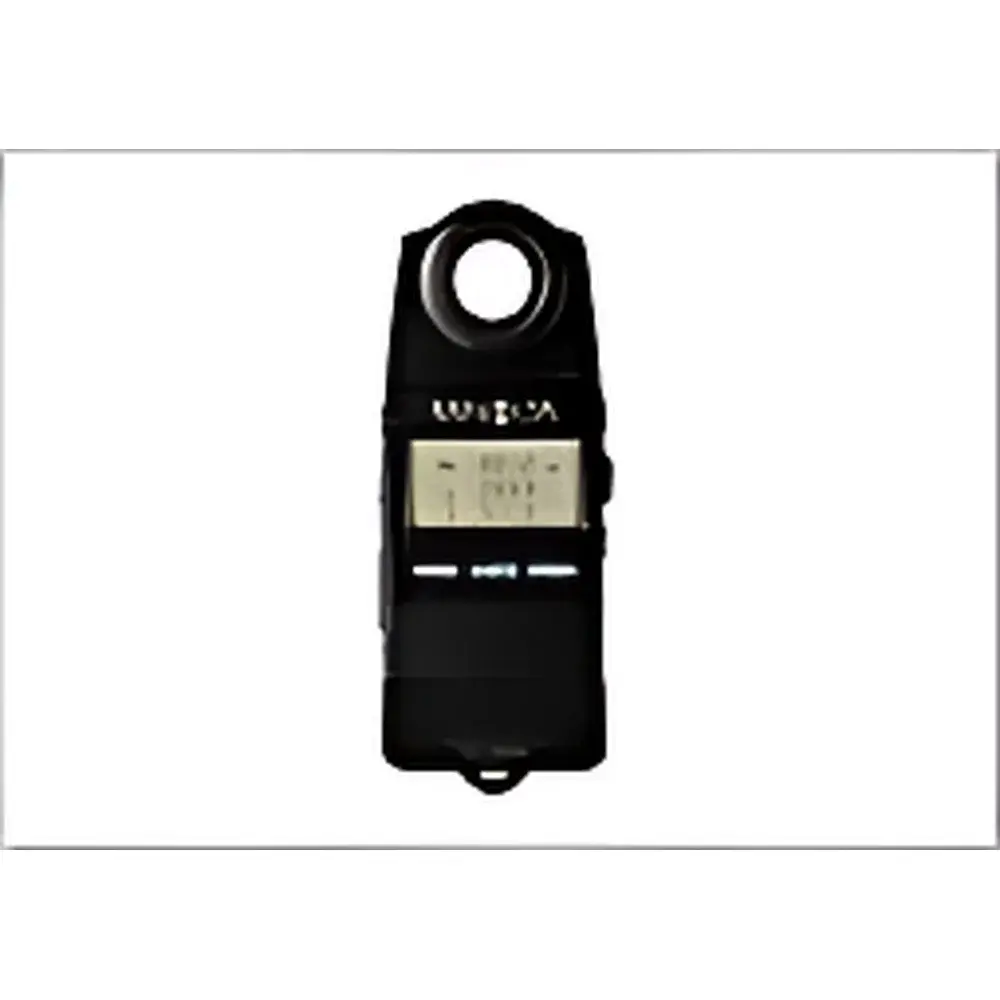
Konica Minolta CL-200 Color Illuminance Meter
| Brand | Konica Minolta |
|---|---|
| Origin | Japan |
| Model | CL-200 |
| Product Type | Color Difference Meter |
| Measurement Principle | Tristimulus-based photometric and colorimetric sensing (CIE 1931 XYZ system) |
| Spectral Response | Approximates CIE standard observer functions x̄(λ), ȳ(λ), z̄(λ) with f₁′ ≤ 8% |
| Illuminance Range | 0.1–99,990 lx (4 auto-ranging scales) |
| Chromaticity Range | ≥5 lx (≥0.5 fcd) for color measurement |
| Accuracy (Ev) | ±2% of reading ±1 digit |
| Accuracy (xy) | ±0.002 (at 800 lx, Standard Illuminant A) |
| Repeatability (Ev) | 0.5% ±1 digit (2σ) |
| Repeatability (xy) | ±0.0005 (at 800 lx, Standard Illuminant A) |
| Temp. Drift (Ev/xy) | ±3% ±1 digit / ±0.003 |
| Humidity Drift (Ev/xy) | ±3% ±1 digit / ±0.003 |
| Response Time | 0.5 s (continuous mode) |
| Display | 4-digit LCD with auto-backlight |
| Interface | RS-232C (bidirectional) |
| Remote Sensing | Up to 100 m via LAN cable (with T-A20/T-A21 adapters, optional) |
| Multi-sensor Support | 2–30 detectors per host |
| Power | 2 × AA alkaline batteries (72 h typical) or AC adapter (AC-A10/A10N, optional) |
| Dimensions | 69 × 174 × 35 mm |
| Weight | 215 g (without batteries) |
| Operating Environment | −10–40 °C, ≤85% RH (non-condensing) |
| Storage | −20–55 °C, ≤85% RH (non-condensing) |
Overview
The Konica Minolta CL-200 Color Illuminance Meter is a handheld, tristimulus-based optical measurement instrument engineered for simultaneous, real-time quantification of illuminance (lux), chromaticity coordinates (CIE 1931 xy or u’v’), correlated color temperature (CCT), and color difference (ΔE and component ΔXYZ, Δxy, Δu’v’) against user-defined references. Unlike spectroradiometric systems, the CL-200 employs precision-filtered silicon photodiodes calibrated to approximate the CIE 1931 standard observer functions x̄(λ), ȳ(λ), and z̄(λ), with an f₁′ mismatch error of ≤8%. This design enables rapid, portable, and cost-effective assessment of light sources—particularly in environments where spectral resolution is secondary to speed, reproducibility, and field-deployable robustness. Its architecture supports both single-point verification and distributed photometric mapping across large surfaces (e.g., projection screens, architectural lighting installations, or display production lines), making it suitable for R&D labs, manufacturing QA/QC stations, lighting design validation, and human factors research under controlled or ambient conditions.
Key Features
- Integrated tristimulus measurement: Simultaneous acquisition of illuminance (Ev), CIE xy or u’v’ chromaticity, CCT (Tcp), Δuv, and multiple color difference metrics (ΔXYZ, ΔEv xy, ΔEv u’v’, ΔEv Δu’v’) relative to one stored target.
- Automatic zero-adjustment on power-up: Performed even without the protective lens cap, enabling immediate measurement readiness without manual intervention.
- Modular remote sensing capability: Detector head separable from main unit via industry-standard LAN cable (up to 100 m), supported by optional T-A20 (host adapter) and T-A21 (detector adapter) units.
- Scalable multi-point configuration: One CL-200 host synchronizes and processes data from 2–30 detector heads—ideal for spatial uniformity analysis of luminaires, LED panels, or projection systems (including ANSI lumen compliance checks).
- Four-tier auto-ranging illuminance measurement: Covers 0.1–99,990 lx with optimized signal-to-noise performance across low-light (e.g., darkroom evaluation) and high-intensity (e.g., roadway lighting) regimes.
- Bidirectional RS-232C interface: Enables PC-based data logging, batch processing of multi-detector datasets, and remote command execution (e.g., trigger, reset, export) using standard terminal protocols.
- Configurable calibration suite: Includes standard A-source calibration, user-defined calibration, multi-channel RGBW calibration (for mercury-xenon or LED-specific sources), and multi-channel user calibration—enhancing traceability for non-standard emitters.
Sample Compatibility & Compliance
The CL-200 is validated for use with all common artificial light sources—including incandescent, fluorescent, HID, OLED, and multi-channel LED arrays—as well as daylight-simulating lamps used in color-matching booths. It complies with foundational photometric standards referenced in IEC 61000-4-11 (immunity), JIS Z 8722 (colorimetry), and ISO/CIE 11664-1:2019 (colorimetric observers). While not a spectroradiometer, its f₁′-compliant sensor response satisfies requirements for routine quality control in applications governed by ASTM E308 (computing tristimulus values), ISO 11664-6 (CCT calculation), and JIS Z 8781-2 (color difference evaluation). The instrument supports GLP-aligned workflows when paired with optional Data Management Software CL-S1w, which provides audit-trail-capable logging, pass/fail thresholding, and time-stamped report generation—facilitating internal QA documentation and regulatory review.
Software & Data Management
The optional CL-S1w Data Management Software transforms the CL-200 into a networked photometric workstation. It enables real-time visualization of up to 30 detector channels, programmable measurement intervals (100 ms–999 s), ANSI lumen calculation per projector test protocols, and customizable limit setting (upper/lower bounds for Ev, xy, CCT). All logged data are timestamped and stored in CSV-compatible format, supporting traceable post-processing in MATLAB, Python, or Excel. CL-S1w also manages firmware updates, detector registration, and calibration file import/export—ensuring consistency across multi-instrument deployments. When connected via RS-232C, the software maintains full bidirectional control, including remote zeroing, memory recall, and batch export. For regulated environments, CL-S1w supports user-access levels and basic electronic signature logging—aligning with FDA 21 CFR Part 11 principles for non-critical laboratory instrumentation.
Applications
- Display manufacturing: Verification of white point stability, chromaticity uniformity, and CCT drift across LCD/OLED panels during burn-in and aging tests.
- Luminaire R&D: Spatial illuminance and chromaticity mapping of architectural, street, and task lighting systems—especially where ANSI/IESNA LM-79–style reporting is required.
- Color-critical environments: Calibration and monitoring of viewing booths (ISO 3664), graphic arts proofing stations, and museum lighting installations.
- Projection system validation: ANSI lumen measurement across screen quadrants using synchronized multi-detector arrays.
- Human-centric lighting studies: Quantifying circadian stimulus (CS) proxies via CCT and illuminance correlation in field-based environmental psychology trials.
- LED module QC: Batch testing of binning consistency, thermal color shift, and driver-induced chromaticity variation under pulsed or DC operation.
FAQ
Does the CL-200 measure spectral power distribution (SPD)?
No. The CL-200 is a tristimulus colorimeter—not a spectroradiometer—and does not resolve wavelength-specific intensity. For SPD analysis, consider the Konica Minolta CS-2000 or CS-3000 series.
Can the CL-200 be used for outdoor daylight measurements?
Yes, provided incident light falls within its operational range (≥5 lx for color data) and the detector is protected from direct precipitation and condensation per its IP rating (no ingress protection specified; use CL-A11 hood for harsh conditions).
Is RS-232C communication compatible with modern Windows/macOS systems?
Yes—via USB-to-RS-232 adapters compliant with FTDI or Prolific chipsets. CL-S1w includes driver configuration guidance and supports standard COM port enumeration.
What is the uncertainty contribution of temperature/humidity drift in long-duration measurements?
Per specifications, Ev and xy drift remain within ±3% ±1 digit and ±0.003 respectively over the full operating range (−10–40°C, ≤85% RH non-condensing), assuming stable thermal equilibrium is reached prior to measurement.
How many detector heads can be daisy-chained without signal degradation?
Up to 30 detectors are supported per host, but optimal signal integrity requires adherence to CAT5e/CAT6 cable specifications and proper termination with T-A20/T-A21 adapters. Konica Minolta recommends ≤100 m total cable length per branch.





