
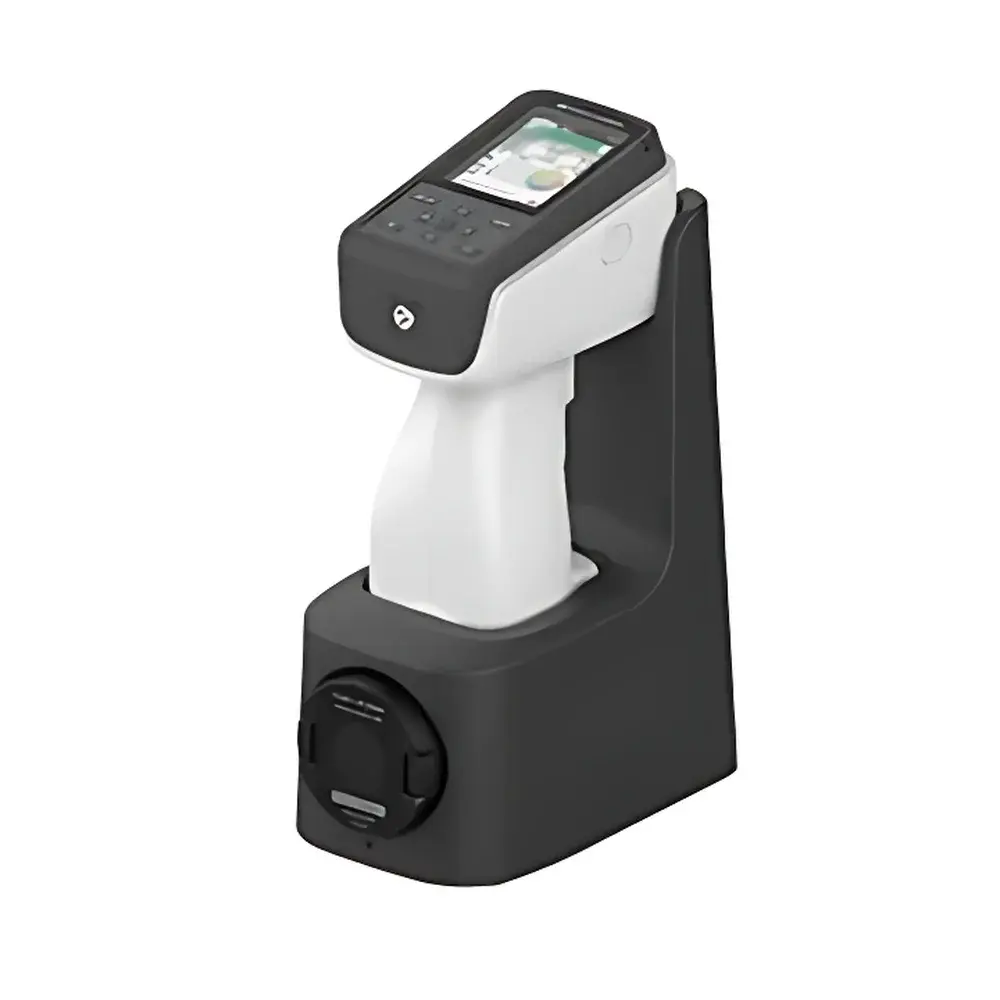
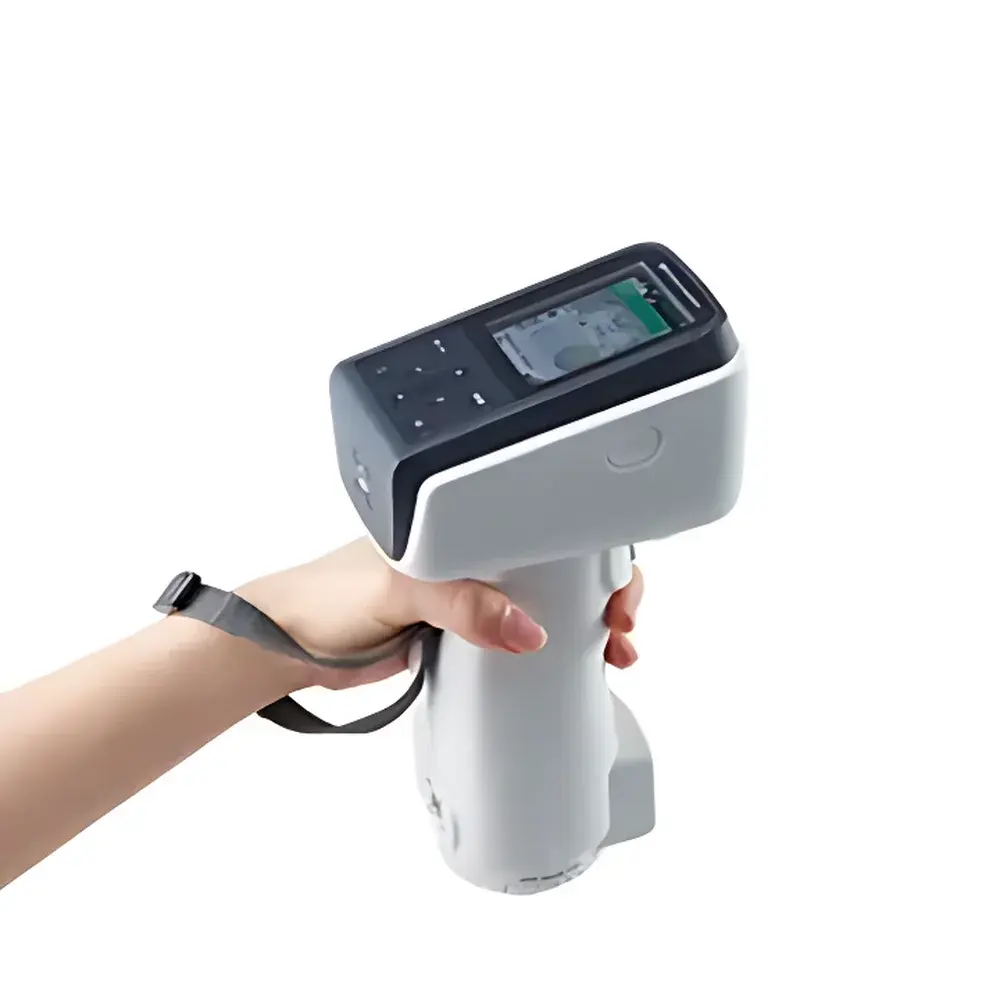
Konica Minolta CM-17d/CM-16d Upright Portable Spectrophotometer
| Brand | Konica Minolta |
|---|---|
| Origin | Japan |
| Instrument Type | Portable |
| Product Category | Spectrophotometric Colorimeter |
| Model | CM-17d / CM-16d |
| Compliance | ISO 13655:2017 (M0/M1/M2/M3), CIE No. 15:2018, ASTM E308, JIS Z 8722 |
| Illuminant Options | D65, A, C, F2, F7, F11, Custom |
| Observer Angle | 10° |
| Measurement Aperture | Ø8 mm (standard), Ø3 mm (optional) |
| Spectral Range | 400–700 nm |
| Spectral Resolution | 10 nm |
| Repeatability | ΔE*ab < 0.04 (white tile, 20 measurements) |
| Inter-instrument Agreement | ΔE*ab < 0.15 (20 instruments, BCRA Series II tiles) |
Overview
The Konica Minolta CM-17d and CM-16d are upright portable spectrophotometers engineered for high-accuracy color measurement in industrial quality control, R&D laboratories, and on-site production environments. These instruments employ diffraction grating-based spectral analysis with a silicon photodiode array detector to capture full reflectance spectra across the visible range (400–700 nm) at 10 nm intervals. Unlike tristimulus colorimeters, spectrophotometric architecture enables precise calculation of CIE XYZ, L*a*b*, L*C*h*, and ΔE metrics under multiple standardized illuminants (D65, A, C, F2, F7, F11) and 10° standard observer conditions—ensuring metrological traceability aligned with ISO 13655:2017 (M0/M1/M2/M3), CIE 15:2018, and ASTM E308. The upright ergonomic design minimizes operator fatigue during extended measurement sessions and improves stability on uneven or confined surfaces—critical for consistent aperture contact on textured, curved, or low-rigidity substrates.
Key Features
- Upright mechanical architecture with integrated tilt-compensated measurement head for repeatable sample contact pressure and geometry
- Dual-aperture capability: Standard Ø8 mm measurement spot with stabilizing ring; optional Ø3 mm aperture for small-area or patterned surface analysis
- Integrated lithium-ion battery (CM-A235) supporting >3,000 measurements per charge; USB-C PD charging compatibility (AC-A405 adapter)
- Onboard memory stores up to 2,000 measurement records with timestamp, illuminant, observer, and pass/fail thresholds
- Bluetooth 5.0 and optional WLAN module (CM-A300) for real-time wireless data streaming to factory MES or cloud-based QC dashboards
- Robust IP52-rated enclosure with scratch-resistant sapphire measurement window and anti-static housing for cleanroom and manufacturing floor deployment
Sample Compatibility & Compliance
The CM-17d/CM-16d accommodates flat, curved, textured, and semi-glossy surfaces—including injection-molded plastics, painted automotive panels, coated papers, textiles, and ceramic glazes. Optional accessories extend functionality: the powder test box (CM-A184) enables controlled volumetric sampling of granular materials; the zero-calibration tube (CM-A182) supports dark-current verification per ISO 13655 Annex B; and glass-backed target masks (CM-A183) maintain optical alignment for transparent or translucent films. All instruments ship with NIST-traceable white calibration tile (CM-A298) and undergo factory certification against BCRA Series II reference standards. Full compliance with ISO/IEC 17025 documentation requirements is supported via audit-ready calibration logs and GLP-compliant metadata tagging in SpectraMagic NX2.
Software & Data Management
SpectraMagic NX2 (freely downloadable) provides comprehensive color data management: statistical process control (SPC) charting, multi-instrument comparison, spectral difference overlays, and automated report generation compliant with ISO 9001 clause 8.2.4. The software supports FDA 21 CFR Part 11–enabled user authentication, electronic signatures, and immutable audit trails for regulated industries. Configuration Tool CM-CT1 allows firmware updates, custom illuminant definition, and instrument-specific tolerance band programming. Raw spectral data exports in CSV, XML, and CxF/X3 formats ensure interoperability with third-party LIMS, SAP QM, and Adobe Color Engine workflows.
Applications
- Automotive: Paint batch consistency verification across body panels, interior trim, and OEM supplier audits
- Plastics & Packaging: Color matching of polyolefin films, PET bottles, and thermoformed trays under M1 (UV-containing) and M2 (UV-excluded) modes
- Printing & Graphic Arts: G7 grayscale calibration, ink formulation validation, and substrate-dependent color shift compensation
- Food & Pharmaceuticals: Visual appearance qualification of coated tablets, gelatin capsules, and food-grade packaging films per USP
- Textiles & Apparel: Shade sorting of dyed yarns and woven fabrics under retail lighting simulations (F11, F2)
FAQ
What is the difference between the CM-17d and CM-16d models?
The CM-17d includes Bluetooth 5.0 as standard and supports optional WLAN connectivity (CM-A300), while the CM-16d relies on USB-C or optional Bluetooth module add-on.
Can the instrument measure transparent or translucent samples?
Yes—when used with the optional glass-backed target mask (CM-A183) and configured in M1 or M2 mode per ISO 13655, it quantifies transmitted color and haze-corrected chromaticity.
Is SpectraMagic NX2 compatible with Windows 11 and macOS?
SpectraMagic NX2 v3.0+ supports Windows 10/11 (64-bit) and macOS 12–14; legacy versions require virtualization on ARM-based Macs.
How often should calibration be performed?
White calibration is recommended before each measurement session; dark calibration (zero adjustment) is required after ambient temperature shifts exceeding ±5°C or every 8 hours of continuous operation.
Does the device support GLP/GMP audit requirements?
Yes—SpectraMagic NX2 generates 21 CFR Part 11–compliant audit logs, including user ID, timestamp, parameter changes, and measurement history export with digital signature capability.




