
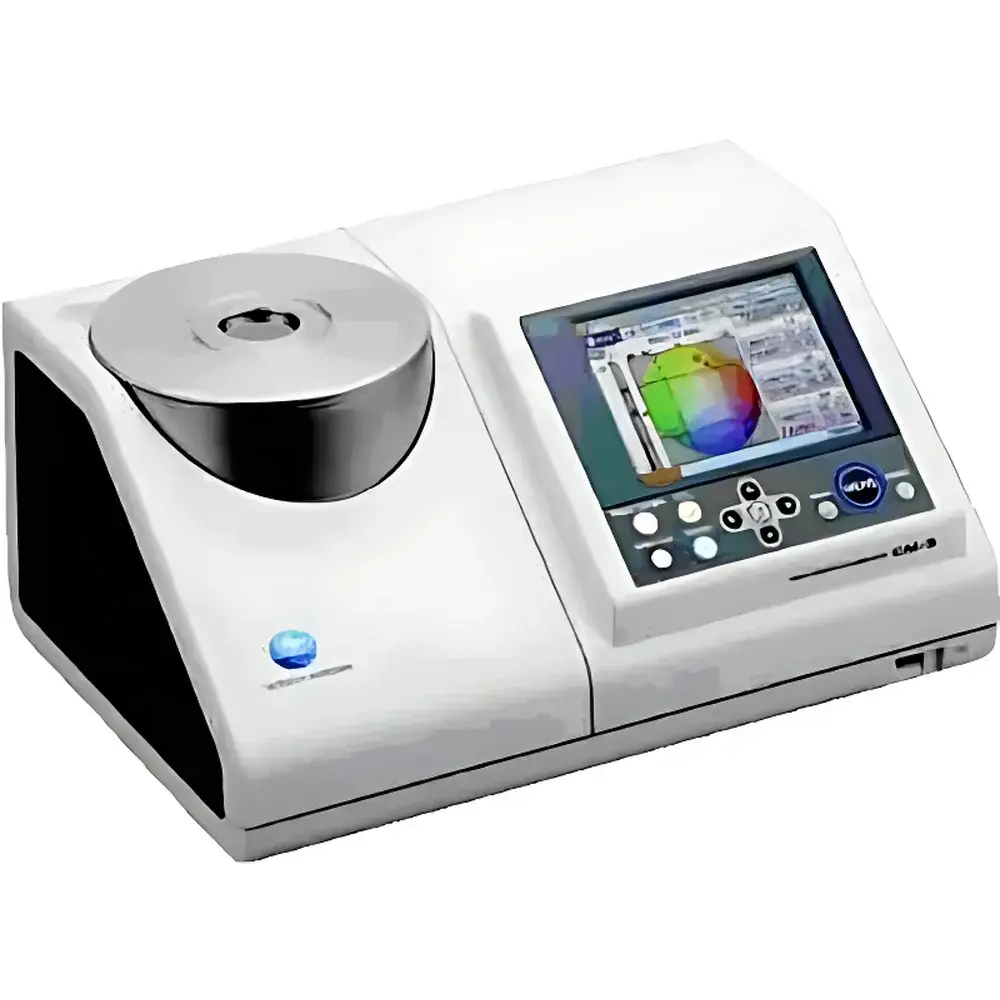
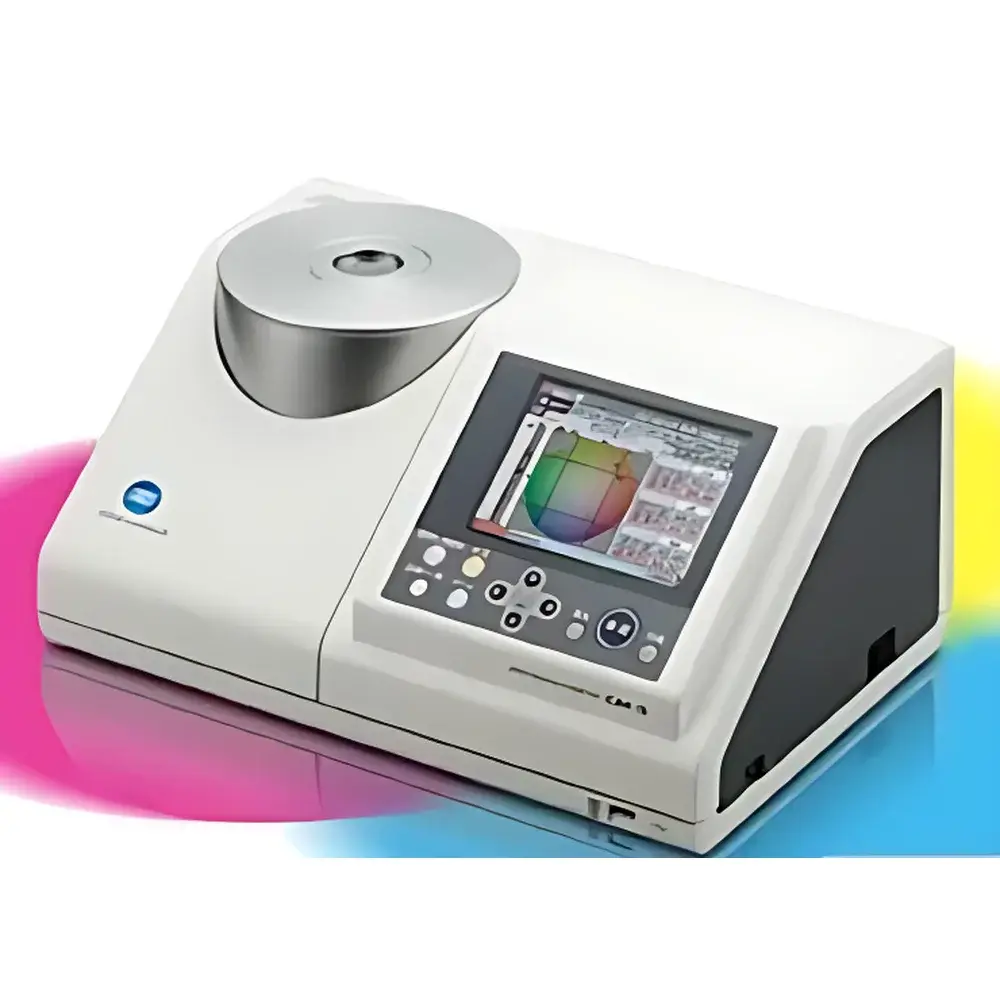
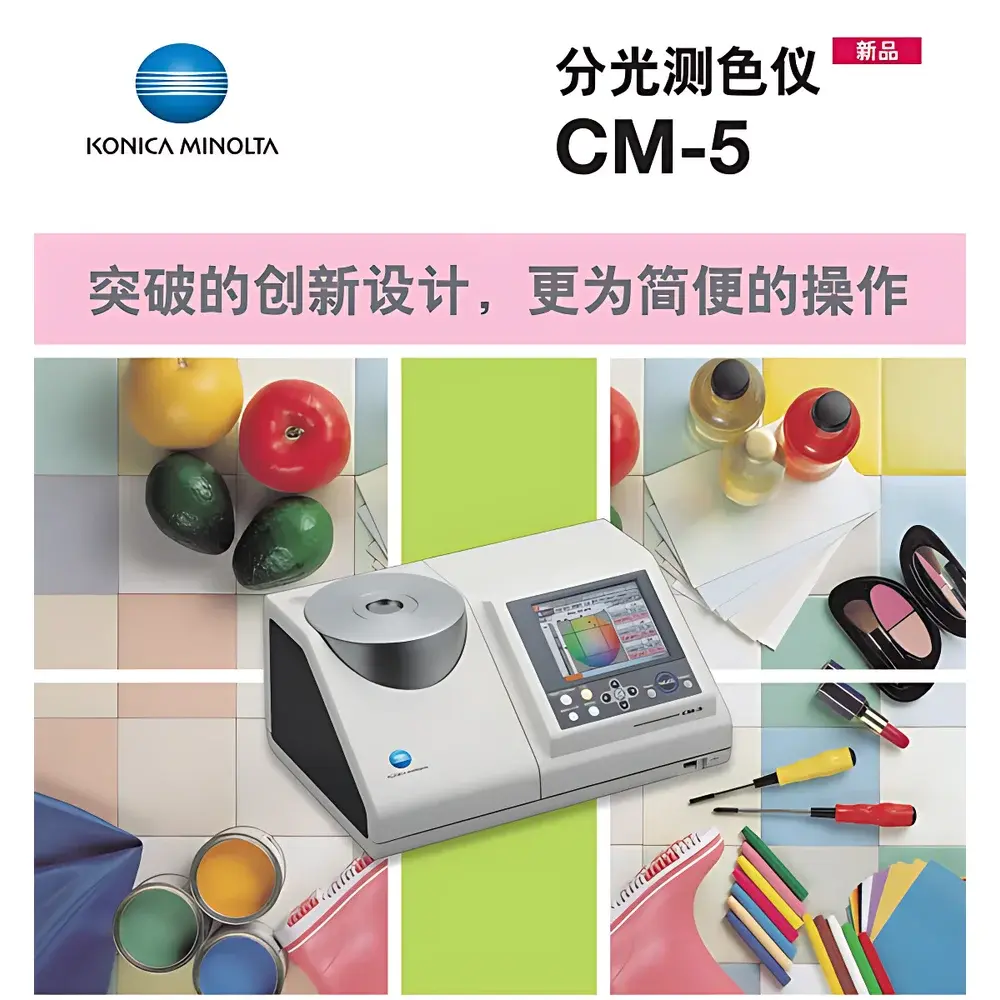
Konica Minolta CM-5 Benchtop Spectrophotometer
| Brand | Konica Minolta |
|---|---|
| Origin | Japan |
| Instrument Type | Benchtop |
| Optical Geometry | d/8° integrating sphere (SCI/SCE switchable) |
| Illuminants | A, C, D50, D65, F2, F6, F7, F8, F10, F11, F12, ID50, ID65 |
| Spectral Range | 360 nm – 740 nm |
| Wavelength Interval | 10 nm |
| FWHM | ~10 nm |
| Reflectance Measurement Range | 0–175% |
| Transmittance Measurement Range | 0–175% |
| Repeatability | ΔE*ab ≤ 0.04 (after white calibration, 30 measurements at 10 s intervals) |
| Inter-instrument Agreement | ΔE*ab ≤ 0.15 (typical, BCRA Series II, 23°C) |
| Aperture Options (Reflectance) | LAV Ø30 mm / Ø36 mm, MAV (optional) Ø8 mm / Ø11 mm, SAV (optional) Ø3 mm / Ø6 mm |
| Transmittance Aperture | Ø20 mm |
| Transmittance Chamber Max Thickness | 60 mm |
| Chamber Width | Unlimited |
| Measurement Time | ~1 s (data output) |
| Minimum Interval | ~3 s |
| Display | 5.7" TFT color LCD |
| Languages | English, Simplified Chinese, Japanese, German, French, Italian, Spanish |
| Compliance | CIE No. 15, ISO 7724-1, ASTM E1164, DIN 5033-7, JIS Z 8722 (Condition c) |
| Interface | USB 1.1, RS-232C |
| Power Supply | AC 100–240 V, 50/60 Hz |
| Dimensions (closed) | 385 × 192 × 261 mm (W × H × D) |
| Weight | ~5.8 kg |
Overview
The Konica Minolta CM-5 Benchtop Spectrophotometer is a high-precision, dual-mode (reflectance and transmittance) color measurement instrument engineered for rigorous industrial quality control and R&D applications. Based on the CIE-compliant d/8° integrating sphere optical geometry with selectable SCI (Specular Component Included) and SCE (Specular Component Excluded) modes, the CM-5 delivers metrologically traceable spectral data across the full visible spectrum (360–740 nm) at 10 nm resolution. Its plane diffraction grating and dual-row 40-element silicon photodiode array ensure stable, low-noise spectral acquisition—critical for detecting subtle metamerism, batch-to-batch variation, or aging-induced chromatic shifts in pharmaceutical tablets, cosmetic emulsions, food packaging inks, and automotive clearcoats. Unlike handheld devices, the CM-5’s benchtop architecture provides mechanical stability essential for repeatable positioning of irregular solids, viscous pastes, granules, and thick transparent substrates—enabling consistent inter-laboratory correlation under GLP and GMP-aligned workflows.
Key Features
- Integrated 5.7-inch full-color TFT LCD with intuitive icon-driven navigation—eliminates dependency on external PCs or printed manuals for routine measurements.
- Dual-mode optical path: d/8° geometry for reflectance (compliant with ISO 7724-1 and ASTM E1164), and 0°/0° geometry for transmittance, both implemented within a single 152 mm diameter integrating sphere.
- Unrestricted transmittance chamber design accommodates samples up to 60 mm thick with no lateral width limitation—ideal for architectural glass, polymer sheets, and molded plastic panels.
- Multi-illuminant support (A, C, D50, D65, F-series, and industry-specific ID illuminants) enables simultaneous display of color values under two user-selected conditions—essential for evaluating lighting-dependent appearance in cosmetics and coatings.
- Onboard spectral visualization: real-time rendering of reflectance/transmittance curves, CIE chromaticity diagrams (x,y and u’,v’), and ΔE-based pass/fail evaluation—without requiring proprietary software installation.
- Seven-language UI (English, Simplified Chinese, Japanese, German, French, Italian, Spanish) facilitates multi-site deployment across global manufacturing facilities and contract laboratories.
- Automatic white calibration (reflectance) and 100% transmittance calibration using internal reference standards—reducing operator-induced variability and supporting audit-ready documentation per FDA 21 CFR Part 11 requirements when paired with compliant data management systems.
Sample Compatibility & Compliance
The CM-5 supports diverse physical sample forms without accessory dependency: flat solids rest directly on the upward-facing port; powders, gels, and suspensions are measured in standard Petri dishes; liquids are analyzed in supplied cuvettes; and rigid transparent materials up to 60 mm thick are positioned freely within the open transmittance chamber. Its optical design conforms to international standards including CIE Publication 15:2018, ISO 7724-1:2022, ASTM E1164-23, DIN 5033-7:2018, and JIS Z 8722:2012 (Condition C). For regulated industries, the instrument’s repeatability (ΔE*ab ≤ 0.04) and inter-instrument agreement (ΔE*ab ≤ 0.15, BCRA Series II) meet typical acceptance criteria for color-critical QC environments governed by USP , EP 2.2.58, and ISO 9001:2015 clause 7.1.5.
Software & Data Management
While fully functional as a standalone unit, the CM-5 interfaces via USB 1.1 and RS-232C for integration into centralized QA/QC networks. Measurement data (up to 4,000 records) and standard references (1,000 entries) are stored internally or exported to USB memory devices (non-encrypted only). The instrument supports export of spectral reflectance/transmittance tables (CSV), CIE XYZ, L*a*b*, and ΔE values—including CIEDE2000, CMC(l:c), and ΔE*94 equations. When connected to Konica Minolta’s optional SpectraMagic NX software, users gain access to advanced statistical process control (SPC) charts, tolerance ellipses in CIELAB space, batch deviation trending, and electronic signature-enabled report generation compliant with 21 CFR Part 11 Annex 11 and ALCOA+ principles.
Applications
The CM-5 serves as a primary color verification tool in sectors where spectral fidelity and regulatory traceability are non-negotiable. In pharmaceutical manufacturing, it quantifies hue consistency of coated tablets and verifies excipient color stability per ICH Q5C guidelines. In food and beverage, it monitors pigment dispersion in sauces, caramel color intensity in soft drinks (via APHA/Hazen scale), and whiteness index (WI) of dairy powders per ASTM E313. Cosmetic formulators use its multi-angle illuminant simulation to assess pearlescent interference effects in nail lacquers and compact powders. Automotive Tier-1 suppliers employ its high repeatability to validate basecoat/clearcoat color match across production lines—particularly under D65 (daylight) and F11 (cool white fluorescent) for interior trim validation.
FAQ
Does the CM-5 require external calibration standards for daily operation?
No—the instrument performs automatic white calibration (reflectance) and 100% transmittance calibration using built-in reference tiles. However, periodic verification against NIST-traceable standards is recommended for ISO/IEC 17025-accredited labs.
Can the CM-5 measure translucent or semi-opaque samples accurately?
Yes—its d/8° geometry with SCI mode captures total reflectance including subsurface scattering, making it suitable for measuring paper, textiles, and filled polymers where bulk scattering dominates.
Is the transmittance chamber compatible with custom sample holders?
Yes—the chamber features a removable sample clamp fixture; users may install third-party fixtures provided they maintain optical alignment and do not obstruct the 20 mm measurement aperture.
How does the CM-5 handle temperature-sensitive colorants like anthocyanins or thermochromic pigments?
The instrument itself does not regulate sample temperature, but its rapid 1-second measurement minimizes thermal drift during acquisition. For critical thermal studies, pairing with an environmental chamber and external trigger synchronization is advised.
Does the CM-5 support user-defined color difference tolerances for automated pass/fail reporting?
Yes—tolerances can be set independently for L*a*b*, ΔE*ab, ΔE00, or derived indices (e.g., YI, WI) and applied across all stored standards, enabling inline QC gatekeeping without manual interpretation.





