
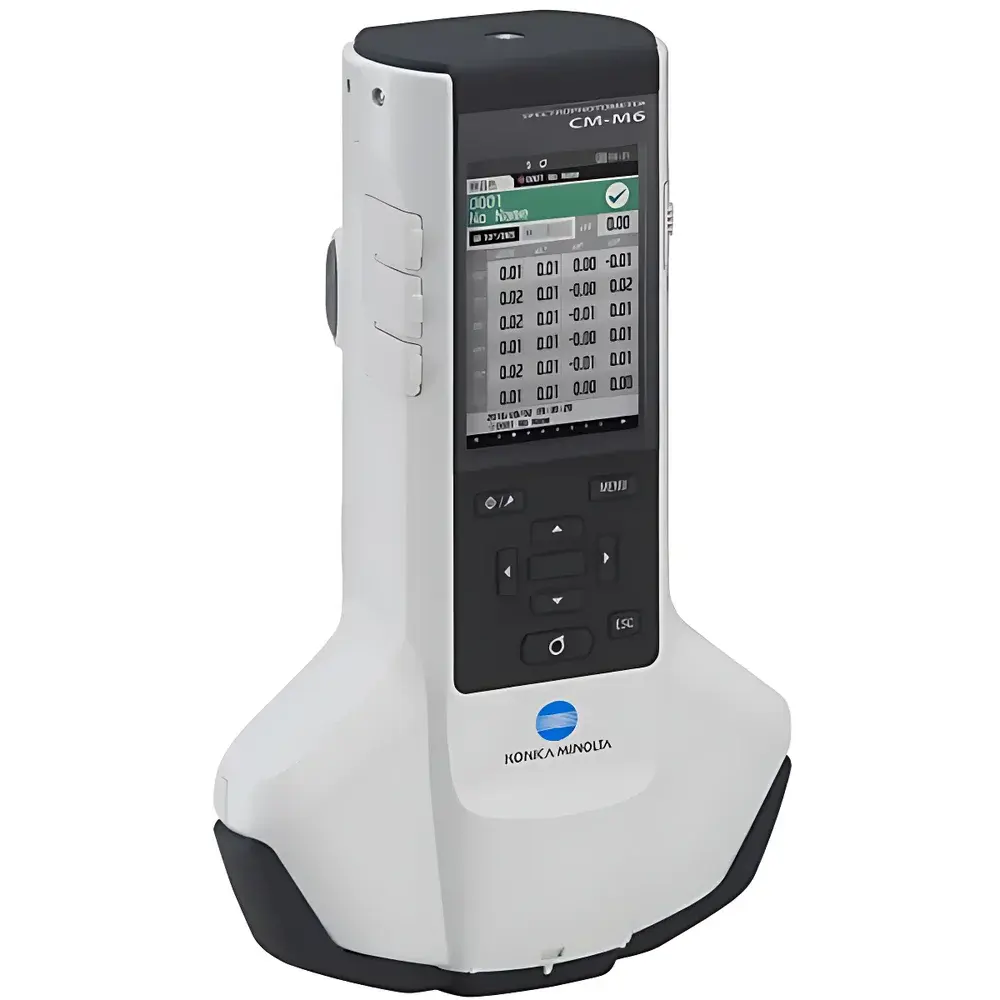
Konica Minolta CM-M6 Multi-Angle Spectrophotometer
| Brand | Konica Minolta |
|---|---|
| Origin | Japan |
| Model | CM-M6 |
| Instrument Type | Portable |
| Optical Configuration | Multi-Angle Geometry |
| Light Source | High-CRI White LED |
| Spectral Range | 400–700 nm |
| Repeatability | Chromaticity Standard Deviation ≤ ΔE*ab 0.05 |
| Measurement Aperture | Ø6 mm |
| Illumination Angle | 45° |
| Viewing Angles | –15°, 15°, 25°, 45°, 75°, 110° |
| Optical Architecture | Mirror-Symmetric Dual Illumination/Reception System |
| Compliance | Designed for ISO 7724, ASTM E308, CIE No. 15, JIS Z 8722 |
Overview
The Konica Minolta CM-M6 Multi-Angle Spectrophotometer is a precision-engineered portable instrument designed for the objective quantification of spatially varying color appearance—particularly in effect coatings such as metallic, pearlescent, and goniochromatic finishes. It operates on the principle of multi-angle spectrophotometry, capturing spectral reflectance data at six discrete viewing angles (–15°, 15°, 25°, 45°, 75°, and 110°) relative to a fixed 45° illumination axis. This geometry enables measurement of both specular-reflected and diffuse-scattered components across the visible spectrum (400–700 nm), delivering full spectral curves and derived colorimetric values (e.g., CIE L*a*b*, ΔE*ab, L*c*h*) for each angle. The instrument’s core innovation lies in its mirror-symmetric dual optical path architecture: two identical, coaxially aligned illumination and detection channels are arranged symmetrically around the central optical axis. This design mitigates angular misalignment errors caused by minor probe tilt or surface curvature—ensuring robust repeatability (≤ ΔE*ab 0.05 SD) even on curved automotive surfaces with radii as small as R = 300 mm.
Key Features
- Mirror-symmetric dual optical system for high angular stability and measurement reproducibility on non-planar surfaces
- Six-view-angle capability (–15° to 110°) optimized for metallic and pearlescent paint evaluation per OEM specifications
- Compact, vertical-form-factor housing with integrated wrist strap—designed for single-hand operation in production line or field environments
- Ø6 mm measurement aperture enabling reliable color assessment on small or intricate components (e.g., trim inserts, badges, grilles)
- High-CRI white LED source ensuring stable, flicker-free illumination compliant with CIE illuminant D65 spectral power distribution
- Rubberized measurement port gasket to prevent surface marring during contact measurement on soft or finished substrates
- Optional Bluetooth® module (sold separately) supporting wireless transmission of spectral and colorimetric data to PCs, tablets, or cloud-based QA platforms
Sample Compatibility & Compliance
The CM-M6 is validated for use on rigid and semi-rigid substrates including automotive clearcoats, plastic body panels, coated metal parts, and powder-coated surfaces. Its compact probe head and low-profile contact design accommodate tight access areas and moderate curvature without requiring custom fixtures. The instrument conforms to international standards governing color measurement practice: ISO 7724-1 (general principles), ISO 7724-2 (instrumental requirements), ASTM E308 (conversion of spectral data to CIE tristimulus values), CIE Publication No. 15 (colorimetry), and JIS Z 8722 (method for color measurement of opaque materials). While not inherently 21 CFR Part 11 compliant, raw spectral datasets exported via Konica Minolta’s proprietary software (CM-S100w) support audit-trail generation when deployed within validated GxP environments under documented SOPs.
Software & Data Management
Data acquisition and analysis are managed through Konica Minolta’s CM-S100w software suite (Windows-based), which supports real-time spectral visualization, multi-angle color difference calculation (ΔE*ab, ΔE00), pass/fail tolerance mapping, and statistical process control (SPC) charting. The software permits user-defined measurement templates—including angle-specific tolerances, reference library management, and batch reporting. Export formats include CSV, XML, and industry-standard CGATS.2 (ICC-compatible) for integration into enterprise quality systems. When paired with the optional Bluetooth module, measurements are timestamped and geotagged (if enabled), facilitating traceability in decentralized manufacturing or third-party inspection workflows.
Applications
- Automotive OEM and Tier-1 supplier quality control of exterior paint finishes (e.g., side panels, hoods, bumpers)
- Validation of effect pigment orientation and flake alignment in metallic and pearl basecoats
- Color matching and batch-to-batch consistency verification across production shifts
- In-field measurement of repaired panels against original equipment specifications
- R&D evaluation of novel effect pigments, clearcoat formulations, and UV-curable coatings
- Supplier qualification testing where multi-angle color agreement is contractually mandated (e.g., GM WERCS, Ford CETP)
FAQ
What standards does the CM-M6 comply with for automotive color measurement?
It adheres to ISO 7724, ASTM E308, CIE No. 15, and JIS Z 8722 for spectral acquisition and colorimetric computation.
Can the CM-M6 measure curved surfaces such as rearview mirrors?
Yes—the mirror-symmetric optical design ensures stable readings on surfaces with radius ≥ R300 mm without requiring mechanical leveling.
Is the Ø6 mm aperture suitable for measuring small decorative elements on vehicles?
Yes; the 6 mm spot size enables repeatable measurement of emblems, sensor housings, and interior trim features previously inaccessible to larger-aperture instruments.
Does the CM-M6 support GLP/GMP-compliant data handling?
Raw spectral data and metadata are exportable in auditable formats; full compliance requires integration into a validated software environment with defined electronic signature and change-control procedures.
Is Bluetooth connectivity standard or optional?
Bluetooth is an optional accessory—purchased and installed separately—to enable wireless data transfer to external devices.





