
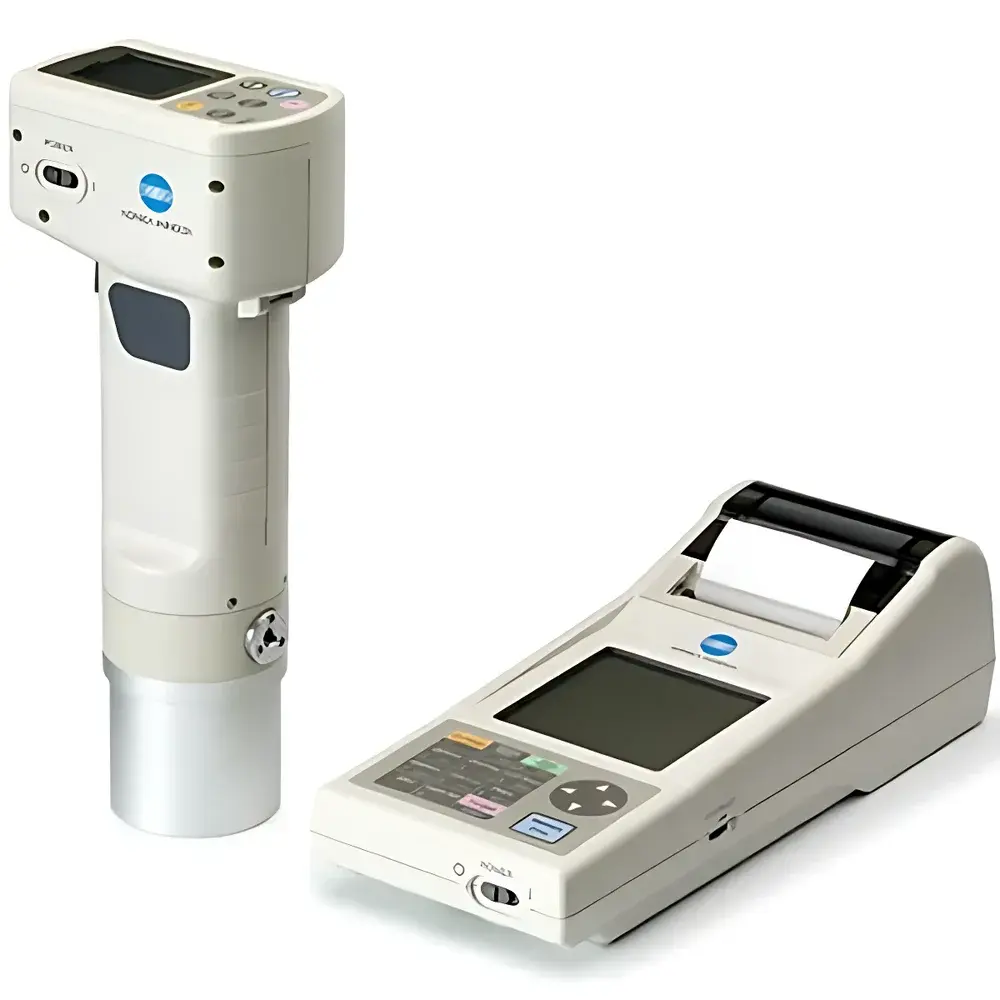
Konica Minolta CR-400/CR-410 Portable Color Difference Meter
| Brand | Konica Minolta |
|---|---|
| Origin | Japan |
| Model | CR-400 / CR-410 |
| Instrument Type | Portable |
| Light Source | Pulsed Xenon Lamp |
| Aperture Options | Φ8 mm (CR-400), Φ50 mm (CR-410) |
| Repeatability | ΔE*ab ≤ 0.07 (after white calibration, 30 measurements at 10-sec intervals) |
| Accuracy | ΔE*ab ≤ 0.6 (CR-400), ≤ 0.8 (CR-410) |
| Memory Capacity | 100 target colors + 1,000 measurement records (standalone) |
| Display | Backlit LCD, 6-language support (English, German, French, Italian, Spanish, Japanese) |
| Power | Rechargeable battery or AC adapter |
| Compliance | Designed for ISO 7724-1, CIE No. 15, ASTM E308, and JIS Z 8722 colorimetric standards |
Overview
The Konica Minolta CR-400 and CR-410 are fourth-generation portable color difference meters engineered for high-precision reflectance color measurement in industrial quality control and R&D environments. Based on the tristimulus colorimetric principle, these instruments employ a pulsed xenon lamp illumination system coupled with silicon photodiode array detection to capture spectral reflectance data across the visible range (approx. 400–700 nm). Unlike spectrophotometers, the CR-400/410 utilize a fixed-filter optical architecture calibrated to the CIE 1931 standard observer and CIE illuminant D65, enabling direct calculation of CIELAB (L*a*b*), CIELCH, XYZ, Yxy, and user-defined color spaces. The CR-400 features an 8 mm measurement aperture optimized for flat, homogeneous surfaces such as painted panels, plastic sheets, and printed substrates. In contrast, the CR-410 integrates a large 50 mm aperture specifically designed to minimize spatial sampling error on textured, granular, or heterogeneous materials—including textiles, leather, wood veneers, ceramics, foodstuffs, and pharmaceutical tablets—without requiring multiple point measurements or manual averaging.
Key Features
- High metrological stability: Repeatability of ΔE*ab ≤ 0.07 under controlled conditions (white calibration plate, 30 repeated readings at 10-second intervals), ensuring consistent inter-laboratory comparability.
- Dual-aperture platform: CR-400 (Φ8 mm) and CR-410 (Φ50 mm) share identical optical calibration, firmware, and data structure—enabling seamless cross-model data exchange and backward compatibility with legacy CR-300/310 datasets.
- Modular operation: Measurement head functions autonomously—equipped with integrated display, keypad, memory, and battery—allowing field use without the DP-400 data processor. Alternatively, it connects directly to Windows PCs via USB for full software control using SpectraMagic NX.
- Configurable evaluation logic: Supports up to six user-defined color difference formulas (e.g., ΔE00, ΔEcmc, custom weighted metrics) and pass/fail thresholds with three-state output (Accept/Warning/Reject), configurable via DP-400 or SpectraMagic NX.
- Comprehensive data handling: Stores 100 reference colors and 1,000 measurement records onboard; expands to 2,000 records when paired with DP-400. All data includes timestamp, operator ID, and measurement condition metadata.
- Regulatory-ready functionality: SpectraMagic NX supports 21 CFR Part 11-compliant audit trails, electronic signatures, and role-based access control—essential for GMP/GLP-regulated environments in pharma, food, and medical device manufacturing.
Sample Compatibility & Compliance
The CR-400/410 accommodate diverse sample geometries and surface characteristics through optional accessories—including liquid cells, powder cups, and extended-depth probes—enabling reliable measurement of translucent films, viscous pastes, powdered pigments, and irregular solids. Both models comply with international colorimetry standards including ISO 7724-1 (diffuse/8° geometry), CIE Publication No. 15 (colorimetry fundamentals), ASTM E308 (computing tristimulus values), and JIS Z 8722 (method for color difference evaluation). Their optical design meets the requirements for routine QC in industries governed by FDA guidance on color consistency in drug product appearance and USDA-FSIS specifications for meat and poultry color grading.
Software & Data Management
SpectraMagic NX is the official Windows-based application for advanced analysis, report generation, and database synchronization. It provides real-time statistical process control (SPC) charts, tolerance ellipsoid visualization in L*a*b* space, batch comparison tools, and export to CSV, PDF, or XML formats. The software supports multi-instrument fleet management, calibration certificate tracking, and automated backup to network drives or cloud storage. All measurement sessions include embedded instrument serial number, firmware version, calibration date, and environmental metadata (ambient temperature/humidity if logged externally), fulfilling traceability requirements per ISO/IEC 17025 and IATF 16949.
Applications
These instruments serve as primary color verification tools across regulated and non-regulated sectors: automotive OEMs validate paint gloss and hue uniformity across body panels; packaging converters verify ink density and substrate whiteness in flexographic and gravure printing; food processors monitor browning index in baked goods and fruit ripeness via chroma shift; pharmaceutical manufacturers assess tablet coating homogeneity and excipient batch-to-batch consistency; and academic labs quantify pigment dispersion efficiency in polymer composites. Their portability and ruggedized housing (IP54-rated) make them suitable for in-line production checks, supplier audits, and field service applications.
FAQ
Can the CR-400 and CR-410 share calibration data?
Yes—both models use identical spectral response curves and factory calibration protocols, allowing direct interchange of white calibration files and reference color libraries.
Is the DP-400 data processor required for basic operation?
No—the measurement head operates independently with full display, memory, and battery power. The DP-400 adds thermal printing, expanded storage, and enhanced UI navigation.
Does SpectraMagic NX support IQ/OQ/PQ documentation?
Yes—it includes built-in validation templates aligned with ASTM E2500 and ISPE GAMP5 guidelines, plus printable reports containing instrument configuration history and performance verification logs.
What is the recommended recalibration interval?
Konica Minolta recommends annual traceable recalibration against NIST-traceable standards, supplemented by daily white calibration using the supplied ceramic tile.
Are there accessories for measuring transparent or translucent samples?
Yes—optional transmission adapters (e.g., CM-TA1) enable measurement of clear films and liquids using d/0° geometry, with compensation for specular component exclusion (SCI/SCE modes simulated via software correction).






