
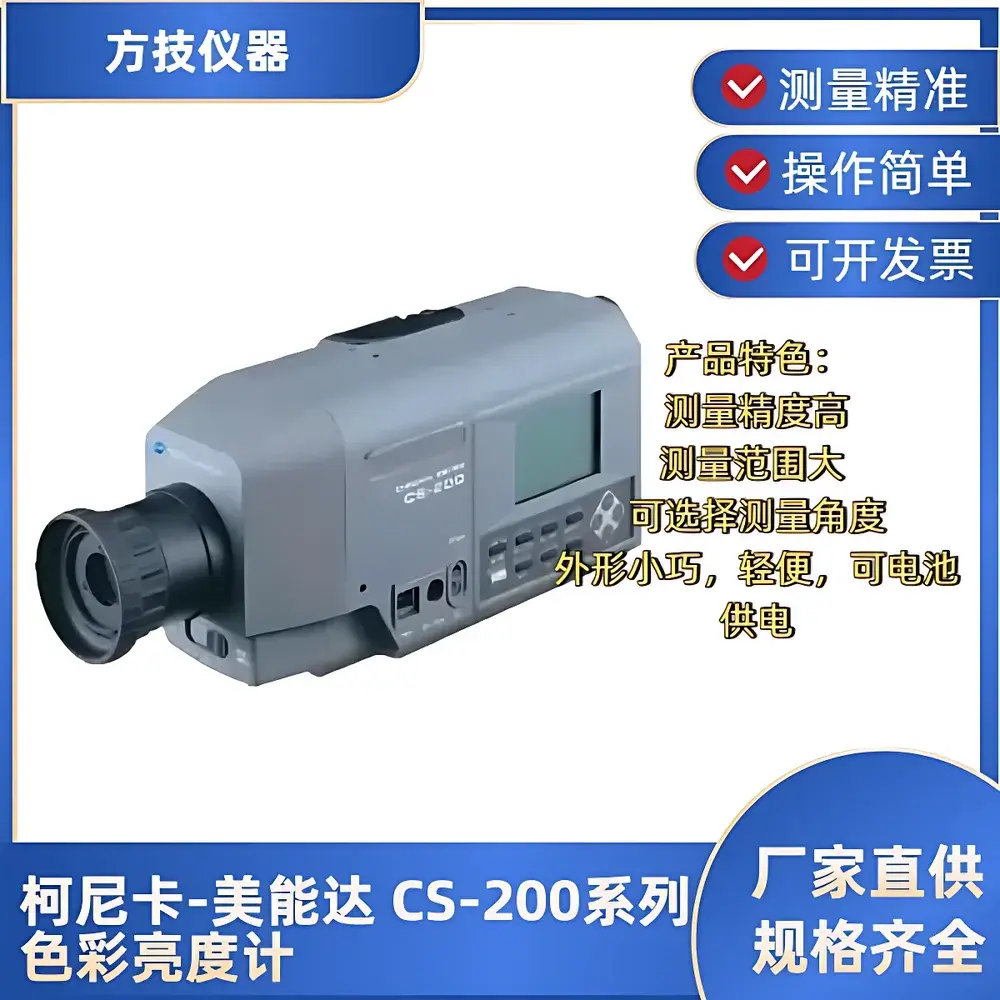
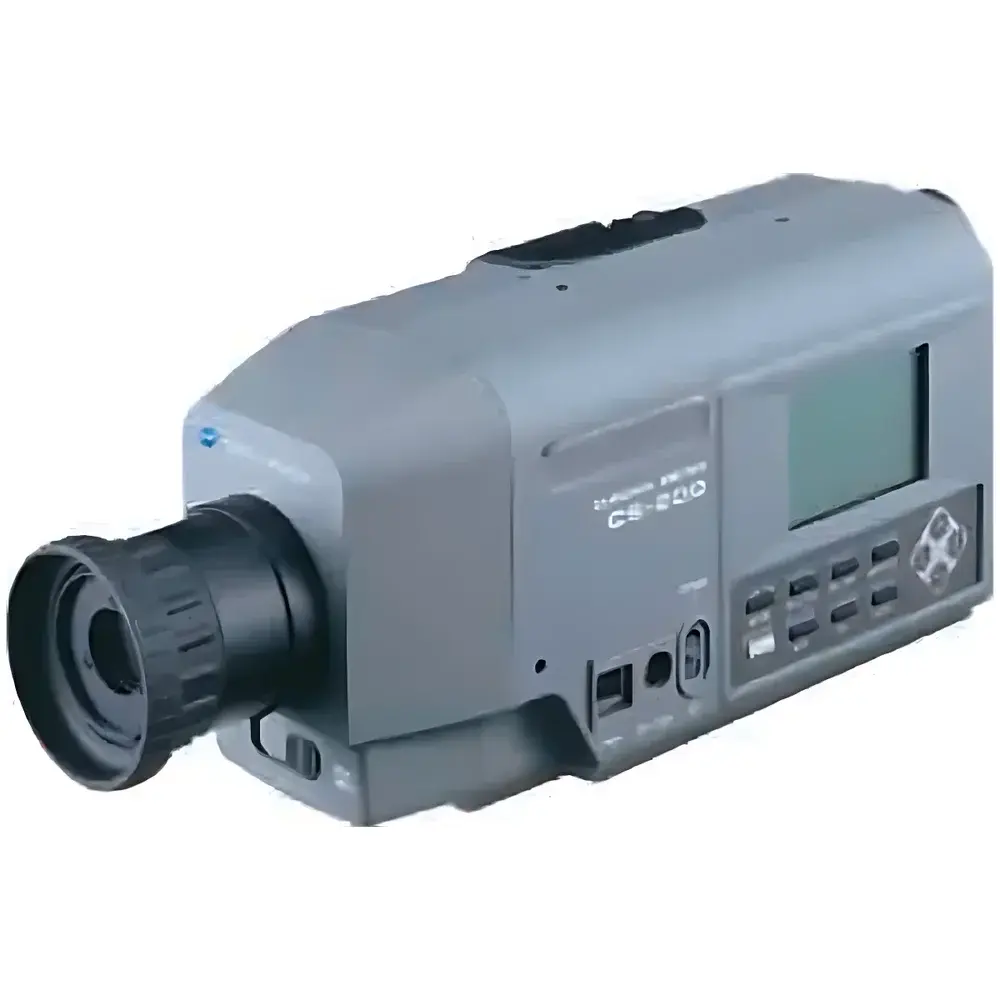
Konica Minolta CS-200 Series Color Luminance Meter / Radiant Luminance Meter / Incident Chromaticity Meter
| Brand | Konica Minolta |
|---|---|
| Origin | Japan |
| Manufacturer Type | Authorized Distributor |
| Origin Category | Imported |
| Model | CS-200 Series |
| Price | USD 16,800 (FOB Yokohama) |
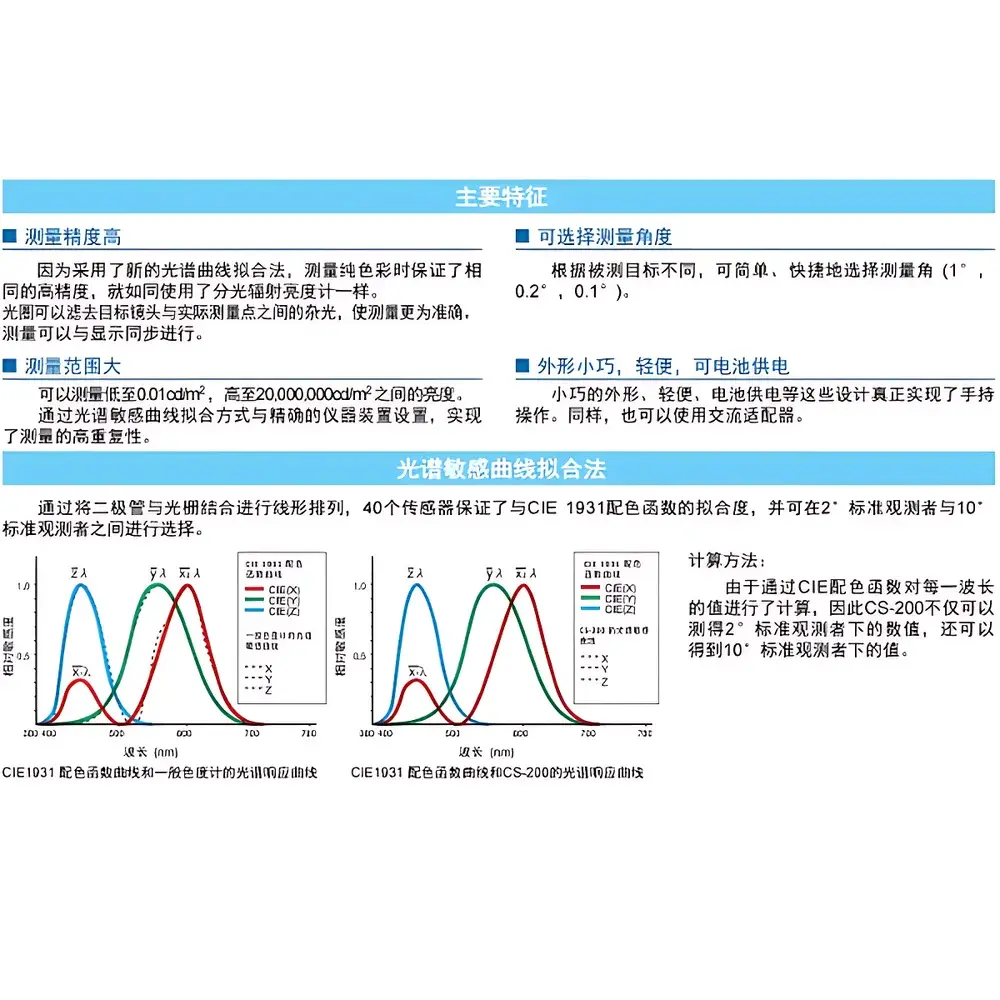
| Measurement Principle | Spectral Response Curve Fitting with 40-Channel Photodiode Array |
| Luminance Range | 0.01 to 20,000,000 cd/m² |
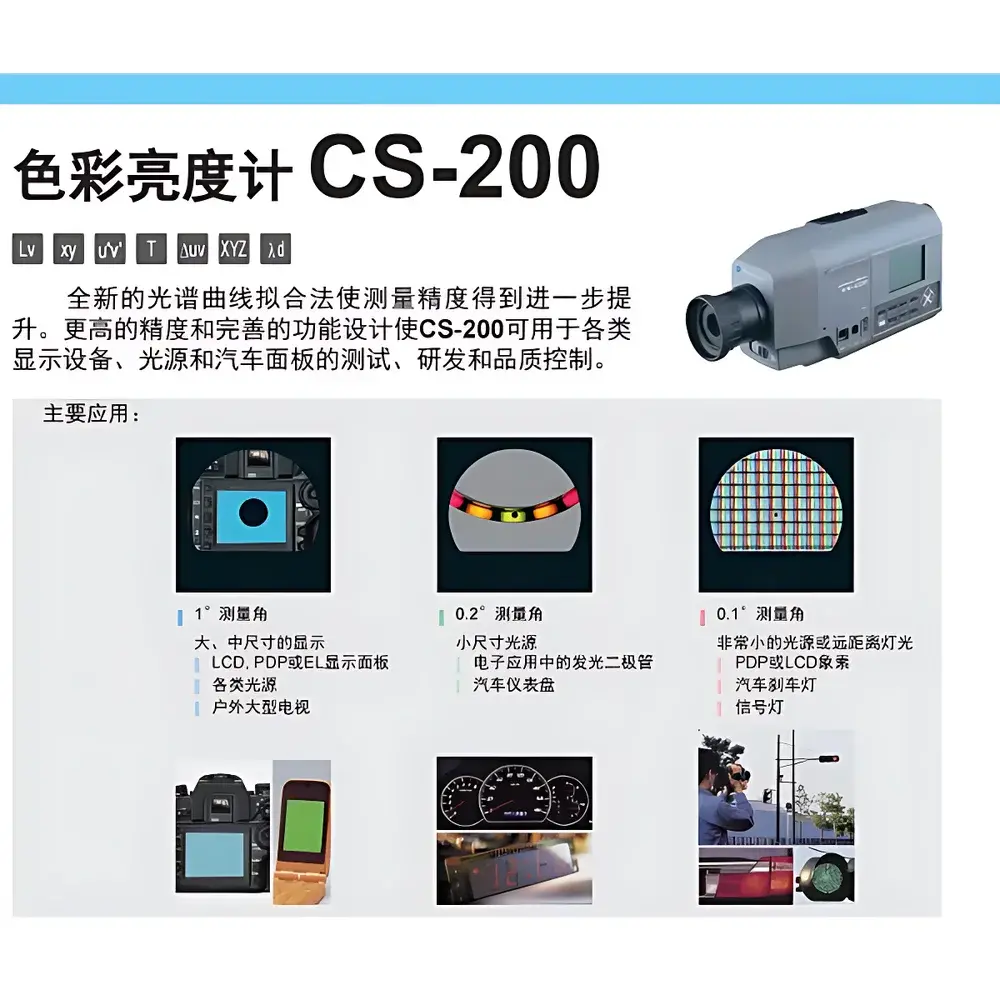
| Field of View Options | 1°, 0.2°, 0.1° |
| CIE Observer Modes | 2° and 10° Standard Observer |
| Compliance | CIE 1931 Color Matching Functions, JIS Z 8722, ISO/CIE 11664-3, ASTM E308-22 |
| Power Supply | Rechargeable Li-ion Battery or AC Adapter |
Overview
The Konica Minolta CS-200 Series is a high-precision, handheld color luminance meter engineered for photometric and chromatic characterization of self-luminous and reflective light sources under real-world conditions. Unlike conventional tristimulus meters relying on broad-band filter-based detection, the CS-200 employs a spectral response curve fitting method—utilizing a linearly arranged 40-channel photodiode array coupled with a precision diffraction grating. This architecture enables direct approximation of the CIE 1931 2° and 10° standard observer color matching functions across the visible spectrum (380–780 nm), delivering measurement fidelity comparable to laboratory-grade spectroradiometers—without requiring spectral data acquisition or post-processing interpolation. The instrument operates on the fundamental principle of photopic luminance quantification (Y in CIE XYZ space) combined with chromaticity coordinate derivation (x, y or u’, v’) and correlated color temperature (CCT) calculation—all traceable to NIST-calibrated reference standards. Its design targets applications where spatial resolution, low-light sensitivity, and observer-angle flexibility are critical: display manufacturing QA, automotive lighting validation, architectural lighting commissioning, and regulatory conformance testing per IEC 62471 and ENERGY STAR SSL requirements.
Key Features
- High-fidelity spectral response simulation via 40-channel photodiode-grating optical path—achieving >95% CIE 1931 function match (2° observer) and >92% match (10° observer) as verified per CIE Publication 15:2018.
- Three interchangeable field-of-view optics: 1° (standard), 0.2° (for small-area LED chips or microdisplays), and 0.1° (for high-resolution OLED subpixels or laser projection spots).
- Extended luminance dynamic range: 0.01 cd/m² (low-brightness OLED black level verification) to 20,000,000 cd/m² (sunlight-reflective signage or automotive headlamp hot-spot analysis), maintained across all FOV settings.
- Real-time synchronous measurement and display—no latency between optical integration and numerical output; supports continuous monitoring at up to 10 Hz sampling rate.
- Integrated optical baffle system suppresses stray light from adjacent surfaces, ensuring measurement integrity even in uncontrolled ambient environments (e.g., production floor or outdoor installation sites).
- Portable form factor (220 × 85 × 185 mm, 1.2 kg) with dual power options: rechargeable lithium-ion battery (up to 8 hours continuous operation) or universal AC adapter (100–240 V, 50/60 Hz).
Sample Compatibility & Compliance
The CS-200 Series accommodates diverse emissive and reflective targets—including LCD/OLED/Mini-LED displays, automotive interior/exterior lamps, signage panels, projection screens, and general lighting fixtures. It supports both absolute luminance (cd/m²), chromaticity (CIE 1931 x,y or CIE 1976 u’,v’), dominant wavelength, excitation purity, and CCT reporting. All measurements comply with international photometric standards: JIS Z 8722 (Methods of measuring luminance and chromaticity), ISO/CIE 11664-3:2019 (Colorimetry – Part 3: CIE Tristimulus Values), and ASTM E308-22 (Standard Practice for Computing the Colors of Objects by Using the CIE System). Instrument calibration is performed against Konica Minolta’s traceable reference standards, certified to ISO/IEC 17025:2017 by JAB-accredited laboratories. Data outputs meet GLP/GMP documentation requirements, including timestamped metadata, operator ID fields, and instrument serial number embedding.
Software & Data Management
The CS-200 interfaces seamlessly with Konica Minolta’s proprietary SpectraMagic NX software (Windows 10/11 compatible) via USB-C or Bluetooth 5.0. SpectraMagic NX provides full configuration control, batch measurement logging, statistical process control (SPC) charting, pass/fail threshold mapping, and export to CSV, Excel, or PDF report formats. Audit trail functionality records all parameter changes, calibration events, and user actions—supporting FDA 21 CFR Part 11 compliance when enabled with digital signature modules. Raw measurement datasets retain full spectral response weighting coefficients and observer-mode selection flags, enabling retrospective reprocessing without hardware re-measurement.
Applications
- Display manufacturing: Mura detection, grayscale uniformity mapping, white point stability tracking over time and temperature.
- Automotive lighting: Headlamp beam pattern luminance profiling, DRL chromaticity tolerance verification per UNECE R149.
- Architectural lighting: Uniformity assessment of façade illumination systems per CIE 153:2010 guidelines.
- Regulatory testing: Photobiological safety evaluation (IEC 62471), ENERGY STAR SSL product certification, and DLC Qualified Products List submissions.
- R&D labs: Material reflectance modeling, LED phosphor development, and human-centric lighting (HCL) spectral tuning validation.
FAQ
Does the CS-200 require annual recalibration to maintain traceability?
Yes—Konica Minolta recommends annual factory recalibration against primary standards. Field verification using certified luminance reference tiles (e.g., Konica Minolta LS-100 Calibration Kit) is advised before each critical measurement session.
Can the CS-200 measure pulsed or PWM-driven light sources?
Yes—the instrument supports synchronized gated integration mode for stable readings on flickering or pulse-width modulated emitters, with adjustable shutter timing from 10 ms to 1 s.
Is the 0.1° optical attachment suitable for measuring micro-LED arrays with 10 µm pitch?
The 0.1° FOV corresponds to ~1.75 mrad angular resolution; at 300 mm working distance, this yields a spot diameter of ~0.53 mm—sufficient for macro-level micro-LED panel homogeneity assessment but not sub-pixel resolution. For pixel-level metrology, a dedicated microscope-coupled spectroradiometer is recommended.
How does the CS-200 handle metamerism in multi-spectral light sources?
While optimized for CIE-compliant colorimetry, the CS-200 does not resolve spectral power distribution (SPD); thus, metameric failure risk remains for sources with divergent SPDs but identical tristimulus values. For SPD-critical applications (e.g., horticultural lighting), a spectroradiometer such as the Konica Minolta CL-500A is advised.




