
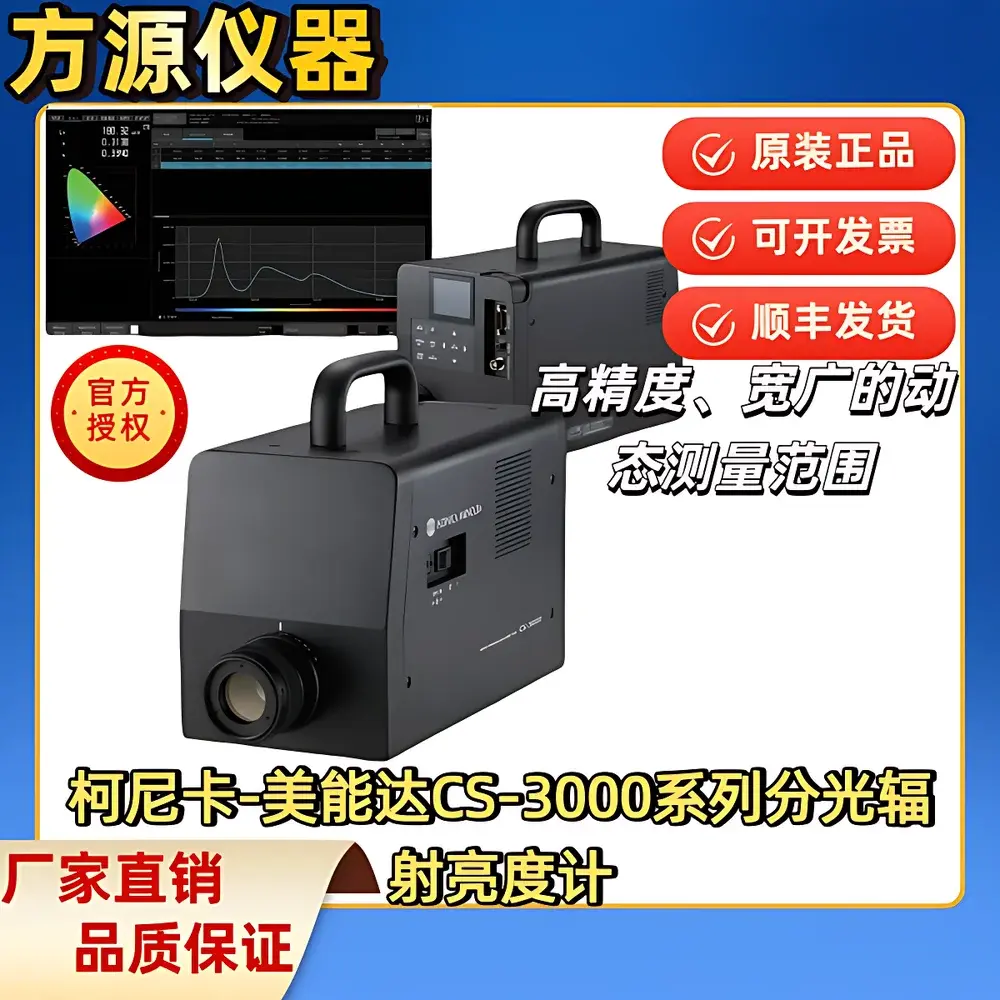
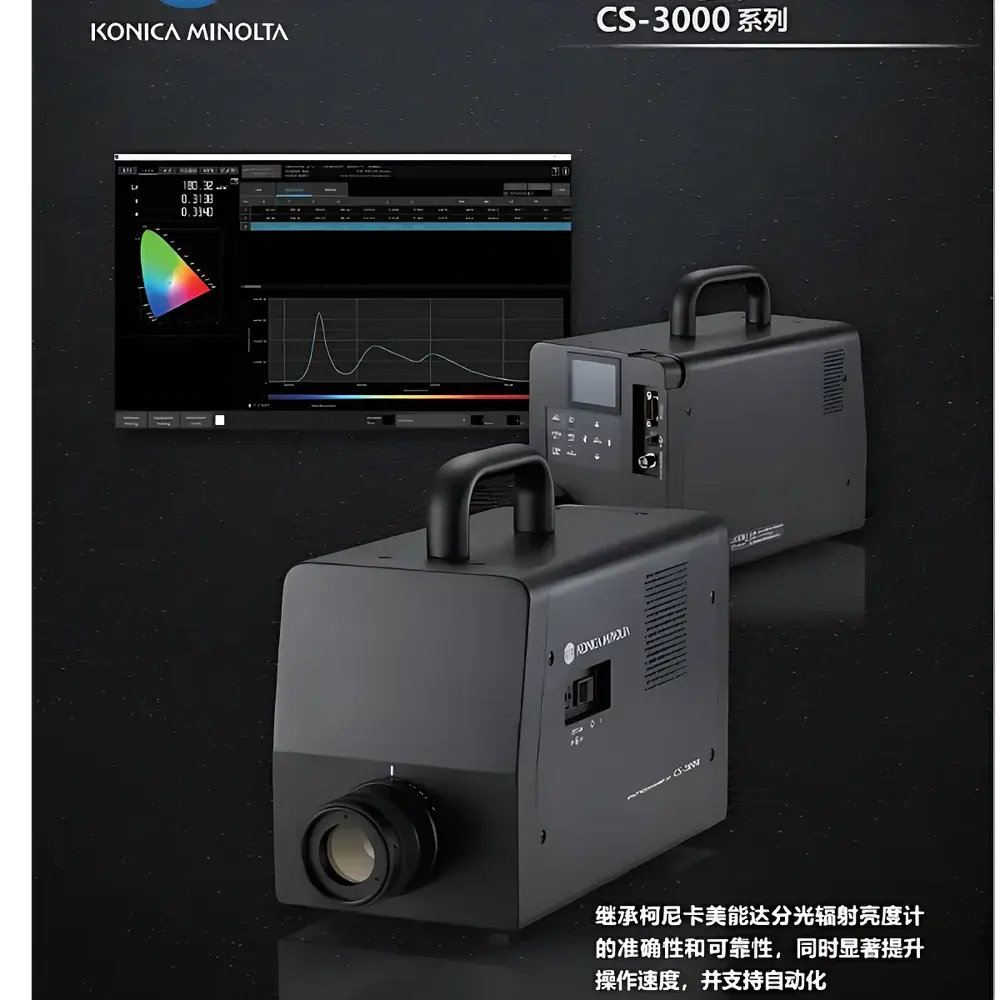
Konica Minolta CS-3000 Series Spectroradiometer
| Brand | Konica Minolta |
|---|---|
| Origin | Japan |
| Model | CS-3000 Series |
| Measurement Principle | Diffraction-grating-based spectroradiometry |
| Luminance Range | 0.0005–3,000 cd/m² (typical, dependent on aperture and lens configuration) |
| Chromaticity Accuracy | ±0.002 in CIE x,y (against NIST-traceable standards) |
| Spectral Resolution | ≤5 nm FWHM |
| Integration Time | 10 ms–10 s (programmable) |
| Interface | USB 2.0, RS-232C, Ethernet (optional) |
| Compliance | ISO/CIE compliant spectral measurement architecture |
| Software Support | Konica Minolta SpectraMagic™ NX v3.x |
Overview
The Konica Minolta CS-3000 Series Spectroradiometer is a high-precision, laboratory-grade optical instrument engineered for absolute spectral radiance and luminance characterization of self-luminous and reflective display surfaces, light sources, and lighting systems. Utilizing a thermally stabilized, fixed-grating monochromator with a back-thinned CCD linear image sensor, the CS-3000 delivers traceable spectral measurements across the visible range (380–780 nm) at ≤5 nm full-width-at-half-maximum (FWHM) resolution. Its optical design adheres to CIE Publication No. 127 and ISO/CIE 19476:2014 requirements for spatially resolved spectral radiance measurement, enabling accurate calculation of photometric (cd/m², lm/m²), colorimetric (CIE 1931 x,y; u’v’; ΔE₀₀), and radiant quantities (W/sr·m²·nm). The system is calibrated against NIST-traceable reference standards and supports optional factory recalibration with documented uncertainty budgets per ISO/IEC 17025 guidelines.
Key Features
- High-speed spectral acquisition: Achieves full-spectrum capture in as little as 100 ms (standard mode), enabling rapid evaluation of dynamic displays and pulsed LED sources.
- Modular optical head design: Interchangeable lenses (e.g., 0.1°, 0.2°, 1° field-of-view) and apertures allow flexible spatial resolution scaling from micro-display pixels to large-area signage.
- Thermal stabilization architecture: Active temperature control of the spectrometer core minimizes wavelength drift (<0.05 nm/°C), ensuring long-term measurement repeatability over extended operation cycles.
- Low-noise detection system: Back-thinned CCD sensor with 2048-pixel linear array provides high quantum efficiency (>70% at 550 nm) and dynamic range exceeding 1:10⁶ (typical).
- Robust mechanical construction: Aluminum alloy housing with EMI-shielded enclosure meets IEC 61326-1 for electromagnetic compatibility in industrial and R&D lab environments.
- Real-time spectral preview and pass/fail thresholding: On-device LCD interface supports immediate visual verification of spectral shape, peak wavelength, and dominant wavelength compliance.
Sample Compatibility & Compliance
The CS-3000 series accommodates planar emissive devices including OLED, MicroLED, LCD, and Mini-LED panels; automotive interior lighting; architectural LED modules; and projection screen reflectance targets under controlled illumination. It supports both near-field (contact or close-proximity) and far-field (telecentric lens configuration) measurement geometries per CIE 127:2007 conditions A and B. All firmware and calibration data are version-controlled and audit-ready for GLP/GMP environments. Measurement reports include full spectral data files (.spc), metadata (integration time, lens ID, calibration date), and traceability statements aligned with ISO/IEC 17025 and FDA 21 CFR Part 11 requirements when used with SpectraMagic™ NX in validated mode.
Software & Data Management
SpectraMagic™ NX v3.x serves as the primary control and analysis platform, offering scriptable automation via COM/ActiveX interfaces for integration into production test lines or automated optical inspection (AOI) workflows. The software enables batch processing of spectral datasets, statistical process control (SPC) charting, multi-point uniformity mapping, and generation of IESNA LM-79/LM-80-compliant reports. Raw spectral data is stored in vendor-neutral formats (ASCII .spc, CSV) and supports third-party import into MATLAB, Python (NumPy/Pandas), or LabVIEW. Audit trails record all user actions, parameter changes, and calibration events with timestamps and operator IDs—fully compliant with electronic record retention mandates.
Applications
- Display manufacturing: Pixel-level luminance uniformity, white point stability, and temporal color shift analysis during burn-in testing.
- Automotive lighting validation: Headlamp beam pattern spectral fidelity, DRL chromaticity consistency, and adaptive driving beam (ADB) modulation characterization.
- AR/VR microdisplay qualification: Angular-dependent spectral output, etendue-matched radiance profiling, and Mura defect quantification.
- Lighting R&D: LED phosphor conversion efficiency modeling, CCT binning verification, and TM-30-15 fidelity index (Rf) and gamut index (Rg) computation.
- Regulatory conformance: Pre-submission testing for ENERGY STAR, DLC, and CE marking requirements related to photobiological safety (IEC 62471) and color rendering accuracy.
FAQ
What spectral calibration standards are used for the CS-3000 series?
Each unit ships with a dual-point NIST-traceable calibration certificate covering both irradiance and radiance modes, with uncertainty values reported per ISO/IEC 17025 Annex A.
Can the CS-3000 measure pulsed or PWM-driven LEDs?
Yes—programmable integration timing (10 ms–10 s) and external trigger synchronization enable precise phase-locked acquisition of modulated light sources.
Is remote operation supported over Ethernet?
Ethernet connectivity is available as an optional hardware module and fully supported in SpectraMagic™ NX for unattended server-based measurement campaigns.
How often is recalibration recommended?
Annual recalibration is advised for routine QC use; biannual recalibration is recommended for metrology-critical applications or after mechanical shock exposure.
Does the system support CIE 2015 color matching functions?
SpectraMagic™ NX v3.x includes selectable CIE 1931, CIE 1964, and CIE 2015 CMFs, with automatic interpolation for non-standard observer angles.



