
Konica Minolta CS-3000HDR / CS-3000 Spectroradiometer
| Brand | Konica Minolta |
|---|---|
| Origin | Japan |
| Model | CS-3000HDR / CS-3000 |
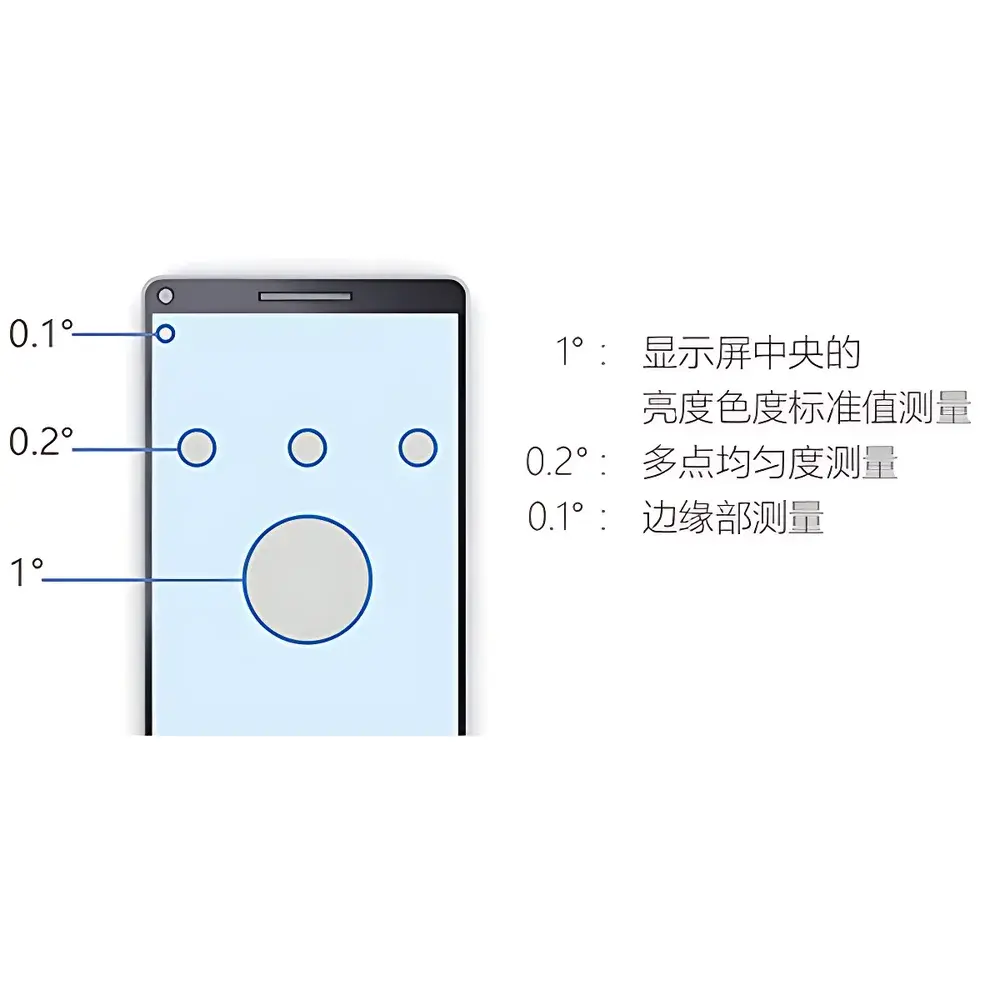
| Measurement Angle Options | 1° / 0.2° / 0.1° (motorized) |
| Luminance Range (1°, CS-3000HDR) | 0.0001–100,000 cd/m² |
| Spectral Bandwidth (FWHM) | <5 nm |
| Chromaticity Accuracy (at 0.05 cd/m²) | x: ±0.0015, y: ±0.001, u': ±0.0014, v': ±0.0006 |
| Compliance | CIE 122:1996 |
| Measurement Modes | FAST, SUPER FAST1, SUPER FAST2, INTELLIGENT DARK, Frequency-Synchronized Integration |
Overview
The Konica Minolta CS-3000HDR and CS-3000 are high-precision spectroradiometers engineered for absolute luminance and chromaticity characterization of modern emissive displays. Operating on the principle of diffraction-grating-based spectral decomposition followed by CCD array detection, these instruments deliver calibrated spectral power distribution (SPD) data across the visible spectrum (380–780 nm) with a full-width-at-half-maximum (FWHM) optical bandwidth of less than 5 nm—meeting the stringent requirements of CIE Publication 122:1996 for colorimetric measurement accuracy. Designed specifically for R&D, production line verification, and quality assurance in display manufacturing, the CS-3000 series supports conventional LCD and OLED technologies as well as next-generation HDR-capable emitters including Micro LED and Mini LED. Its core architecture integrates thermally stabilized optics, low-noise signal processing, and real-time dark-current compensation to ensure metrological integrity under variable ambient and operational conditions.
Key Features
- Motorized triple-angle optical head (1°, 0.2°, 0.1°) enabling rapid adaptation to diverse display pixel pitches and viewing distances without manual lens exchange
- Extended dynamic luminance range: 0.0001–100,000 cd/m² (CS-3000HDR model), validated per 1° field-of-view configuration
- Three accelerated acquisition modes—FAST (≈1/6 normal integration time), SUPER FAST1 (≈1/20), and SUPER FAST2 (≈1/90)—enabling gamma curve mapping and uniformity analysis in minutes rather than hours
- INTELLIGENT DARK algorithm: continuously models sensor dark-current drift using on-the-fly reference measurements and internal compensation coefficients, eliminating the need for periodic full dark scans while preserving traceable accuracy
- Auto-detection and synchronization of display emission frequency (e.g., PWM, DC dimming, or hybrid driving schemes); integration time is automatically set to integer multiples of frame period to suppress temporal aliasing and improve repeatability
- CIE 1931 xy and CIE 1976 u’v’ chromaticity coordinates computed directly from measured SPD, with certified accuracy at low luminance levels (e.g., ±0.0015 in x at 0.05 cd/m²)
Sample Compatibility & Compliance
The CS-3000 series is optimized for flat-panel emissive sources, including active-matrix OLED, quantum-dot enhanced LCD, transparent OLED, and microscale emissive arrays. It accommodates both laboratory-grade characterization (e.g., angular emission profiling, temporal response analysis) and inline factory testing via RS-232, USB, or Ethernet interfaces. All photometric and colorimetric calculations adhere to CIE 122:1996 guidelines for spectral radiance measurement, and the instrument’s calibration traceability is maintained to NMI-level standards through Konica Minolta’s accredited calibration services. While not inherently FDA 21 CFR Part 11 compliant, audit-ready data export (CSV, XML, SPC) and timestamped measurement logs support GLP/GMP-aligned documentation workflows when integrated into validated test systems.
Software & Data Management
The CS-Suite software provides native control, real-time spectral visualization, batch measurement scripting, and automated report generation. Raw spectral data are stored in industry-standard formats (JIS Z 8722-compliant ASCII, CIE 15:2018 SPD XML schema), ensuring interoperability with third-party analysis platforms such as MATLAB, Python-based color science toolkits (e.g., colour-science), and statistical process control (SPC) suites. Export options include full SPD tables, CIE XYZ, Yxy, u’v’, CCT, Duv, and ΔE₀₀ matrices. For automated test cells, the instrument supports SCPI-compliant command sets and TCP/IP socket communication, enabling seamless integration with LabVIEW, Python automation frameworks, or MES-level orchestration layers.
Applications
- Gamma curve validation and grayscale tracking across brightness levels (0.001–100,000 cd/m²)
- Low-luminance uniformity mapping for OLED panel burn-in assessment and Mura detection
- I-V-L (current–voltage–luminance) characterization of display subpixels and emissive materials during material development
- HDR metadata verification—including PQ (SMPTE ST 2084) and HLG transfer function compliance—via absolute nits measurement at peak white and black levels
- Color filter and encapsulation layer evaluation through spectral reflectance/emission ratio analysis
- Calibration and verification of integrating sphere-based display testers and camera-based photometry systems
FAQ
What is the difference between the CS-3000 and CS-3000HDR models?
The CS-3000HDR extends the lower and upper luminance limits of the base CS-3000, supporting measurements from 0.0001 cd/m² to 100,000 cd/m² using the 1° optical configuration. The standard CS-3000 typically covers 0.001–30,000 cd/m².
Does the instrument require periodic recalibration?
Yes. Konica Minolta recommends annual calibration against traceable standards; extended calibration intervals may be justified under documented stability monitoring per ISO/IEC 17025 requirements.
Can the CS-3000 measure pulsed or flickering light sources?
Yes—its frequency-synchronization function detects modulation frequency (1 Hz–2 kHz) and locks integration timing to avoid beat-frequency artifacts, ensuring repeatable photometric results for PWM-driven displays.
Is dark-current compensation performed automatically during every measurement?
Not by default—but the INTELLIGENT DARK mode enables intelligent estimation of dark-current drift without dedicated dark scans, maintaining accuracy while optimizing throughput in high-volume test environments.
Which CIE standards does the CS-3000 implement for chromaticity computation?
It implements CIE 1931 2° Standard Observer and CIE 1964 10° Standard Observer spectral tristimulus values, with chromaticity coordinates calculated per CIE 15:2018 and CIE 122:1996 specifications.




