
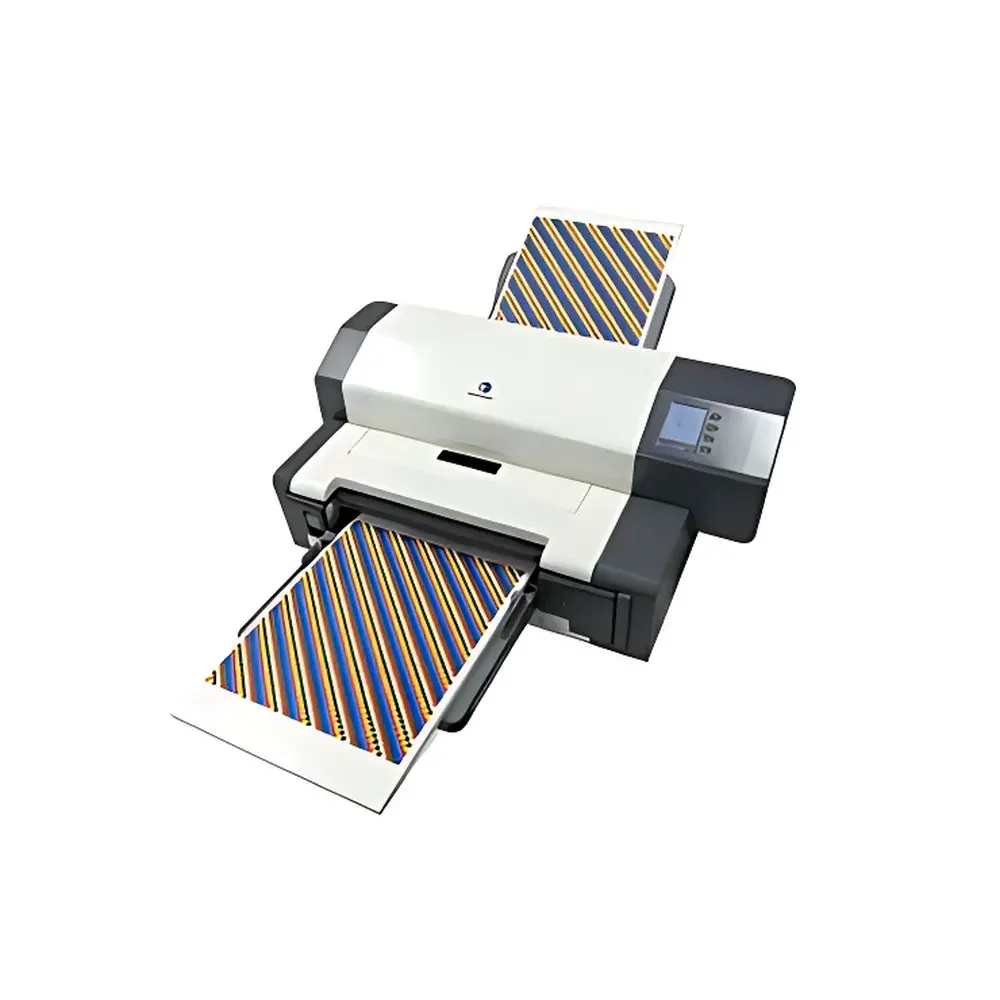
Konica Minolta FD-9 Desktop Spectrodensitometer
| Brand | Konica Minolta |
|---|---|
| Origin | Japan |
| Model | FD-9 |
| Product Type | Spectrodensitometer |
| Instrument Type | Desktop |
| Optical Geometry | d/8° integrating sphere |
| Compliance | ISO 5-4, ISO 13655:2017 (M0/M1/M2/M3), ASTM E308, ISO 2846-1 |
| Connectivity | USB 2.0, TCP/IP Ethernet |
| Display | Built-in high-resolution LCD touchscreen |
| Automation Support | Optional auto-feeder (up to 100 sheets) |
| Measurement Mode | Single-spot stop-and-measure (non-scanning) |
| Data Output | Multi-illumination condition simultaneous reporting (M0, M1, M2) |
| Software Interface | Konica Minolta SpectraMagic NX Pro (FDA 21 CFR Part 11 compliant audit trail optional) |
Overview
The Konica Minolta FD-9 Desktop Spectrodensitometer is a high-precision, production-grade optical measurement instrument engineered specifically for color-critical workflows in commercial printing, packaging, and prepress environments. Unlike scanning-based densitometers or general-purpose spectrophotometers, the FD-9 employs a true single-spot, stop-and-measure methodology—where the sensor physically positions over each patch and acquires spectral reflectance data under controlled illumination before advancing. This architecture eliminates interpolation artifacts and ensures metrological integrity across heterogeneous chart layouts, including hybrid, non-standard, or legacy target formats. Its core optical design features an 8°/d integrating sphere geometry compliant with ISO 13655:2017, enabling accurate separation of diffuse and specular components and supporting full M0, M1, M2, and M3 measurement modes within a single acquisition cycle. The instrument operates across the visible spectrum (typically 360–740 nm at 10 nm intervals), delivering absolute spectral reflectance data traceable to NIST-certified standards. Designed for integration into automated quality control pipelines, the FD-9 meets ISO 5-4 requirements for densitometric repeatability and supports GLP/GMP-aligned operational protocols through configurable user authentication, electronic signatures, and audit-trail-enabled software options.
Key Features
- World-class measurement speed: Completes full characterization of 1,500-patch charts—including spectral capture, illumination mode switching, and data export—in approximately 4 minutes.
- Non-scanning, position-locked spot measurement: Eliminates spatial averaging errors associated with line-scan or drum-based systems; guarantees per-patch fidelity without interpolation.
- Simultaneous multi-illumination reporting: Generates M0 (D50), M1 (D50 + UV component), M2 (UV-cut), and M3 (polarized) density and colorimetric values from one physical measurement sequence.
- Flexible chart compatibility: No proprietary chart format required—supports custom, mixed-layout, or industry-standard targets (e.g., IT8.7/4, ECI2002, GRACoL, SWOP, FOGRA39) without preprocessing or alignment templates.
- Integrated automation readiness: Optional high-capacity auto-feeder accommodates up to 100 sheets, enabling unattended overnight calibration verification and process validation runs.
- Dual connectivity architecture: Native USB 2.0 interface for local PC control and TCP/IP Ethernet port for networked deployment—enabling centralized management across multiple FD-9 units in shared lab or pressroom environments.
- Onboard interactive interface: 7-inch high-resolution LCD touchscreen with intuitive icon-driven navigation, real-time spectral preview, and immediate pass/fail flagging against user-defined tolerances.
Sample Compatibility & Compliance
The FD-9 accepts standard sheet-fed substrates up to 300 g/m², including coated/uncoated paper, synthetic films, corrugated board, and metallized foils. Its 4.5 mm aperture ensures stable contactless measurement on textured or embossed surfaces without mechanical pressure. All optical calibrations are performed using factory-installed ceramic white and black standards traceable to JCSS (Japan Calibration Service System). The instrument conforms to ISO 13655:2017 for spectral densitometry, ISO 5-4 for repeatability assessment (<0.01 ΔE*₀₀ for solid patches), and ASTM E308 for colorimetric computation. When paired with SpectraMagic NX Pro v4.0+, it supports FDA 21 CFR Part 11 compliance via optional electronic signature modules, role-based access control, and immutable audit logs—making it suitable for regulated print validation in pharmaceutical packaging and medical device labeling applications.
Software & Data Management
Konica Minolta SpectraMagic NX Pro serves as the primary analysis and reporting platform for the FD-9. It provides full spectral data visualization, ISO-compliant density calculation (Status T, Status E, Status I), dot gain analysis, TVI curves, and G7® gray balance verification. Raw spectral files (.qtx) are stored in open-format XML structure for third-party integration with MIS, ERP, or cloud-based QC dashboards. Batch processing scripts support automated report generation (PDF, CSV, Excel), statistical process control (SPC) charting, and trend analysis across time-series measurements. Data export includes full metadata: instrument serial number, calibration timestamp, operator ID, environmental conditions (optional hygrothermograph input), and measurement geometry parameters—ensuring full traceability per ISO/IEC 17025 requirements.
Applications
- Press calibration and linearization: Rapid generation of ICC profiles and plate curve adjustments using single-pass chart measurement.
- Proof-to-press validation: Objective comparison of digital proofs against press sheets under standardized M1 illumination.
- Contract proofing verification: Quantitative assessment of conformance to ISO 12647-2 and GRACoL specifications.
- Color consistency monitoring: Long-term drift tracking across shifts, inks lots, and substrate batches.
- G7® certification support: Automated gray balance analysis and neutral print density reporting.
- Regulated packaging QA: Documentation-ready reports for FDA, EU MDR, or ISO 13485 audits in pharmaceutical and medical printing.
FAQ
What illumination standards does the FD-9 support?
The FD-9 natively supports M0 (D50), M1 (D50 + UV), M2 (UV-filtered), and M3 (polarized) modes per ISO 13655:2017—all derived from a single spectral acquisition without re-measurement.
Can the FD-9 measure metallic or pearlescent inks?
Yes, its d/8° geometry with specular component included (SCI) mode enables robust measurement of effect pigments; however, for gonio-apparent materials, a dedicated multi-angle spectrophotometer is recommended.
Is remote firmware update supported?
Firmware updates are delivered via Konica Minolta’s secure Customer Portal and installed locally through USB or Ethernet; no cloud-based OTA functionality is implemented to maintain air-gapped lab security.
Does the FD-9 require annual recalibration?
While not mandatory, Konica Minolta recommends biannual verification against certified reference standards; full recalibration by an accredited service center is advised every 24 months or after impact events.
How is measurement traceability maintained?
Each unit ships with a Certificate of Conformance listing JCSS-traceable calibration data; users may generate internal calibration records with timestamps, operator IDs, and environmental logs via SpectraMagic NX Pro’s GLP module.




