
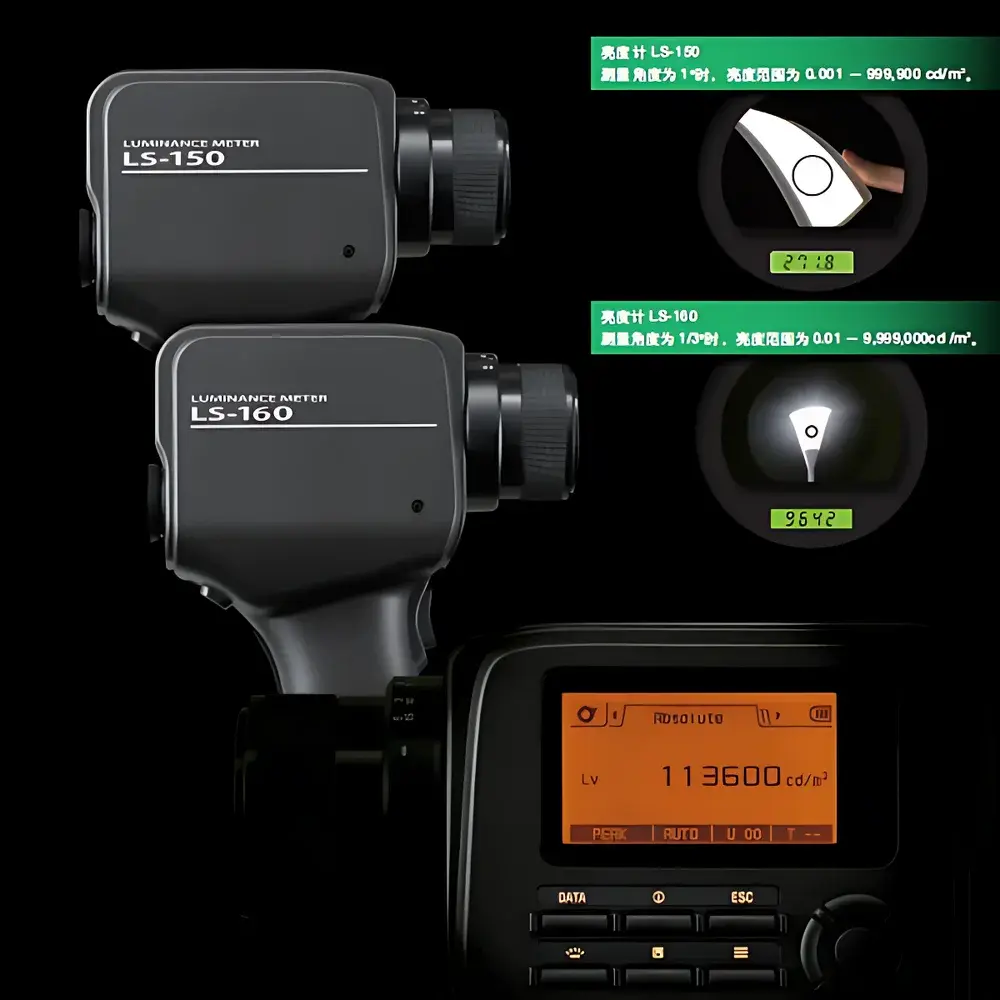
Konica Minolta LS-150 / LS-160 Portable Luminance Meter
| Brand | Konica Minolta |
|---|---|
| Origin | Japan |
| Model | LS-150 / LS-160 |
| Luminance Range | 0.001–999,900 cd/m² (LS-150), 0.01–9,999,000 cd/m² (LS-160) |
| Measurement Angle | 1° / 1/3° |
| Optical System | Single-Lens Reflex (SLR), f=85 mm, F2.8 |
| Spectral Response | Matched to CIE V(λ) Photopic Luminosity Function |
| Accuracy | ±2% ±2 digits (≤1 cd/m²), ±2% ±1 digit (>1 cd/m²) |
| Repeatability | 0.2% + 1 digit |
| Minimum Measured Area | 14.4 mm Ø (1.3 mm Ø with optional close-up lens for LS-160) |
| Shortest Measurement Distance | 1012 mm (213 mm with close-up lens) |
| Operating Temperature | 0–40 °C, RH ≤85% (non-condensing) |
| Dimensions | 71 × 214 × 154 mm |
| Weight | 850 g (body only) |
| Compliance | DIN 5032-7 Class B (LS-150) |
| Interface | USB 2.0 |
| Power | USB bus power or AC adapter (optional) |
| Data Storage | 1,000 readings |
| Display | Backlit multi-digit LCD (external), 4-digit LED-backlit viewfinder LCD |
Overview
The Konica Minolta LS-150 and LS-160 are high-precision, portable luminance meters engineered for photometric measurement of surface and source luminance under diverse ambient and operational conditions. Based on the CIE 1931 photopic luminosity function V(λ), these instruments employ a single-lens reflex (SLR) optical architecture with spectral sensitivity rigorously calibrated to match human photopic vision—enabling traceable, metrologically sound luminance quantification in cd/m² (candela per square meter) or foot-lamberts (fl). As direct successors to the LS-100 and LS-110, the LS-150/160 series integrates enhanced V(λ) matching, extended dynamic range, and improved stray-light suppression (<1% contribution from off-axis irradiance), making them suitable for demanding applications where spectral fidelity and spatial resolution are critical—such as display characterization, transportation signaling, architectural lighting validation, and regulatory compliance testing.
Key Features
- SLR optical design with f=85 mm, F2.8 lens and 9° field-of-view—enables precise targeting and real-time visual confirmation of measurement area via integrated viewfinder
- Dual measurement angles: 1° standard (LS-150/160) and optional 1/3° (LS-160 only) for high-resolution spot analysis
- Extended luminance range: up to 999,900 cd/m² (LS-150) and 9,999,000 cd/m² (LS-160), supporting both low-brightness OLEDs and ultra-bright automotive LEDs or traffic signals
- Advanced stray-light rejection (<1%) and polarization error ≤1%, ensuring measurement integrity in complex illumination environments
- Temperature drift compensation ≤0.2%/K, validated across 0–40 °C operating range
- Two measurement modes: auto-exposure (0.7–4.3 s) and manual integration (0.7–7.1 s); supports peak/valley capture and luminance ratio calculation
- USB 2.0 interface for real-time data streaming and firmware updates; compatible with Konica Minolta’s CS-S20 software for traceable report generation
Sample Compatibility & Compliance
The LS-150 and LS-160 are designed for non-contact measurement of planar and curved surfaces, emissive displays (CRT, OLED, microLED), signal lamps, roadway signage, tunnel lighting installations, and aircraft/automotive instrumentation panels. With an effective minimum measurement spot diameter of 14.4 mm at 1012 mm working distance—and reducible to 0.4 mm using the optional close-up lens (LS-160 only)—the instruments support ISO/CIE-compliant point-source evaluation per IEC 62471 (photobiological safety) and EN 13201 (road lighting). The LS-150 meets DIN 5032-7 Class B requirements for photometric accuracy and linearity, while both models support calibration traceability to NMI-level standards via Konica Minolta’s accredited calibration services. All measurements adhere to GLP-relevant audit trails when used with CS-S20 software configured for FDA 21 CFR Part 11 compliance (electronic signatures, change logs, user access controls).
Software & Data Management
CS-S20 Data Management Software provides full instrument control, real-time graphing, batch export (CSV, PDF, XML), and customizable reporting templates aligned with ISO/IEC 17025 documentation requirements. The software enables user-defined calibration factor application, multi-point reference storage (up to 10 standards), and automated pass/fail evaluation against preset luminance thresholds. Audit-ready features include timestamped measurement logs, operator ID assignment, and immutable record retention—essential for QA/QC laboratories operating under GMP or ISO 9001 frameworks. Firmware updates and configuration backups are managed directly through the USB interface without external hardware dependencies.
Applications
- Characterization of display luminance uniformity, contrast ratio, and viewing-angle dependence in R&D and production test environments
- Verification of traffic signal luminance per UN ECE Regulation 10 and EN 12367 for railway and aviation ground lighting
- Compliance testing of roadway and tunnel lighting installations against CIE 115 and EN 13201-3
- Photometric validation of outdoor advertising signage, emergency exit signs, and architectural façade lighting
- Quality assurance of backlight units, automotive HUDs, and avionics displays during manufacturing and field service
- Academic and industrial research involving human visual performance modeling, mesopic vision studies, and glare assessment
FAQ
What is the difference between LS-150 and LS-160?
The LS-160 offers higher luminance range (up to 9.999×10⁶ cd/m² vs. 9.999×10⁵ cd/m²), optional 1/3° measurement angle, and compatibility with the close-up lens for sub-millimeter spot measurement (0.4 mm Ø). Both share identical SLR optics, V(λ) matching, and software ecosystem.
Is calibration traceable to national standards?
Yes—Konica Minolta provides ISO/IEC 17025-accredited calibration certificates traceable to NMI Japan (AIST) or NIST upon request. Field recalibration is supported using certified reference standards.
Can the instrument measure pulsed or modulated light sources?
Yes—integrated 20–400 Hz synchronization mode allows stable measurement of PWM-driven LEDs and flickering displays by locking exposure timing to the modulation frequency.
Does the LS-150/160 comply with FDA or EU regulatory requirements for medical device testing?
While not a medical device itself, the instrument supports photometric testing of medical displays (e.g., DICOM GSDF validation) and is deployable in regulated environments when paired with CS-S20 Part 11 configuration and documented calibration history.





