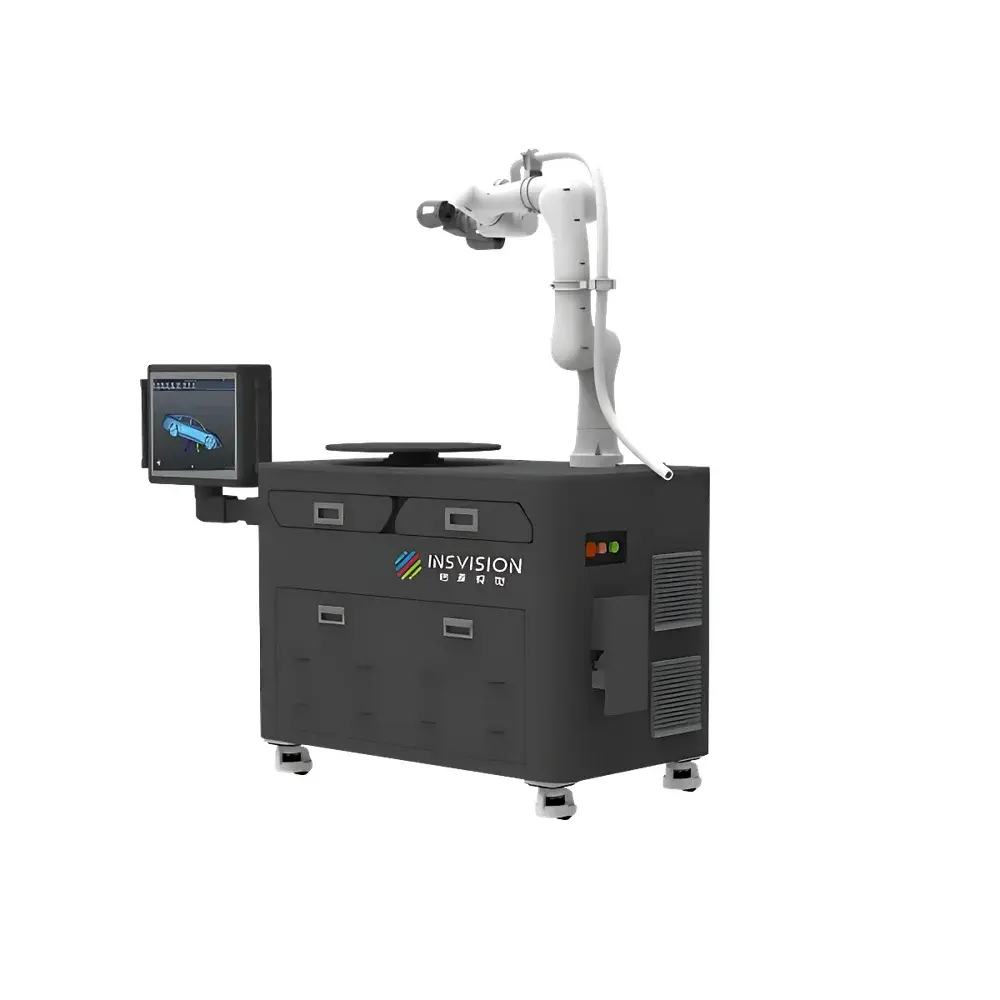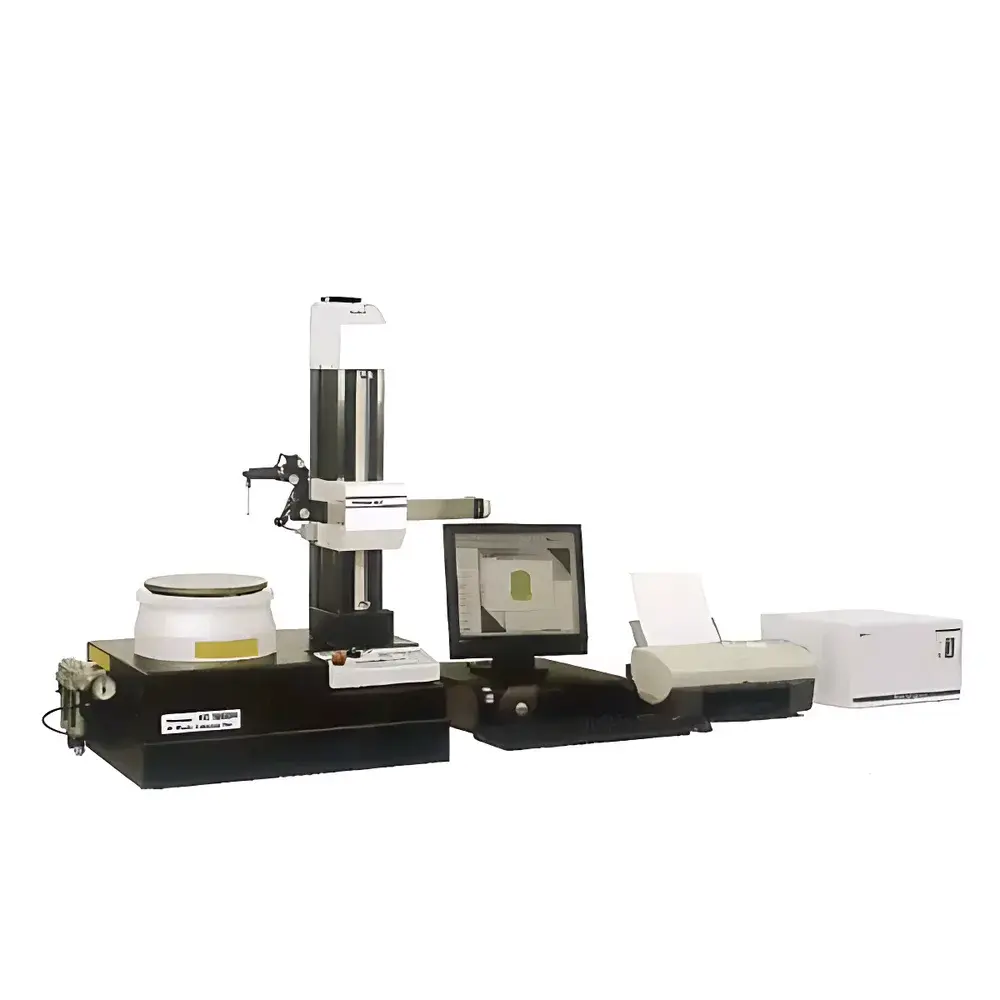
Kosaka Laboratory EC1850H Desktop Roundness and Cylindricity Measuring Instrument
| Brand | Kosaka Laboratory |
|---|---|
| Origin | Japan |
| Model | EC1850H |
| Bearing Type | Porous Air Bearing (Multi-Orifice, Hydrostatic) |
| Spindle Radial Accuracy | (0.02 + 0.00035H) µm (H = height in mm from turntable surface) |
| Max Measurable Diameter | Φ368 mm (internal/external), Φ470 mm (external only), Φ320 mm (internal only) |
| Max Workpiece Diameter/Load Capacity | Φ510 mm / 25 kg |
| Vertical Travel (Z-axis) | 300 mm (with extended stylus arm) |
| Automation Features | Auto-centering, Auto-tilt correction, One-touch multi-orientation probe holder, R/Z-axis servo-controlled auto-stop, Defect region annotation on polar/linear plots |
| Compliance | Designed for ISO 1101, ISO 12181 (Roundness), ISO 12180 (Cylindricity), and ASME Y14.5 geometric dimensioning and tolerancing (GD&T) workflows |
Overview
The Kosaka Laboratory EC1850H is a high-precision desktop roundness and cylindricity measuring instrument engineered for metrology-grade geometric assessment of rotationally symmetric components. It operates on the principle of radial deviation measurement using a high-stability porous air-bearing spindle and a kinematically optimized vertical column system. The instrument rotates the workpiece while a tactile stylus traces its surface profile in both radial (R) and axial (Z) directions, generating full 360° polar data sets for quantitative evaluation of form errors—including roundness, cylindricity, concentricity, runout, straightness, and taper. Its hydrostatic air bearing spindle ensures minimal mechanical hysteresis and thermal drift, enabling repeatable sub-micron resolution in industrial and laboratory environments. Designed for integration into quality control workflows compliant with ISO/IEC 17025-accredited laboratories, the EC1850H supports traceable calibration through NIST-traceable reference artifacts and built-in spindle error separation algorithms.
Key Features
- Porous air-bearing spindle with multi-orifice design delivering ultra-low radial error motion—(0.02 + 0.00035H) µm—as specified per ISO 230-7.
- Integrated auto-centering and auto-tilt correction system that eliminates manual iterative alignment; achieves sub-5 µm centering repeatability within <15 seconds.
- One-touch multi-orientation probe holder with extended lever arm (up to 100 mm overhang), enabling access to deep bores, stepped surfaces, internal diameters, and inclined features without stylus reconfiguration.
- R- and Z-axis servo-controlled auto-stop functionality: dynamically locates optimal probe contact position via real-time force feedback, minimizing operator dependency and reducing setup time by >60%.
- Dedicated defect annotation module allowing direct selection of irregularities on linear or polar deviation plots—enabling targeted tolerance band analysis and automated report flagging per GD&T callouts.
- Emergency stop circuitry compliant with IEC 60204-1, including dual-channel safety monitoring of spindle rotation, Z-axis travel, and probe loading force.
Sample Compatibility & Compliance
The EC1850H accommodates cylindrical, disc-shaped, and flanged workpieces up to Φ510 mm diameter and 25 kg mass. Internal diameter measurement capability extends down to Φ320 mm with standard probe configurations; external measurements support up to Φ470 mm. Vertical travel of 300 mm (with extended stylus arm) permits full-height profiling of shafts, bearing races, hydraulic spools, and precision bushings. All measurement routines adhere to ISO 12181-1 (roundness), ISO 12180-1 (cylindricity), and ISO 1101 (geometrical tolerancing). Data output formats comply with ISO 10360-5 for coordinate measuring machine (CMM) verification protocols. The system is compatible with third-party calibration spheres and master rings certified to ISO 17025 standards.
Software & Data Management
The proprietary Kosaka Measurement Suite (v8.2+) provides intuitive graphical interface for sequence programming, real-time deviation visualization, and statistical process control (SPC) integration. Users define multi-feature measurement plans—including simultaneous roundness, cylindricity, and coaxiality—via drag-and-drop parameter templates. Software enforces audit trail logging per FDA 21 CFR Part 11 requirements, recording operator ID, timestamp, calibration status, and raw profile data hashes. Export options include ASCII (.txt), CSV, DXF, and XML-based GDML (Geometric Dimensioning Markup Language) for interoperability with Minitab, JMP, and enterprise QMS platforms. Optional GLP/GMP modules provide electronic signature enforcement and change control workflows.
Applications
The EC1850H serves critical metrology functions across aerospace (turbine blade root profiles, bearing seat geometry), automotive (crankshaft journals, CV joint housings), medical device manufacturing (orthopedic implant stems, dental abutment interfaces), and precision optics (lens mount concentricity, collimator tube cylindricity). Its robust architecture and sealed air-bearing column make it suitable for shop-floor deployment near CNC lathes and grinding cells, while its sub-micron stability meets ISO/IEC 17025 laboratory validation criteria. Routine use cases include first-article inspection, process capability studies (Cpk/Ppk), supplier qualification audits, and failure analysis of out-of-spec geometric deviations.
FAQ
What standards does the EC1850H support for roundness and cylindricity evaluation?
It fully complies with ISO 12181-1 (roundness), ISO 12180-1 (cylindricity), ISO 1101 (GD&T), and ASME Y14.5–2018 for geometric tolerancing interpretation.
Can the system measure both internal and external diameters automatically?
Yes—using the one-touch probe holder and programmable Z/R-axis positioning, the EC1850H executes fully automated ID/OD measurement sequences without manual stylus repositioning.
Is the software validated for regulated industries such as pharmaceuticals or medical devices?
The optional GxP package includes 21 CFR Part 11-compliant audit trails, electronic signatures, and configuration change control—validated per IQ/OQ protocols.
What is the maximum part height that can be measured with the standard configuration?
With the extended stylus arm, vertical travel reaches 300 mm; standard column height allows up to 220 mm without extension.
Does the system require external vibration isolation?
While not mandatory, installation on a granite slab or active vibration isolation table is recommended for sub-0.05 µm repeatability in high-sensitivity applications.