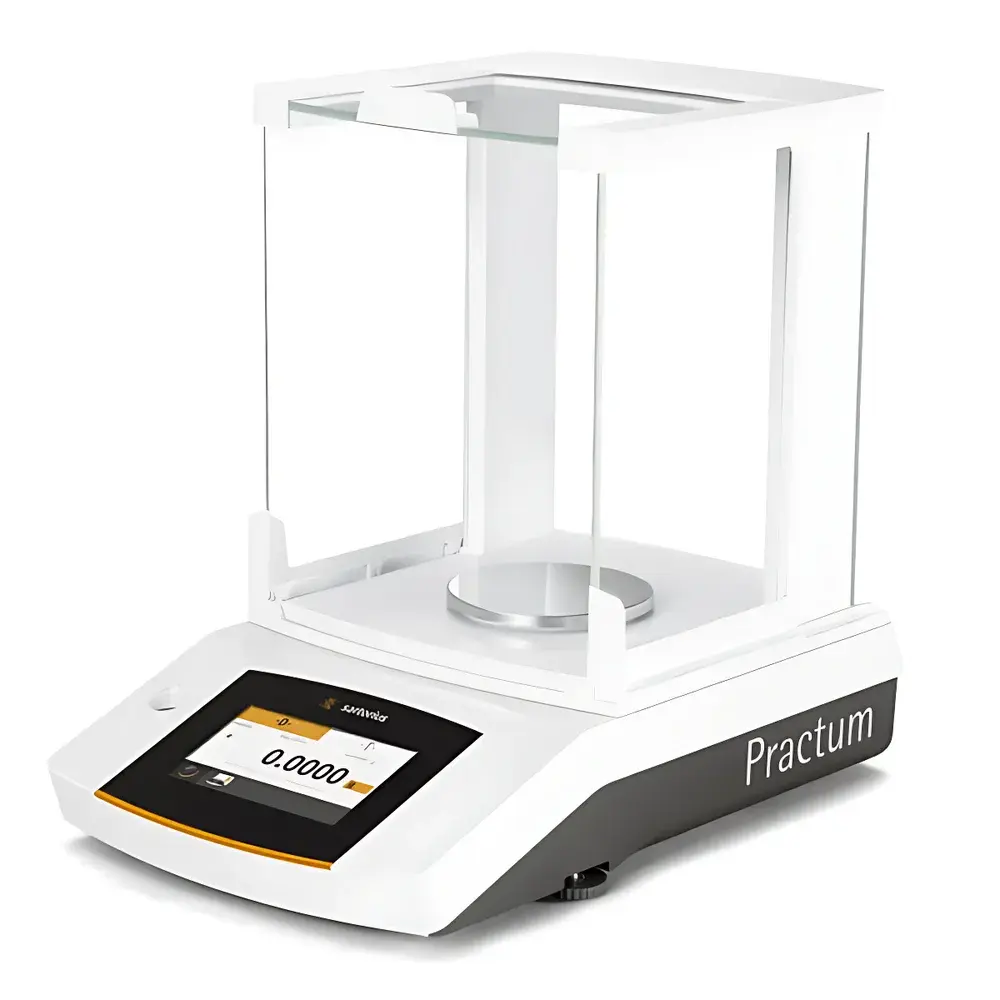
Sartorius Practum313-1CN Precision Balance
| Brand | Sartorius |
|---|---|
| Origin | Shanghai, China |
| Manufacturer Type | Authorized Distributor |
| Product Category | Domestic |
| Model | Practum313-1CN |
| Instrument Type | Precision Balance |
| Maximum Capacity | 310 g |
| Readability | 1 mg |
| Linearity | ±2 mg |
| Repeatability | 1 mg |
| Calibration | External |
| Pan Diameter | 120 mm |
| Dimensions (W × D × H) | 218 × 360 × 320 mm |
| Connectivity | USB interface for data export to Excel |
Overview
The Sartorius Practum313-1CN is a high-performance precision balance engineered for routine laboratory weighing tasks requiring reliable 1 mg readability and robust operational stability. Designed according to ISO/IEC 17025 and GLP-compliant workflows, it employs electromagnetic force compensation (EMFC) technology—ensuring fast stabilization, minimal drift, and high reproducibility across diverse environmental conditions. With a maximum capacity of 310 g and optimized mechanical architecture—including reinforced load cell mounting and shock-absorbing feet—the Practum313-1CN delivers consistent accuracy even on non-ideal lab benches or in shared facilities with moderate vibration. Its sealed keypad, IP42-rated housing, and corrosion-resistant stainless-steel pan enhance durability in QC labs, academic teaching environments, and pharmaceutical production support areas where frequent cleaning and multi-user access are standard.
Key Features
- Electromagnetic force compensation (EMFC) sensor system for rapid response (<2 s stabilization), low temperature drift, and long-term calibration stability.
- Integrated draft shield with removable side panels and front sliding door—designed for unobstructed access while maintaining measurement integrity during volatile or fine-powder weighing.
- Large, intuitive monochrome LCD with backlight and adjustable contrast; supports dual-unit display (g, mg, oz, ct, %, pcs) without menu navigation.
- USB 2.0 port compliant with HID class protocol—enables direct plug-and-play data transfer to Microsoft Excel®, LIMS, or ELN systems without proprietary drivers.
- Regulatory lock function: Admin-configurable password protection restricts access to calibration, unit settings, and application modes—critical for student labs, GMP training rooms, and audited environments.
- Peak hold mode: Captures and retains transient weight maxima—essential for dynamic measurements such as live animal weighing, viscous sample settling, or container tare under flow conditions.
- Auto-leveling assistance: Oversized front-mounted leveling feet combined with integrated bubble level indicator simplify horizontal alignment verification per ISO 17025 Section 6.4.1 requirements.
Sample Compatibility & Compliance
The Practum313-1CN accommodates heterogeneous sample types—including powders, granules, liquids in beakers or volumetric flasks, solid reference standards, and small biological specimens—without compromising repeatability. Its 120 mm stainless-steel pan provides ample surface area for large-diameter containers used in density determination or checkweighing protocols. Optional accessories include the Sartorius Density Kit (YDK01-1), enabling ASTM D792-compliant solid density calculations via hydrostatic weighing, and the Counting Kit (CK01-1) for statistical piece counting with automatic average weight learning. The balance conforms to OIML R76-1 (Class II), EN 45501, and USP requirements for analytical and semi-micro applications. Full traceability is supported through built-in audit trail logging (when paired with optional Sartorius LabX software) meeting FDA 21 CFR Part 11 and EU Annex 11 expectations.
Software & Data Management
While standalone operation requires no software, the Practum313-1CN integrates seamlessly into regulated digital workflows. Its native USB interface supports ASCII-formatted real-time data streaming with timestamp, gross/net/tare flags, and stable status indicators—compatible with LabWare LIMS, Thermo Fisher SampleManager, and custom Python-based acquisition scripts. For full ALCOA+ compliance, pairing with Sartorius LabX software enables electronic signatures, role-based user permissions, automated report generation (PDF/CSV), and secure database archiving with version-controlled method templates. All internal memory logs—including calibration events, error codes, and environmental alerts—are exportable for internal audits or regulatory inspections.
Applications
- Quality control laboratories performing raw material verification, finished product checkweighing, and batch release testing per ISO 9001 and ICH Q7 guidelines.
- Academic chemistry and biology departments conducting stoichiometric preparation, titrant standardization, and gravimetric analysis in undergraduate teaching labs.
- Pharmaceutical R&D units executing formulation development, excipient blending, and tablet weight uniformity testing per USP .
- Food safety labs implementing HACCP-critical control point monitoring, including ingredient portioning and packaging net weight validation.
- Environmental testing facilities performing soil/sediment sample drying loss, filter residue quantification, and reagent mass calibration prior to ICP-MS or GC-MS analysis.
FAQ
What external calibration weights are required for the Practum313-1CN?
A Class M2 200 g and 100 g weight set—or a single 300 g M2 weight—is recommended for full-range verification per ISO 17025 Clause 6.5.2.
Does the balance support internal calibration?
No—this model features external calibration only; an internal motorized calibrator is not included. Internal calibration variants are available under the Practum Pro series.
Can the USB output be configured for automatic printing?
Yes—via keyboard wedge emulation mode, the balance can emulate a HID keyboard device and feed stabilized readings directly into designated cells in Excel or Notepad, triggering print commands via macro scripts.
Is the Practum313-1CN suitable for use in a fume hood?
It may be installed in low-airflow hoods with stable temperature (±2 °C) and humidity (<70% RH non-condensing); however, draft shield removal is not advised, and ISO 17025 recommends dedicated bench placement for optimal uncertainty performance.
How does the “regulatory lock” function comply with 21 CFR Part 11?
The hardware lock itself satisfies §11.10(a) user authentication; full Part 11 compliance requires integration with LabX or equivalent validated software providing electronic signatures, audit trails, and record retention controls.