
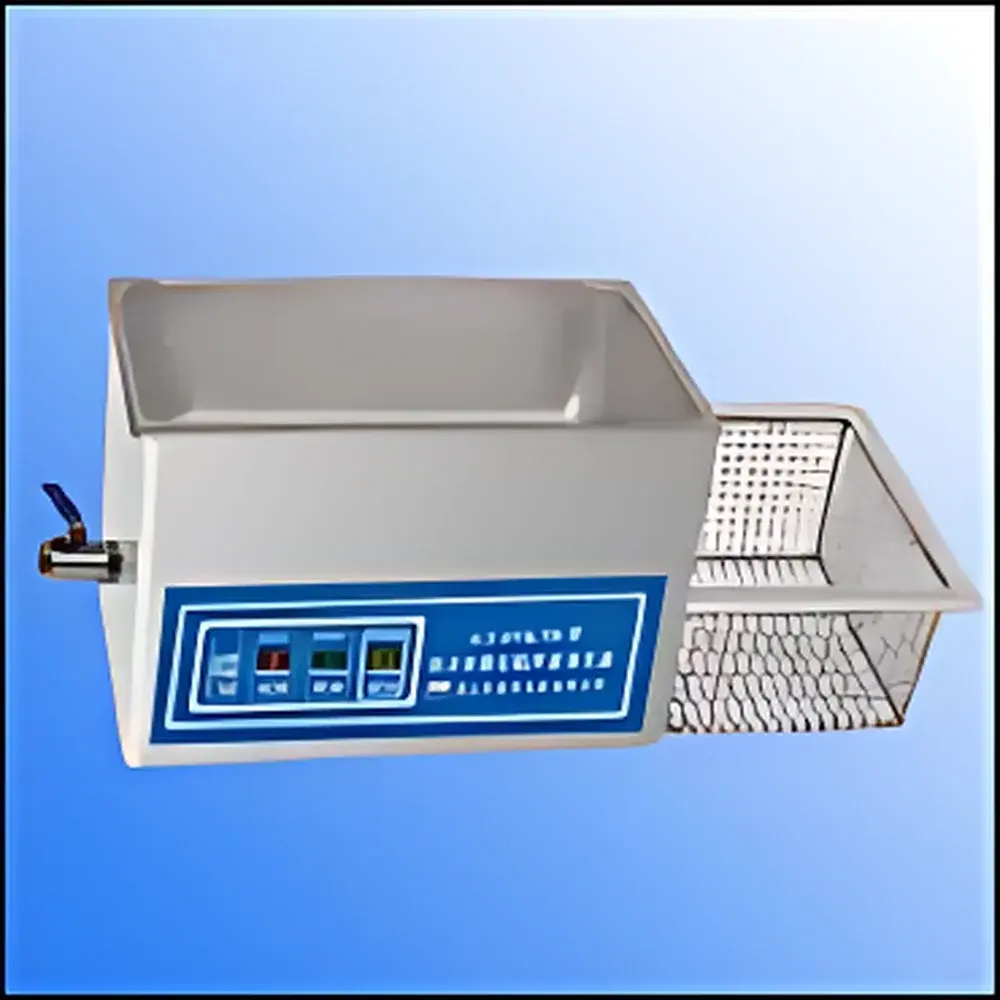
KQ-50DE Desktop Digital Ultrasonic Cleaner (2 L)
| Origin | Shanghai, China |
|---|---|
| Manufacturer Type | Authorized Distributor |
| Origin Category | Domestic (China) |
| Model | KQ-50DE |
| Ultrasonic Frequency | 40 kHz |
| Ultrasonic Power Output | 50 W |
| Tank Capacity | 2 L |
| Internal Tank Dimensions | 150 × 140 × 100 mm (L × W × H) |
| External Dimensions | 208 × 192 × 210 mm (L × W × H) |
| Temperature Control Range | Ambient to 80 °C (adjustable in 1 °C increments) |
| Timer Range | 1–99 minutes (KQ-50DE supports 40–99 min preset mode) |
| Heating Power | 100 W (integrated) |
| Safety Features | Low-water level detection, over-temperature/over-voltage/over-current protection, auto-shutdown |
| Construction | Stainless steel inner tank (304 grade), reinforced stainless steel mesh basket (argon-welded), engineered ABS plastic housing (KQ-50DE), acoustic noise-reducing lid included |
| Cumulative Operating Time Counter | Up to 999,999 hours |
| Control System | Embedded microcontroller with digital LED display for time, temperature, power, and status indicators |
Overview
The KQ-50DE Desktop Digital Ultrasonic Cleaner is a compact, precision-engineered laboratory instrument designed for routine cleaning, degassing, dispersion, emulsification, homogenization, solvent extraction, and mild cell disruption applications. It operates on the principle of ultrasonic cavitation: high-frequency mechanical vibrations (40 kHz) generated by piezoelectric transducers bonded to the bottom of a stainless steel tank induce microscopic bubble formation and collapse in the cleaning solution—producing localized energy densities sufficient to dislodge particulate contaminants from surfaces without mechanical abrasion or thermal degradation. Its 2 L capacity, combined with stable 50 W per transducer output and integrated heating (up to 80 °C), enables reproducible, non-destructive processing of small-volume samples in academic labs, QC environments, R&D facilities, and light industrial settings.
Key Features
- Digital LED interface with independent real-time display of set/actual temperature, elapsed time, ultrasonic power level, and cumulative operating hours (up to 999,999 h)
- Microcontroller-based control system ensuring precise parameter retention across power cycles and consistent operational repeatability
- Stainless steel (AISI 304) inner tank and argon-welded stainless steel mesh basket for corrosion resistance and structural integrity
- Acoustic damping lid included to reduce ambient noise and minimize solvent evaporation during extended operation
- Comprehensive safety architecture: automatic shutdown triggered by low liquid level, over-temperature (>85 °C), over-voltage (>±10% nominal), or over-current conditions
- Heating function (100 W) with ±1 °C stability and 1 °C adjustable resolution, supporting temperature-assisted cleaning protocols
- Robust housing constructed from flame-retardant engineering-grade ABS plastic, optimized for benchtop durability and chemical splash resistance
- Factory-calibrated transducer array delivering uniform energy distribution across the entire tank volume
Sample Compatibility & Compliance
The KQ-50DE accommodates a wide range of sample formats including glassware (vials, cuvettes, pipette tips), metal components (surgical tools, optical mounts), ceramic substrates, and polymer-based labware. It is compatible with aqueous solutions, ethanol, isopropanol, acetone, and other common laboratory solvents—provided compatibility with stainless steel and ABS is verified. While not certified for medical device reprocessing under ISO 15883 or FDA 510(k), the unit meets general electrical safety requirements per GB 4793.1–2019 (equivalent to IEC 61010-1) and electromagnetic compatibility standards per GB/T 18268.1–2010. Its digital logging capability supports GLP-aligned documentation when paired with external audit trails.
Software & Data Management
The KQ-50DE operates as a standalone embedded system with no PC connectivity or proprietary software. All operational parameters—including time, temperature, power, and fault logs—are retained in non-volatile memory and displayed directly on the front-panel LED screen. The cumulative hour counter and date-of-manufacture display facilitate preventive maintenance scheduling and warranty tracking in accordance with ISO/IEC 17025 Clause 6.4.2 (equipment management). For laboratories requiring electronic records compliant with 21 CFR Part 11, integration with external data acquisition systems via RS-232 (optional adapter) or manual log transcription is recommended.
Applications
- Routine cleaning of analytical glassware prior to spectroscopic or chromatographic analysis
- Removal of organic residues from semiconductor wafers and MEMS components
- Preparation of nanoparticle dispersions and colloidal suspensions
- Extraction of bioactive compounds from botanical matrices in phytochemical research
- Deagglomeration of ceramic powders prior to sintering or rheological characterization
- Cell lysis optimization studies in molecular biology (low-intensity, short-duration protocols)
- Ultrasonic degassing of HPLC mobile phases and calibration standards
FAQ
What is the maximum recommended operating temperature for aqueous solutions?
The heater is rated for continuous operation up to 80 °C; exceeding this may accelerate tank seal degradation and compromise long-term transducer adhesion.
Can the KQ-50DE be used with flammable solvents such as acetone or hexane?
No—this unit lacks explosion-proof certification and internal spark suppression. Only non-flammable or low-flashpoint solvents (e.g., IPA <40% v/v in water) should be used under strict ventilation and supervision.
Is the stainless steel mesh basket included with every unit?
Yes—the argon-welded 304 stainless steel basket is standard equipment and designed for repeated autoclaving and chemical immersion.
Does the timer support intermittent (pulse) ultrasonic operation?
No—the KQ-50DE provides only continuous ultrasonic output during the set time interval; pulsed modes require external controllers or higher-tier models.
How often should the transducers be inspected for performance drift?
Under normal use (≤4 h/day), annual verification using a calibrated hydrophone or cavitation intensity test kit is recommended per ISO 13073-1 guidelines.



