
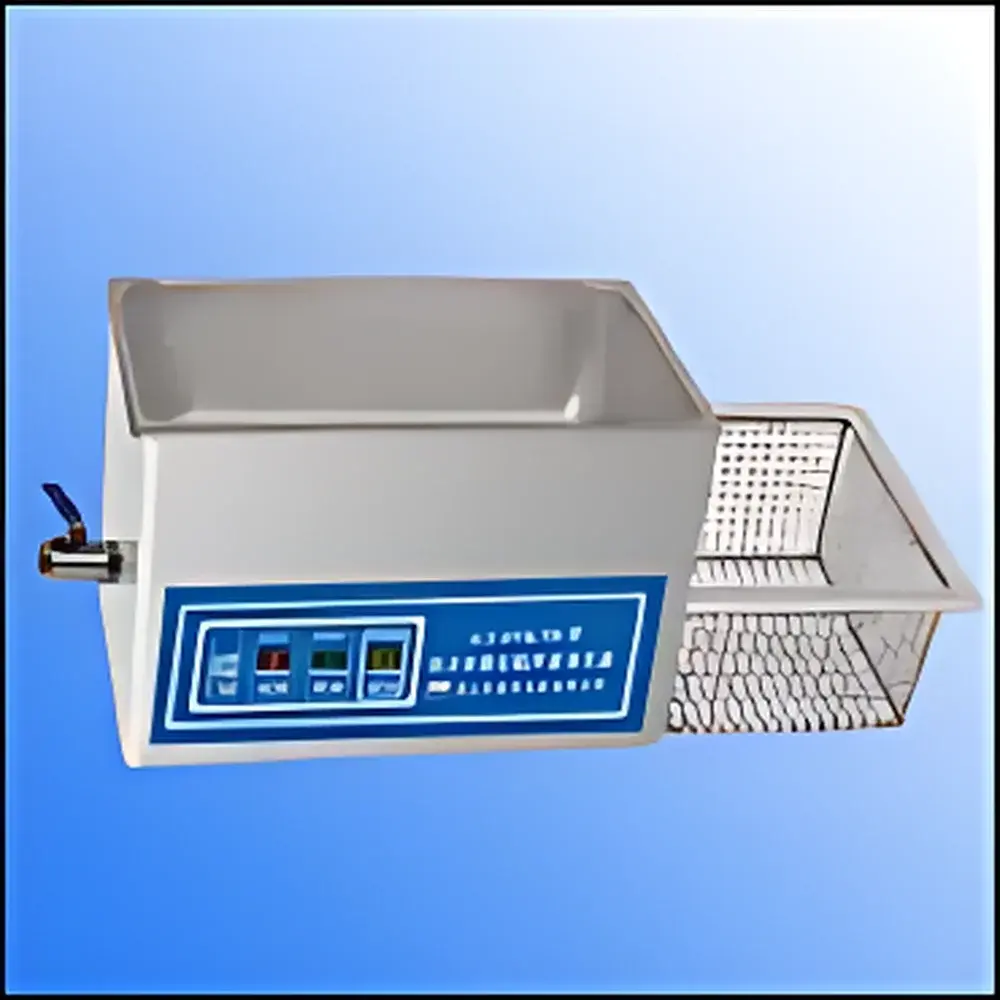
KQ-600KDV Desktop High-Power Digital Ultrasonic Cleaner
| Origin | Shanghai, China |
|---|---|
| Manufacturer Type | Authorized Distributor |
| Country of Origin | China |
| Model | KQ-600KDV |
| Price | USD 2,850 (FOB Shanghai) |
| Dimensions (L×W×H) | 410 × 350 × 380 mm |
| Tank Internal Dimensions (L×W×H) | 300 × 240 × 180 mm |
| Tank Capacity | 13 L |
| Ultrasonic Frequency | 40 kHz |
| Ultrasonic Power Output | 600 W |
| Heating Power | 600 W |
| Temperature Range | 20–80 °C |
| Timer Range | 1–480 min |
| Sound-Dampening Lid | Yes |
| Drain Valve | Yes |
| Tank Material | 304 Stainless Steel |
| Rack Material | 304 Stainless Steel (argon-welded mesh) |
| Protection Features | Digital over-temperature, over-voltage, and over-current monitoring with LED indicators |
Overview
The KQ-600KDV Desktop High-Power Digital Ultrasonic Cleaner is an integrated benchtop system engineered for precision cleaning, degassing, dispersion, emulsification, homogenization, solvent extraction, particle size reduction, and cell lysis in research laboratories, quality control environments, and small-scale industrial settings. It operates on the principle of piezoelectric ultrasonic cavitation: high-frequency (40 kHz) acoustic energy is transmitted through liquid media via submerged transducers bonded to the stainless steel tank bottom, generating controlled microbubble collapse that delivers localized shear forces, microstreaming, and thermal effects. This physical mechanism enables effective removal of particulate, organic, and weakly adherent contaminants from complex geometries—including microfluidic channels, optical components, semiconductor wafers, surgical instruments, and analytical sample vials—without mechanical abrasion or chemical aggression. The unit’s fully digital control architecture ensures repeatable process execution across diverse sample types and cleaning protocols.
Key Features
- 600 W total ultrasonic power output delivered by six independently mounted 100 W piezoelectric transducers, providing uniform energy distribution across the 13 L tank volume
- Integrated 600 W heating system with ±1 °C temperature stability and real-time digital display of both setpoint and actual bath temperature (20–80 °C range)
- Precision digital timer (1–480 minutes) with memory function to retain last-used parameters for rapid protocol recall
- 304 stainless steel tank (300 × 240 × 180 mm internal) formed by deep-drawn stamping and electropolished for corrosion resistance and cleanability
- Argon-welded 304 stainless steel mesh rack with optimized aperture geometry to minimize shadowing and ensure full ultrasonic exposure
- Acoustically damped hinged lid with silicone gasket to reduce ambient noise (≤65 dB at 1 m) and prevent solvent evaporation during heated operation
- Integrated drain valve with quick-connect fitting for safe, spill-free tank emptying and maintenance
- Digital safety monitoring system with simultaneous visual indicators for over-temperature, over-voltage, and over-current conditions
Sample Compatibility & Compliance
The KQ-600KDV supports a broad range of sample formats including glassware (vials, cuvettes, pipette tips), metal parts (sensors, calibration standards), ceramics, polymers, and biological substrates. It is compatible with aqueous solutions, mild alkaline detergents, and low-boiling organic solvents (e.g., isopropanol, acetone, ethanol), provided vapor handling and ventilation requirements are met per local occupational health regulations (OSHA 29 CFR 1910.1200, EU CLP Regulation). The unit meets IEC 61000-6-3 (EMC emissions) and IEC 61000-6-2 (immunity) standards. Its construction and operational controls align with general laboratory equipment requirements under ISO/IEC 17025:2017 for testing laboratories, and its digital logging capability supports traceability in GLP-compliant workflows when paired with external audit-trail software.
Software & Data Management
While the KQ-600KDV operates via standalone front-panel controls, its digital interface provides non-volatile parameter retention and real-time status feedback without external software dependency. All operational settings—including time, temperature, and power activation—are displayed simultaneously on a dual-line LCD. For laboratories requiring electronic recordkeeping, the unit’s stable analog/digital hybrid design allows integration into facility-wide monitoring systems via optional RS-232 or 4–20 mA analog output modules (sold separately). When used in regulated environments, users may implement manual logbooks or third-party electronic lab notebooks (ELNs) to document cleaning cycles, maintenance events, and calibration verifications in accordance with FDA 21 CFR Part 11 principles—particularly where batch release or analytical instrument preparation is involved.
Applications
- Pre-analytical sample preparation: cleaning HPLC autosampler vials, GC inlet liners, and ICP-MS nebulizers to eliminate carryover and baseline drift
- Materials science: deburring MEMS devices, removing polishing residues from sapphire substrates, and dispersing nanomaterials in suspension
- Pharmaceutical QC: sanitizing tablet punches, disassembled capsule fillers, and dissolution apparatus components between batches
- Academic research: lysing bacterial and mammalian cells for protein extraction, facilitating sonochemical synthesis, and accelerating solid-liquid extraction of plant metabolites
- Maintenance of metrology tools: restoring surface integrity of optical flats, gauge blocks, and interferometer reference mirrors
FAQ
What is the recommended cleaning solution for routine use?
Aqueous alkaline detergent solutions (pH 9–11) at 40–60 °C are optimal for general organic and particulate removal; avoid chloride-containing formulations to prevent pitting of stainless steel components.
Can this unit be used for sterilization?
No—ultrasonic cleaning removes bioburden but does not achieve sterility assurance levels (SAL); it is a pre-sterilization cleaning step compliant with ISO 15883 and AAMI ST79 guidelines.
Is degassing functionality built-in?
Yes—the 40 kHz frequency and programmable dwell time enable efficient dissolved gas removal from solvents prior to chromatography or spectroscopy applications.
How often should the transducers be inspected?
Visual inspection of transducer bonding integrity and tank bottom surface condition is recommended every 500 operating hours or quarterly, whichever occurs first.
Does the unit support continuous operation?
Yes—designed for unattended operation up to 480 minutes per cycle; however, thermal management requires adequate ambient airflow and periodic cooling intervals for extended daily use.



