
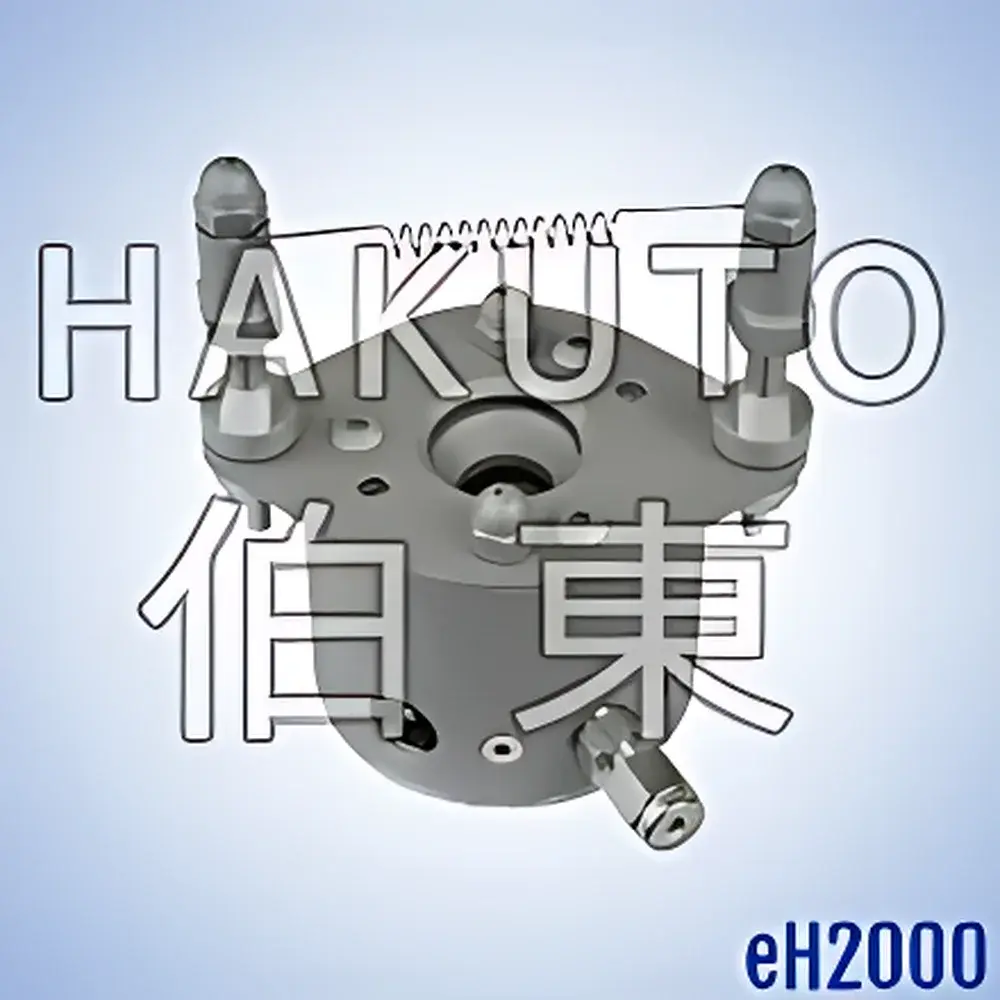
KRI eH 2000 Hall-Effect Ion Source (USA Import)
| Brand | Kaufman & Robinson, Inc. |
|---|---|
| Origin | USA |
| Model | eH 2000 |
| Cooling | Water-cooled |
| Discharge Voltage Range | 50–300 V DC |
| Discharge Current | Up to 15 A |
| Beam Divergence (HWHM) | >45° |
| Anode Diameter | ~5 cm |
| Physical Dimensions | Ø5.7" × H5.5" |
| Compatible Gases | Ar, Xe, Kr, O₂, N₂, Organic Precursors |
| Mounting Interface | Conflat or Quick-Connect Flange |
| Operating Pressure Range | 1×10⁻⁴ – 1×10⁻² Torr |
| Power Supply | eHx-30010A DC Magnetic Confinement Controller |
| Optional Features | Adjustable-angle mount, Sidewinder filament cathode, Grooved anode, eH 2000L / eH 2000×02 / eH 2000 LEHO variants |
Overview
The KRI eH 2000 Hall-effect ion source is a high-current, water-cooled plasma generation device engineered for precision surface engineering in medium-to-large vacuum systems. Based on the physics of magnetically confined electron drift and crossed electric-magnetic field acceleration—distinct from conventional Kaufman-type gridded ion sources—the eH 2000 operates without extraction grids, eliminating grid erosion, thermal distortion, and beam divergence limitations inherent in electrostatic optics. Instead, it utilizes a radial magnetic field configuration combined with axial electric potential to sustain a stable Hall current, enabling uniform, low-energy ion flux across broad-area substrates. Designed for continuous-duty operation in UHV-compatible environments (down to 1×10⁻⁸ Torr base pressure), the eH 2000 delivers reproducible ion currents up to 15 A at discharge voltages between 50–300 V DC, making it suitable for applications demanding high throughput and long-term stability—particularly ion-assisted deposition (IAD), in-situ pre-cleaning, and low-energy physical sputtering.
Key Features
- Water-cooled front plate and anode assembly: Enables sustained high-current operation (>10 A) without thermal degradation; significantly extends component lifetime versus air-cooled predecessors such as the eH 1000.
- Modular, field-replaceable anode structure: Supports rapid maintenance with plug-and-play spare anodes—minimizing system downtime during routine servicing or process optimization.
- Wide-angle ion beam profile (HWHM >45°): Ensures homogeneous ion flux distribution over substrates up to 300 mm in diameter, critical for uniform film density, stoichiometry control, and etch rate consistency.
- Multi-gas compatibility: Fully compatible with inert gases (Ar, Kr, Xe), reactive species (O₂, N₂), and organic precursors—enabling both physical and reactive ion beam processing within a single platform.
- Integrated DC magnetic confinement architecture: Eliminates need for external electromagnets; built-in permanent magnets provide stable, repeatable plasma confinement across operating conditions.
- Flexible mounting options: Available with standard CF-63/CF-100 flanges or quick-connect interfaces; accommodates load-lock integration, inline chamber configurations, and multi-source arrays.
Sample Compatibility & Compliance
The eH 2000 is routinely deployed in vacuum systems conforming to ISO 27893 (vacuum equipment safety), ASTM F2255 (thin-film adhesion testing), and SEMI F29 (semiconductor process equipment standards). Its robust construction—using oxygen-free copper, stainless steel, and alumina ceramics—ensures compatibility with aggressive chemistries and high-temperature bake-out protocols required for UHV and EUV lithography tool qualification. The ion source meets electromagnetic compatibility requirements per CISPR 11 Group 2 Class A and operates within IEC 61000-6-3 emission limits. When integrated into automated coating platforms, its analog/digital I/O interface supports full traceability under FDA 21 CFR Part 11-compliant software architectures when paired with validated PLC or motion-control systems.
Software & Data Management
The eH 2000 operates with the KRI eHx-30010A controller, offering programmable ramping profiles, closed-loop current stabilization, and real-time monitoring of discharge voltage, anode current, neutralizer emission, and gas flow rates via RS-485 or Ethernet/IP. Optional LabVIEW™ and Python SDKs enable direct integration into custom process automation frameworks. All operational parameters—including timestamps, setpoints, and fault logs—are recorded with millisecond resolution and exportable in CSV or HDF5 format for GLP/GMP audit trails. Remote diagnostics support includes predictive maintenance alerts based on cathode emission decay trends and anode voltage drift analysis.
Applications
- Ion-assisted deposition (IAD) of optical coatings (e.g., TiO₂, SiO₂, Ta₂O₅) with enhanced density, reduced columnar growth, and improved environmental stability.
- In-situ and load-lock pre-cleaning of substrates prior to PVD/CVD—removing hydrocarbons, native oxides, and adventitious carbon without substrate heating or damage.
- Low-energy (<100 eV) ion beam etching of III-V semiconductors (GaAs, InP), polymers (PI, PET), and flexible electronics—preserving surface stoichiometry and minimizing subsurface damage.
- Surface functionalization of biomedical implants (Ti-6Al-4V, CoCr) through controlled nitrogen or oxygen ion implantation to modulate protein adsorption kinetics.
- Direct ion-beam-assisted synthesis of nanocomposite films (e.g., metal-doped DLC, SiNₓ:H) where simultaneous sputter deposition and ion bombardment govern phase evolution.
- Calibration and benchmarking of residual gas analyzers (RGAs) and quadrupole mass spectrometers using well-characterized noble gas ion beams.
FAQ
What distinguishes the eH 2000 from traditional Kaufman ion sources?
The eH 2000 is a Hall-effect ion source—not a gridded Kaufman source—meaning it uses magnetic confinement and self-sustaining plasma discharge rather than thermionic cathodes and electrostatic extraction grids. This eliminates grid-related failure modes and enables broader, more uniform beams at lower energy dispersion.
Can the eH 2000 operate in ultra-high vacuum (UHV) environments?
Yes. With all-metal seals, low-outgassing materials, and bakeable components, the eH 2000 is qualified for continuous operation in UHV systems down to 1×10⁻⁸ Torr base pressure when properly conditioned.
Is the eHx-30010A controller compatible with third-party PLCs or SCADA systems?
Yes. It provides Modbus TCP, EtherNet/IP, and analog 0–10 V / 4–20 mA interfaces for seamless integration into industrial automation ecosystems.
What neutralizer options are supported?
Standard filament cathodes, Sidewinder™ rotating filament assemblies, and hollow cathode neutralizers are available—selected based on gas type, current demand, and lifetime requirements.
Does KRI offer application-specific validation documentation?
Upon request, KRI supplies test reports including beam current mapping (Faraday cup scans), energy distribution measurements (retarding field analyzer data), and long-duration stability logs aligned with ISO/IEC 17025-accredited calibration practices.



