
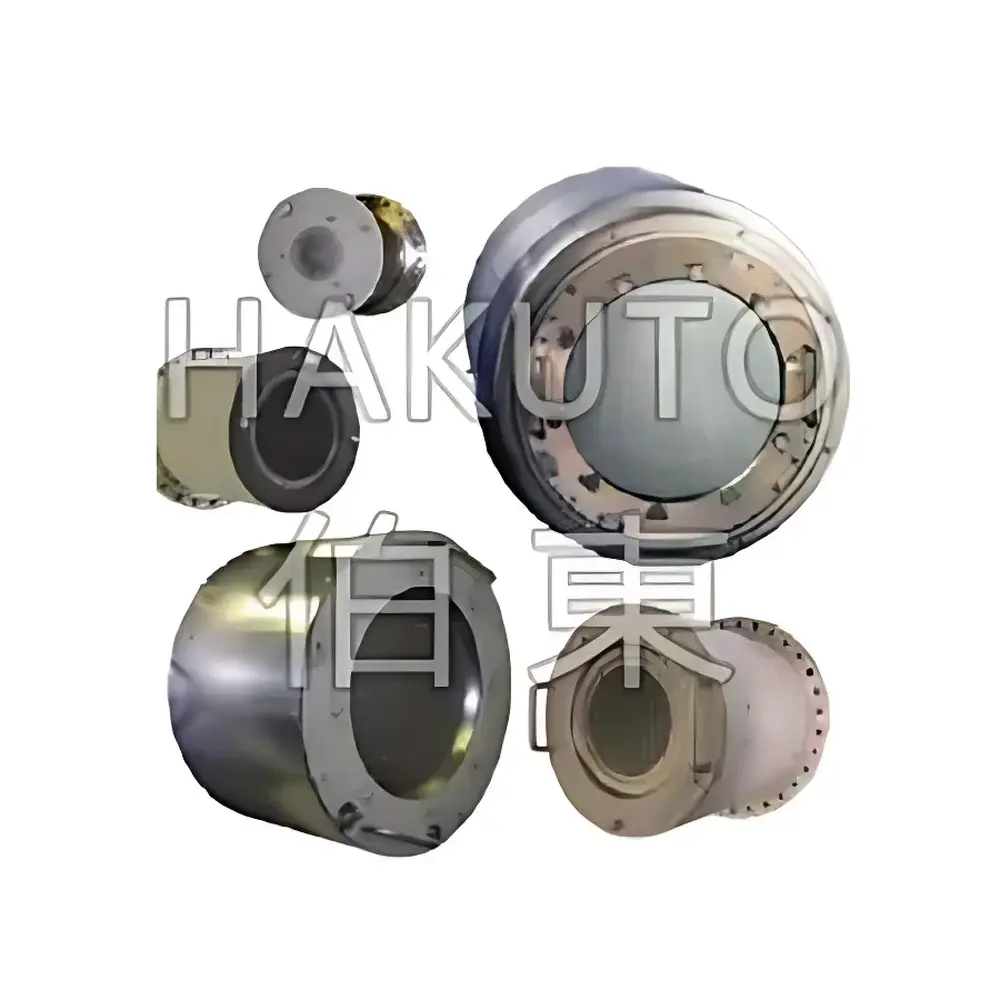
KRI Kaufman Ion Source KDC 100
| Brand | KRI (Kimball Physics / Kaufman) |
|---|---|
| Origin | USA |
| Model | KDC 100 |
| Ion Energy Range | 100–1200 eV |
| Max. Ion Current | >400 mA |
| Grid Diameter | 12 cm |
| Cathode Configuration | Dual Filament |
| Confinement | DC Magnetic |
| Anode Voltage | 0–100 V DC |
| Neutralizer Options | Sidewinder Filament, LFN 2000, or KSC 1212 |
| Beam Collimation | Parallel, Low-Divergence |
| Mounting | Quick-Release or Movable Flange |
| Operating Distance | 20–91 cm (8–36 in) |
| Gas Compatibility | Inert (Ar, Xe), Reactive (O₂, N₂, CF₄), or Mixed Gases |
| Control Interface | Analog + Digital (4-gas MFC support) |
| Optional | Motorized Tilt Mount |
Overview
The KRI Kaufman Ion Source KDC 100 is a medium-aperture, magnetically confined DC ion source engineered for high-stability, long-lifetime operation in industrial and research-scale thin-film processing systems. Based on the classic Kaufman-type design—first developed at Hughes Research Laboratories—the KDC 100 generates broad-beam, low-energy ions via electron bombardment of process gas within a magnetic confinement region. Electrons emitted from dual tungsten or thoriated tungsten filaments are trapped by axial magnetic fields, increasing ionization efficiency and enabling stable plasma generation at pressures between 1 × 10⁻⁴ and 5 × 10⁻³ Torr. Ions are extracted through a precision-machined, self-aligning two-grid system (12 cm diameter), delivering a highly collimated, parallel beam with minimal angular divergence (<±3° full angle). This architecture ensures uniform ion flux across substrates up to 300 mm in diameter, making the KDC 100 particularly suitable for integration into sputter deposition, ion-assisted evaporation (IAE), ion beam assisted deposition (IBAD), and reactive ion etching (RIE) platforms.
Key Features
- Dual-cathode filament configuration with redundant thermal emission capability, enhancing operational uptime and extending service intervals.
- Self-aligning, water-cooled grid assembly fabricated from molybdenum or graphite—optimized for thermal stability and resistance to sputter erosion under continuous high-current operation.
- OptiBeam™ grid geometry enabling precise control over ion energy distribution function (IEDF) and minimizing beam halo effects.
- Integrated neutralizer options—including Sidewinder filament, LFN 2000 hollow cathode, or KSC 1212 thermionic emitter—ensuring effective space-charge compensation across the full operating current range (up to 400 mA).
- Modular flange interface (CF-63 or ISO-KF 63 compatible) supporting rapid installation, alignment verification, and in-situ maintenance without breaking vacuum.
- Analog and digital control inputs (0–10 V, RS-232/RS-485) for synchronized operation with mass flow controllers (MFCs), power supplies, and PLC-based process sequencers.
Sample Compatibility & Compliance
The KDC 100 supports processing of conductive, semiconductive, and insulating substrates—including silicon wafers, optical glass, polymer films, and ceramic components—without requiring conductive seeding layers. It operates reliably with inert gases (Ar, Kr, Xe), reactive species (O₂, N₂, CHF₃, SF₆), and multi-component mixtures, enabling stoichiometric control in oxide, nitride, and carbide film synthesis. The system complies with standard vacuum safety protocols per ANSI Z88.1 and EU Machinery Directive 2006/42/EC. When integrated into Class 100 cleanroom-compatible coating tools, it meets ISO 14644-1 air cleanliness requirements. For regulated environments (e.g., medical device or aerospace coating lines), optional audit-trail-capable controllers support 21 CFR Part 11-compliant data logging when paired with validated SCADA software.
Software & Data Management
While the KDC 100 operates as a hardware-integrated subsystem, its analog/digital I/O enables seamless integration with industry-standard automation frameworks including LabVIEW, EPICS, and Siemens SIMATIC S7. Real-time monitoring of filament current, anode voltage, extraction voltage, neutralizer bias, and gas flow rates is supported via scalable DAQ modules. Process recipes—including ramp profiles for ion energy and current during substrate rotation cycles—can be stored and recalled with timestamped metadata. Optional KRI IonSource Manager™ software provides remote diagnostics, predictive filament life estimation, and deviation alerts based on historical plasma impedance trends—facilitating preventive maintenance scheduling aligned with GLP/GMP documentation practices.
Applications
- Ion Beam Assisted Deposition (IBAD): Enhancing adhesion, density, and crystallinity of evaporated or sputtered films (e.g., TiO₂ anti-reflective coatings, YBCO superconducting layers).
- Ion Beam Sputter Deposition (IBSD): High-purity, low-defect-rate growth of multilayer optical filters, hard carbon coatings (DLC), and magneto-optic stacks.
- Ion Beam Etching (IBE): Anisotropic, maskless patterning of Si, GaN, and quartz with sub-10 nm depth control and <0.5 nm RMS surface roughness.
- Surface Activation & Cleaning: Pre-deposition treatment of polymeric substrates (PET, PC) to increase surface energy (>72 dyn/cm) prior to metallization or lamination.
- Thin-Film Stress Modification: In-situ ion bombardment during growth to tune compressive/tensile stress states in SiNₓ and Al₂O₃ barrier layers.
FAQ
What vacuum conditions are required for stable KDC 100 operation?
Stable plasma ignition and beam extraction require base pressure ≤5 × 10⁻⁶ Torr, with operating pressure maintained between 1 × 10⁻⁴ and 5 × 10⁻³ Torr using active gas dosing.
Can the KDC 100 be used with oxygen without accelerating filament oxidation?
Yes—when operated with dual filaments in alternating duty cycles and combined with pulsed O₂ delivery, filament lifetime exceeds 500 hours under typical IBAD conditions.
Is beam steering or angular adjustment available as standard?
No—beam direction is fixed relative to the source axis; however, a motorized tilt mount (KRI part #TILT-KDC100) is available as an optional accessory for ±15° programmable alignment.
How is neutralizer performance verified during commissioning?
Neutralizer efficacy is confirmed via Langmuir probe scans across the beam cross-section, ensuring charge-neutral flux (ion-to-electron current ratio ≥0.98) at the target plane.
Does KRI provide calibration certificates traceable to NIST standards?
Yes—upon request, factory calibration reports include beam current linearity verification (±1.5% full scale) and energy distribution measurements using a retarding field energy analyzer (RFEA).



