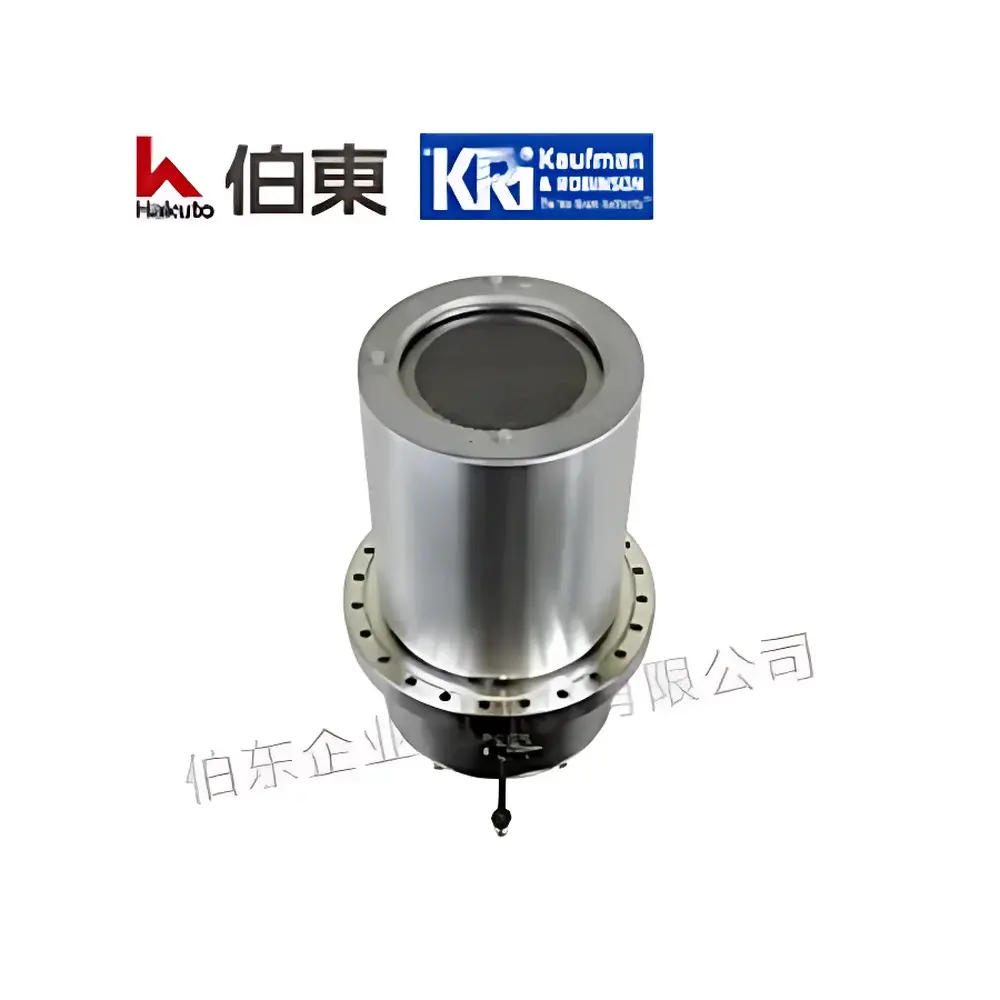
KRI RFICP 140 Radiofrequency Inductively Coupled Plasma Ion Source
| Brand | Kaufman & Robinson, Inc. |
|---|---|
| Origin | USA |
| Model | RFICP 140 |
| Anode RF Power | 1 kW (1.8 MHz) |
| Ion Beam Energy | 100–1200 eV |
| Max. Ion Current | >500 mA |
| Gas Compatibility | Ar, O₂, N₂, others |
| Gas Flow Rate | 5–40 sccm |
| Operating Pressure | <0.5 mTorr |
| Beam Aperture | 14 cm Ø |
| Grid Material | Molybdenum / Graphite |
| Beam Optics | OptiBeam™ self-aligning ion optics |
| Neutralizer | LFN 2000 |
| Dimensions | 25.1 cm H × 24.6 cm D |
| Flange | 12" CF |
Overview
The KRI RFICP 140 is a compact, gridded radiofrequency inductively coupled plasma (RF-ICP) ion source engineered for high-precision, low-contamination ion beam applications in semiconductor thin-film processing and surface engineering. Unlike thermionic or DC discharge sources, the RFICP 140 generates a stable, electrodeless plasma via 1.8 MHz RF excitation of process gases—eliminating cathode erosion and enabling extended operational lifetime and superior beam stability. Its core architecture integrates a water-cooled anode coil, a quartz plasma chamber, and a precision-machined molybdenum/graphite grid assembly, supporting reproducible ion beam generation under ultra-high vacuum (UHV) compatible conditions (<0.5 mTorr). Designed for integration into UHV deposition and etch platforms—including ion beam sputter deposition (IBSD), ion beam assisted deposition (IBAD), and ion beam etching (IBE)—the RFICP 140 delivers controllable ion energies from 100 to 1200 eV with beam current exceeding 500 mA, making it suitable for demanding applications such as optical coating densification, pre-deposition substrate cleaning, and atomic-layer-level surface modification.
Key Features
- Electrodeless RF-ICP plasma generation at 1.8 MHz ensures long-term plasma stability and eliminates cathode degradation common in DC sources.
- OptiBeam™ self-aligning ion optics system enables rapid, repeatable beam shaping—parallel, focused, or divergent—without manual realignment during maintenance cycles.
- 14 cm diameter molybdenum/graphite dual-grid assembly optimized for high transmittance and thermal resilience under sustained beam operation.
- Integrated LFN 2000 low-energy electron neutralizer suppresses space charge effects, ensuring stable beam transport and uniform ion flux distribution across substrates up to 200 mm diameter.
- Compact mechanical footprint (25.1 cm height × 24.6 cm diameter) with standard 12″ ConFlat (CF) flange facilitates drop-in replacement in existing UHV chambers and modular tool integration.
- Automated RF matching network maintains optimal power transfer across variable gas compositions (Ar, O₂, N₂, and reactive mixtures) and pressure regimes (5–40 sccm, <0.5 mTorr).
Sample Compatibility & Compliance
The RFICP 140 operates within Class 100–1000 cleanroom-compatible vacuum environments and is routinely deployed in ISO/IEC 17025-accredited thin-film laboratories. Its all-metal, UHV-bakeable construction (including oxygen-free copper RF coil and stainless-steel housing) complies with ASTM F1319 (Standard Practice for Vacuum System Integrity Testing) and supports GLP/GMP traceability when paired with calibrated mass flow controllers and residual gas analyzers. The source meets SEMI S2/S8 safety guidelines for semiconductor manufacturing equipment and is compatible with process control systems adhering to FDA 21 CFR Part 11 requirements when integrated with audit-trail-enabled PLCs or SCADA platforms.
Software & Data Management
While the RFICP 140 operates via analog and digital I/O interfaces (0–10 V control signals, RS-232/RS-485), its performance parameters—including RF forward/reflected power, grid voltage, neutralizer emission current, and gas flow setpoints—are fully compatible with industry-standard automation frameworks (SECS/GEM, OPC UA). When interfaced with KRI’s optional IonSource Control Suite (ISC-S), users gain access to real-time beam diagnostics, recipe-based parameter logging, and trend analysis aligned with ISO 9001 documentation workflows. All operational logs—including runtime hours, fault events, and grid temperature history—can be exported in CSV or XML format for internal quality audits or regulatory submissions.
Applications
- Pre-deposition substrate cleaning prior to PVD/CVD to remove native oxides and hydrocarbon contaminants without substrate heating.
- Ion beam assisted deposition (IBAD) of optical coatings (e.g., TiO₂/SiO₂ multilayers) to enhance film density, reduce scattering losses, and improve environmental stability.
- High-resolution ion beam etching (IBE) of compound semiconductors (GaAs, InP) and dielectric stacks with sub-5 nm depth control and <1° sidewall angle tolerance.
- Low-damage surface activation of III-V and 2D materials (e.g., MoS₂, h-BN) for subsequent epitaxial growth or metal contact formation.
- In-situ ion beam sputter deposition (IBSD) of ultra-pure metallic films (Au, Pt, NiFe) for magnetic tunnel junctions and quantum device fabrication.
FAQ
What vacuum level is required for stable operation of the RFICP 140?
The source requires a base pressure ≤5×10⁻⁷ Torr and operating pressure <0.5 mTorr for optimal plasma ignition and beam stability.
Can the RFICP 140 operate with reactive gases such as O₂ or NF₃?
Yes—its quartz plasma chamber and molybdenum grids are chemically resistant to oxidizing and fluorinating species; gas flow must remain within 5–40 sccm range.
Is grid alignment required after routine maintenance?
No—the OptiBeam™ system incorporates kinematic mounting and thermal expansion compensation, eliminating manual re-alignment per SEMI E10 maintenance protocols.
What neutralizer model is recommended for 200 mm substrate processing?
The LFN 2000 is factory-qualified for uniform neutralization across substrates up to 200 mm diameter at beam currents up to 600 mA.
Does KRI provide calibration certificates traceable to NIST standards?
Yes—upon request, KRI issues ISO/IEC 17025-compliant calibration reports for grid voltage, beam current, and RF power sensors, valid for 12 months.
Related Products