
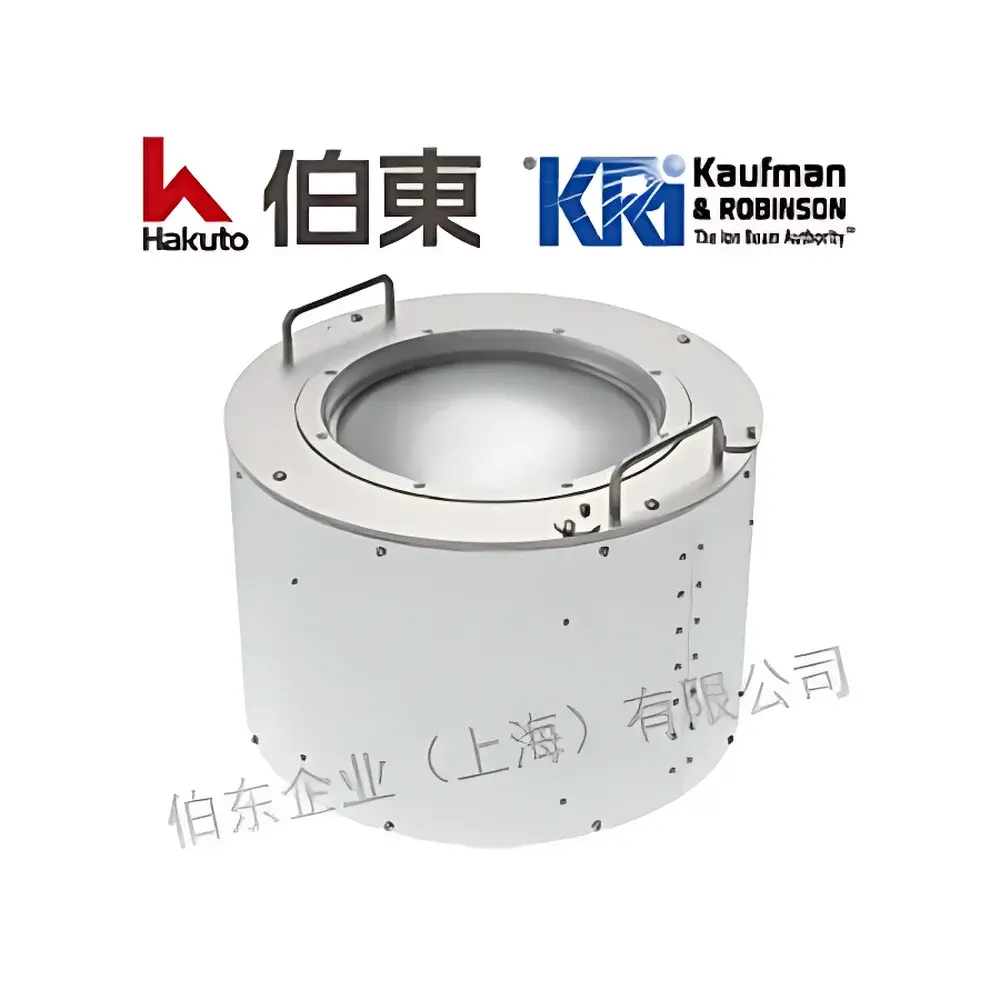
KRi RFICP 220 RF Ion Source
| Brand | Kaufman |
|---|---|
| Origin | USA |
| Model | RFICP 220 |
| Anode Power | 2 kW @ 2 MHz |
| Max Beam Current | >1000 mA |
| Ion Energy Range | 100–1200 eV |
| Beam Diameter | 22 cm |
| Gas Compatibility | Ar, O₂, N₂, others |
| Gas Flow | 5–50 sccm |
| Operating Pressure | <0.5 mTorr |
| Grid Material | Molybdenum |
| Ion Optics | OptiBeam™ self-aligning electrostatic lens system |
| Neutralizer | LFN 2000 or MHC 1000 |
| Flange | 10" CF |
| Dimensions (H × D) | 30 cm × 41 cm |
| Compliance | Designed for UHV integration and compatible with ISO-KF/CF vacuum standards |
Overview
The KRi RFICP 220 is a high-performance, radio-frequency inductively coupled plasma (RF-ICP) ion source engineered for precision ion beam applications in ultra-high vacuum (UHV) environments. Unlike thermionic or DC discharge ion sources, the RFICP 220 utilizes a 2 MHz, 2 kW RF power supply with automatic impedance matching to sustain a stable, high-density argon (or reactive gas) plasma within a water-cooled anode chamber. Ions are extracted through a 22 cm diameter molybdenum grid assembly and shaped via the proprietary OptiBeam™ electrostatic ion optics system—enabling precise control over beam divergence, collimation, and focal characteristics. This architecture delivers exceptional beam uniformity, long-term current stability (>98% reproducibility over 8-hour runs), and minimal grid erosion—critical for repeatable surface modification, thin-film synthesis, and nanoscale etch profiling in R&D and pilot-scale deposition systems.
Key Features
- RF-driven inductively coupled plasma generation—eliminates filament degradation and enables operation with reactive gases (O₂, N₂) without cathode poisoning
- Self-aligning OptiBeam™ ion optics with three-grid configuration for independent control of extraction voltage, acceleration voltage, and focusing potential
- Adjustable ion beam profiles: parallel (±1.5° divergence), focused (spot size down to 8 mm at 30 cm working distance), or defocused (uniform irradiation over Ø150 mm substrate area)
- Integrated LFN 2000 low-energy electron flood neutralizer for charge compensation during insulating substrate processing
- 10″ ConFlat (CF) vacuum interface with standardized bolt pattern—designed for direct integration into sputter coaters, IBAD systems, and multi-chamber semiconductor toolsets
- Real-time monitoring ports for beam current (via Faraday cup output), RF forward/reflected power, and coolant flow status
Sample Compatibility & Compliance
The RFICP 220 supports substrates ranging from 2″ wafers to 200 mm (8″) full-diameter silicon or glass carriers. Its beam energy tunability (100–1200 eV) allows optimization across material classes: low-energy (100–300 eV) for gentle native oxide removal and surface activation; mid-range (400–800 eV) for stoichiometric ion-beam-assisted deposition (IBAD) of optical coatings (e.g., TiO₂, SiO₂, Ta₂O₅); and high-energy (900–1200 eV) for anisotropic ion-beam etching (IBE) of Si, SiO₂, and Si₃N₄ with sub-5 nm depth control. The system complies with ISO 27893:2021 (vacuum equipment safety), meets electromagnetic compatibility per FCC Part 18, and is designed to support GLP/GMP documentation workflows—including audit-ready log files for beam parameters, gas flows, and operational timestamps when interfaced with compatible PLC or SCADA platforms.
Software & Data Management
The RFICP 220 operates via analog and digital I/O (0–10 V, RS-485 Modbus RTU) for seamless integration into host process controllers (e.g., Brooks Automation ESP, MKS Instruments Sentron). Optional KRi Control Suite v3.2 provides local touchscreen HMI with recipe-based operation, real-time beam current vs. energy plots, and CSV export of time-stamped operational logs. All parameter sets—including RF match tuning history, grid voltage ramps, and neutralizer bias sweeps—are stored with SHA-256 checksums to satisfy FDA 21 CFR Part 11 requirements for electronic records and signatures when deployed in regulated environments.
Applications
- Pre-deposition substrate cleaning and surface activation prior to PVD/CVD—removing hydrocarbons and weakly bound oxides without thermal damage
- Ion-beam-assisted deposition (IBAD) of low-stress, high-adhesion optical multilayers for laser mirrors, AR filters, and EUV mask blanks
- High-resolution ion-beam etching (IBE) of compound semiconductors (GaAs, InP) and dielectrics for photonic integrated circuits (PICs)
- Ion-beam sputter deposition (IBSD) of ultra-pure, columnar-free metal films (Au, Pt, Cr) for metrology standards and quantum device fabrication
- In-situ ion-beam polishing of X-ray optics and synchrotron monochromator crystals requiring sub-Å roughness
FAQ
What vacuum level is required for stable RFICP 220 operation?
Optimal performance requires base pressure ≤2×10⁻⁷ Torr, with operating pressure maintained below 0.5 mTorr during gas flow—achievable using turbomolecular pumping backed by dry scroll or cryo pumps.
Can the RFICP 220 operate continuously for extended periods?
Yes—rated for 10,000+ hours mean time between maintenance (MTBM) under nominal conditions; grid replacement interval exceeds 2,000 hours at 800 eV / 800 mA.
Is remote diagnostics supported?
Standard RS-485 Modbus interface enables remote monitoring of RF power, beam current, coolant temperature, and fault codes; optional Ethernet/IP gateway available for factory network integration.
Does KRi provide application-specific beam calibration reports?
Yes—each unit ships with traceable beam profile maps (measured via movable Faraday cup array) and energy distribution histograms (EDH) certified to NIST-traceable standards.
How is grid alignment maintained during thermal cycling?
The OptiBeam™ system employs thermally matched Invar spacers and kinematic mounting to limit grid misalignment to <5 µrad over 0–60°C ambient fluctuations.
Related Products



