
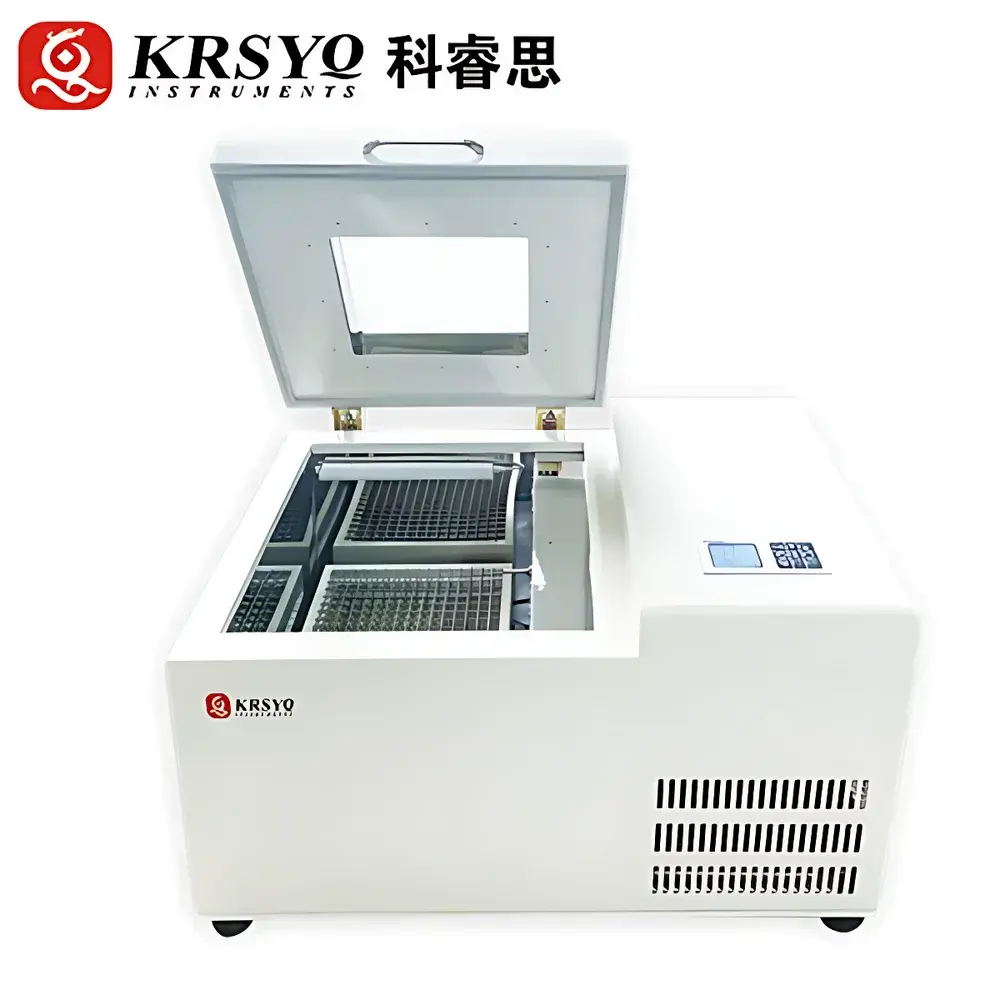
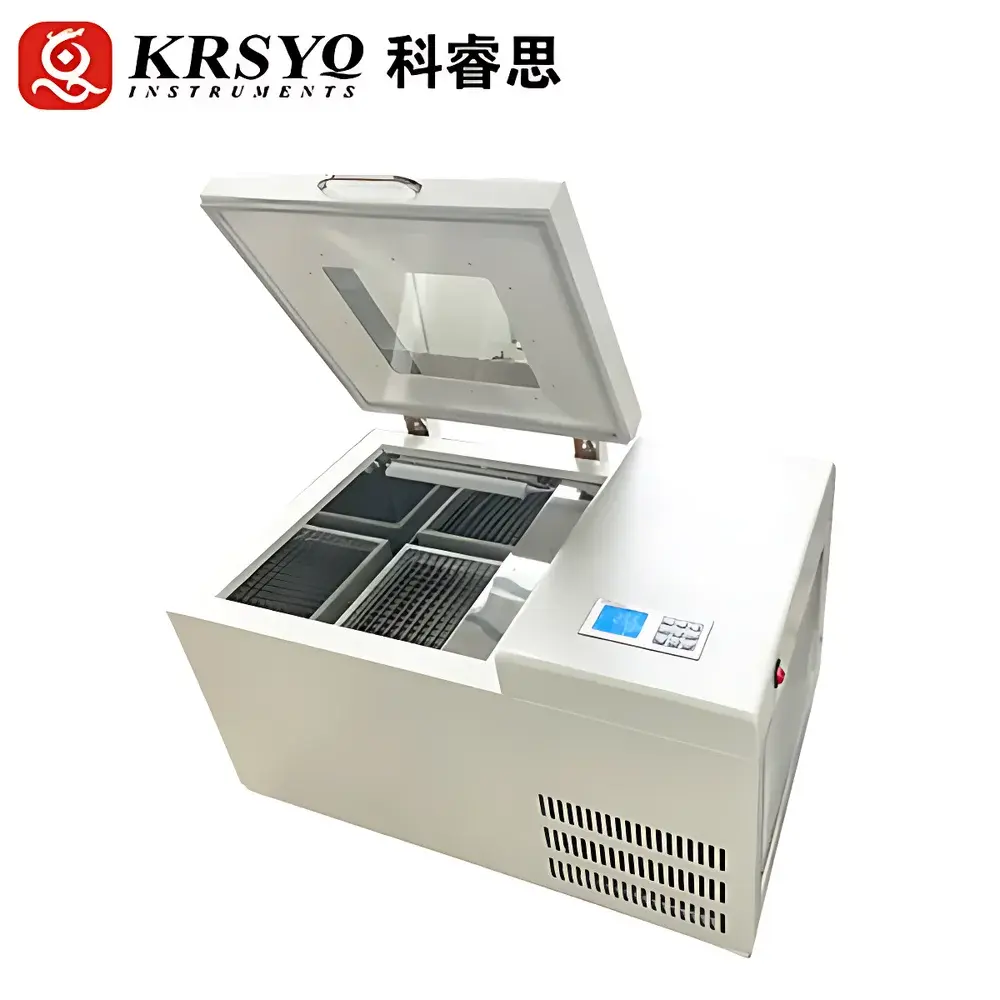
KRSYQ KRS-Z Constant Temperature Orbital/Reciprocal Shaker
| Brand | KRSYQ |
|---|---|
| Origin | Hunan, China |
| Manufacturer Type | Direct Manufacturer |
| Model | KRS-Z |
| Speed Range | 40–300 rpm |
| Oscillation Mode | Orbital, Reciprocating, or Dual-Mode |
| Amplitude | 20 mm |
| Temperature Control | Yes (air-bath configuration) |
| Display | Digital speed readout with timer |
| Clamp System | Stainless steel universal spring clamp (custom clamps available) |
| Compliance | GB/T 32710.13–2016, GB/T 2423.3–2016, GB/T 32710.6–2016, GB/T 32710.9–2016 |
Overview
The KRSYQ KRS-Z Constant Temperature Orbital/Reciprocal Shaker is an engineered laboratory platform designed for precise, reproducible agitation of multiple samples under controlled thermal conditions. Operating on air-bath heating principles, the unit maintains uniform chamber temperature via a high-efficiency circulating fan system that promotes laminar airflow and minimizes thermal gradients across the sample zone. Its dual-mode oscillation mechanism—selectable between orbital (circular) and reciprocating (linear back-and-forth) motion—enables method flexibility for applications requiring either gentle suspension homogenization or more vigorous mixing. The 20 mm amplitude ensures consistent energy transfer without excessive shear, making it suitable for delicate biological suspensions, microbial cultures, and environmental extract preparations. Unlike water-bath shakers, the air-bath design eliminates condensation risks and supports rapid temperature stabilization, while integrated drainage features (drain plug for air-bath models; optional faucet for oil-bath variants) enhance operational safety and long-term maintenance.
Key Features
- Dual-mode operation: User-selectable orbital, reciprocating, or alternating dual-mode oscillation for method optimization
- Digital speed control with real-time rpm display (40–300 rpm range) and programmable timer (0–999 min)
- Stainless steel universal spring clamp system accommodating tubes (10–50 mL), flasks (up to 1 L), microplates, and custom vessels
- Forced-air convection architecture with optimized fan placement ensures ±0.5 °C temperature uniformity across the chamber (at setpoint 25–60 °C)
- Condensate management system: side-channel vapor runoff prevents vertical droplet formation onto samples
- Robust mechanical construction with dual-layer tension springs enabling stable multi-vessel loading and comparative experimental setups
- Compliance-ready design: meets structural and functional requirements outlined in GB/T 32710.13–2016 (vibrational testing equipment), GB/T 2423.3–2016 (damp heat testing), and GB/T 32710.9–2016 (constant-temperature incubators)
Sample Compatibility & Compliance
The KRS-Z accommodates a broad spectrum of container formats—including Erlenmeyer flasks, centrifuge tubes, culture bottles, and deep-well microplates—without requiring adapter reconfiguration. Its universal clamp geometry supports both standard and non-standard vessel geometries, with optional custom fixture development available upon request. From a regulatory standpoint, the device aligns with national standards governing environmental simulation and laboratory instrumentation performance. While not inherently 21 CFR Part 11 compliant (as it lacks electronic audit trail functionality), its mechanical reliability, traceable calibration pathways, and adherence to GB/T 32710 series standards support integration into GLP-compliant workflows where manual log entries and periodic verification are employed. It is widely deployed in laboratories conducting soil nutrient extraction (e.g., DTPA-extractable metals), microbial growth kinetics, enzyme reaction monitoring, and stability testing per ISO 17025-accredited protocols.
Software & Data Management
The KRS-Z operates via an embedded digital controller with no external software dependency. All parameters—including speed, time, and temperature—are set and monitored locally using the front-panel keypad and LED display. For laboratories requiring data continuity, optional RS-485 serial output (available on upgraded firmware versions) enables connection to SCADA systems or centralized lab data loggers. Though not equipped with cloud synchronization or remote access, the unit’s deterministic behavior, repeatable setpoint response, and absence of proprietary drivers simplify validation documentation. Users may integrate the shaker into broader quality systems by pairing it with calibrated thermistors and tachometers for independent verification of thermal and rotational performance during IQ/OQ/PQ qualification.
Applications
- Soil science: Extraction of bioavailable heavy metals (e.g., Zn, Cu, Cd) using standardized chelating solutions under controlled temperature and agitation
- Microbiology: Aerobic cultivation of bacterial and fungal strains in liquid media, including antibiotic susceptibility assays and biodegradation studies
- Environmental analysis: Preparation of aqueous extracts from sediment, sludge, or plant tissue prior to ICP-MS or HPLC analysis
- Pharmaceutical R&D: Dissolution profiling of solid dosage forms, excipient compatibility screening, and buffer equilibration
- Food safety testing: Homogenization of food homogenates for pathogen enrichment (e.g., Salmonella, Listeria) in accordance with ISO 6579 and AOAC guidelines
- Academic teaching labs: Demonstrating kinetic principles, enzyme kinetics, and cell lysis optimization under variable shear conditions
FAQ
Is the KRS-Z compatible with water-jacketed or oil-bath configurations?
Yes — the base model is an air-bath shaker, but KRSYQ offers parallel oil-bath and water-jacketed variants (KRS-Z-O and KRS-Z-W) with dedicated inlet/outlet ports and temperature ranges up to 100 °C.
Can the oscillation mode be changed during operation?
No — mode selection must be performed prior to initiating the run. Switching between orbital and reciprocating modes requires stopping the unit, adjusting the mechanical linkage, and restarting.
What is the maximum load capacity per shelf?
The standard platform supports up to 15 kg distributed evenly; total payload must remain within 85% of rated capacity to maintain speed accuracy and thermal uniformity.
Does the unit include calibration documentation?
Factory calibration certificates for temperature and speed are provided with each shipment. Traceable NIST-certified reference instruments are used during production verification.
How often should preventive maintenance be performed?
KRSYQ recommends biannual inspection of drive belts, spring tension integrity, and fan motor performance — particularly in continuous-use environments exceeding 12 h/day.



