
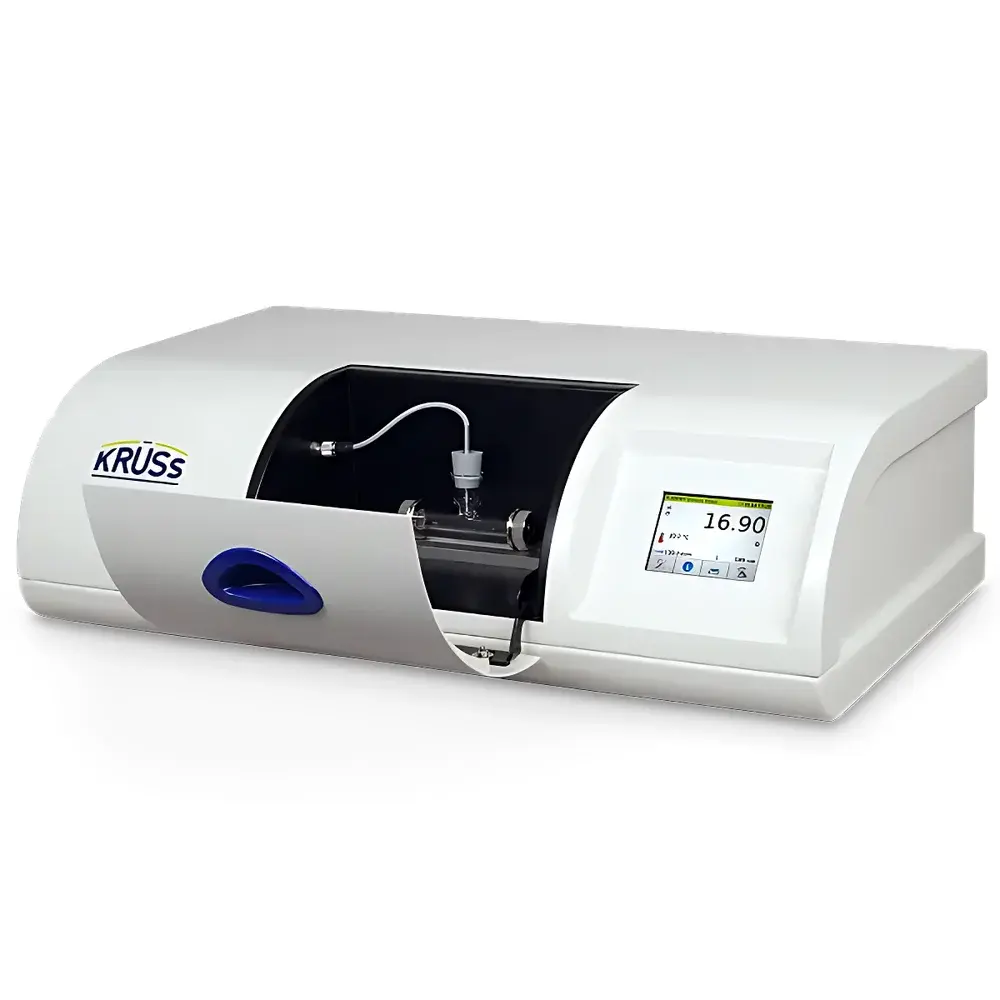
KRUESS P3000 Automated Polarimeter
| Brand | KRUESS |
|---|---|
| Origin | Germany |
| Model | P3000 |
| Product Type | Automated Polarimeter |
| Temperature Control | Yes (0–99.9 °C, ±0.2 °C accuracy) |
| Display | 5.7" TFT LCD (320 × 240 px), touch-enabled |
| Light Source | LED @ 589 nm (fixed sodium-D line) |
| Measurement Range | ±90°, ±259 °Z |
| Resolution | 0.01 °Z |
| Accuracy & Repeatability | ±0.01 °Z |
| Measurement Time | ≤1 s (full range) |
| Sample Cell Path Length | 220 mm |
| Minimum Detectable Concentration | 0.1 % (OD3) |
| Calibration | Menu-driven automatic calibration |
| Interface | RS-232 |
| Power Supply | 90–250 V AC, 50/60 Hz |
| Dimensions (W×D×H) | 64.5 × 20.0 × 36.0 cm |
| Weight | 28 kg |
Overview
The KRUESS P3000 Automated Polarimeter is a precision optical instrument engineered for rapid, high-reproducibility measurement of optical rotation in chiral substances. Based on the fundamental principle of polarimetry—quantifying the angular deviation of plane-polarized light as it passes through an optically active medium—the P3000 employs a stabilized 589 nm LED light source aligned to the sodium-D spectral line, ensuring compliance with internationally recognized reference conditions (e.g., ISO 5725, USP , and Ph. Eur. 2.2.7). Designed as a streamlined variant of the P8000 platform, the P3000 retains KRUESS’s proprietary fast-acquisition algorithm, enabling full-range measurements (±90° or ±259 °Z) in under one second without mechanical scanning or manual zeroing. Its robust architecture integrates thermally stabilized optics and real-time temperature monitoring (0–99.9 °C, resolution 0.1 °C, control accuracy ±0.2 °C), critical for eliminating thermal drift in concentration- and conformation-sensitive assays.
Key Features
- Single-wavelength LED illumination at 589 nm—no lamp replacement, no warm-up delay, and long-term wavelength stability compliant with pharmacopeial requirements
- High-speed measurement engine: delivers repeatable results in ≤1 s across the full angular range (±90° / ±259 °Z)
- Integrated Peltier-assisted temperature control system with direct readout and programmable setpoint (0–99.9 °C)
- 5.7-inch capacitive touchscreen interface with intuitive menu navigation and on-device data review
- Automatic calibration routine accessible via main menu—no external standards required for routine verification
- RS-232 serial interface for integration into laboratory networks, LIMS, or automated QC workflows
- Dual-unit display: simultaneous readout in degrees (°) and international sugar scale (°Z), supporting direct compliance with ICUMSA and AOAC methods
Sample Compatibility & Compliance
The P3000 accommodates standard 220 mm path-length sample cells (including jacketed variants for active temperature equilibration), compatible with aqueous, alcoholic, and low-viscosity organic solutions. It meets essential regulatory expectations for routine quality control in GMP-compliant environments: its fixed-wavelength design and traceable calibration protocol align with FDA 21 CFR Part 11 data integrity principles when paired with validated software logging. While the instrument itself does not embed audit-trail functionality, its RS-232 output supports timestamped, operator-identified data capture in third-party systems compliant with GLP and ISO/IEC 17025 documentation requirements. Measurement uncertainty (±0.01 °Z) satisfies typical acceptance criteria for raw material identity testing per ICH Q5C and intermediate purity assessment per USP .
Software & Data Management
The P3000 operates autonomously via embedded firmware—no PC dependency is required for basic operation. All measurements are stored internally with date/time stamps and operator ID fields (assignable via touchscreen). Data export occurs via RS-232 to ASCII-formatted text files (.txt), containing measurement value, unit, temperature, and timestamp—enabling straightforward import into Excel, LabWare LIMS, or custom QA databases. For laboratories requiring electronic record retention, KRUESS provides optional configuration guidance for pairing the P3000 with validated terminal emulation software that enforces user authentication, electronic signatures, and immutable log generation—supporting alignment with 21 CFR Part 11 Subpart B controls.
Applications
- Pharmaceuticals: Enantiomeric excess determination of chiral APIs; monitoring racemization kinetics during synthesis; excipient purity verification per EP 2.2.7
- Chemical Manufacturing: Quantitative analysis of optically active intermediates (e.g., epoxides, amino alcohols); batch-to-batch consistency checks for asymmetric catalysis outputs
- Sugar & Food Industry: Direct °Z measurement of sucrose, glucose, and fructose solutions per ICUMSA Method GS4/8-12; Brix-correlated concentration validation in syrups and fruit concentrates
- Academic & R&D Labs: Teaching polarimetric principles; kinetic studies of hydrolysis or mutarotation; method development for novel chiral sensors
FAQ
Does the P3000 support multiple wavelengths?
No—the P3000 uses a single, fixed 589 nm LED source optimized for sodium-D line compliance. Multi-wavelength capability is available only in the P8000 and higher-tier KRUESS platforms.
Can the instrument be calibrated using user-provided sucrose standards?
Yes—while the built-in automatic calibration uses internal references, manual calibration with NIST-traceable sucrose solutions (e.g., 10–30 % w/w) is fully supported via the calibration menu.
Is temperature-controlled measurement mandatory for all analyses?
No—ambient-temperature operation is permitted, but temperature reporting is always active. For pharmacopeial compliance (e.g., USP ), temperature must be recorded and maintained within specified limits.
What sample cell types are compatible with the 220 mm path length?
Standard 220 mm cells (10 mm bore), thermostatted jacketed cells, and sealed quartz cells for volatile or air-sensitive samples—all conforming to ISO 1042 dimensional tolerances.
Does the P3000 meet ISO/IEC 17025 requirements for accredited testing labs?
When operated within documented procedures—including daily verification with certified standards, environmental monitoring, and traceable maintenance logs—the P3000 satisfies metrological requirements for inclusion in scope of accreditation under ISO/IEC 17025:2017 Clause 6.4.




