
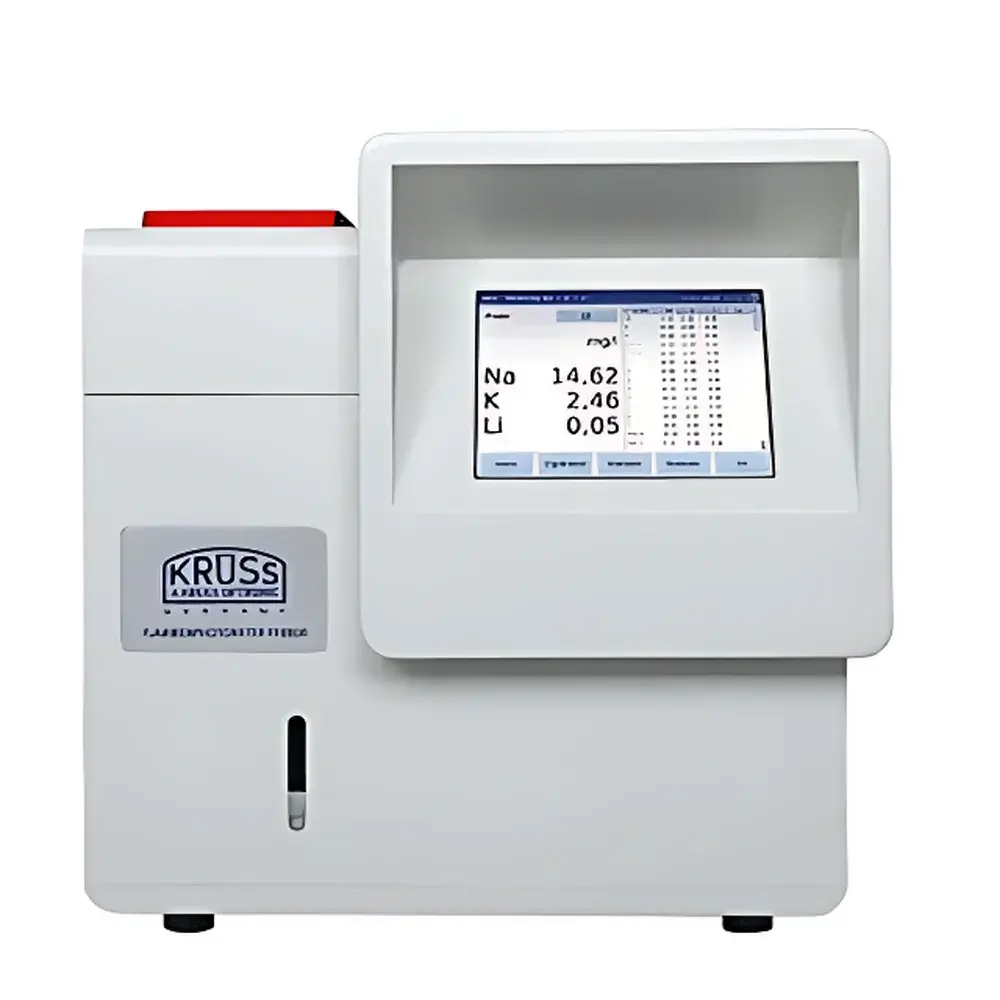
KRÜSS FP8800 Flame Photometer
| Brand | KRÜSS |
|---|---|
| Origin | Germany |
| Model | FP8800 |
| Type | Automated Flame Photometer |
| Measurement Principle | Flame Atomic Emission Spectrometry (F-AES) |
| Simultaneous Channels | 5 independent, configurable for Na, K, Li, Ca, Ba, Mg |
| Display | 8.4" TFT touchscreen interface |
| Data Storage | Up to 999 measurement records |
| Throughput | Up to 300 measurements per hour |
| Compliance | cGMP/GLP, FDA 21 CFR Part 11 (audit trail, electronic signature support), DHCP & LIMS integration capable |
| Calibration Output | Tabular and graphical calibration curves |
| Safety | Integrated intelligent flame safety interlock system |
| Category | Optical Measurement Instrument — Flame Photometer |
Overview
The KRÜSS FP8800 Flame Photometer is an automated, benchtop optical instrument engineered for quantitative elemental analysis of alkali and alkaline earth metals—including sodium (Na), potassium (K), lithium (Li), calcium (Ca), barium (Ba), and magnesium (Mg)—in aqueous solutions. It operates on the principle of Flame Atomic Emission Spectrometry (F-AES): sample solutions are nebulized into a stable air-propane flame, where metal ions are thermally excited and emit characteristic wavelengths of visible light. These emissions are isolated via interference filters and quantified by photodiodes with high signal-to-noise ratio. Designed for routine laboratory and process analytical applications—such as water quality monitoring, clinical serum analysis, fertilizer formulation, and pharmaceutical excipient testing—the FP8800 delivers robust performance without requiring spectrometer-grade optics or complex maintenance protocols.
Key Features
- Five independently configurable detection channels, each assignable to Na, K, Li, Ca, Ba, or Mg—enabling simultaneous multi-element analysis without sequential reconfiguration.
- Integrated 8.4-inch high-resolution TFT touchscreen interface with intuitive icon-driven navigation, eliminating external PC dependency for basic operation and calibration.
- Real-time calibration curve visualization in both tabular and graphical formats, supporting linear, quadratic, and multi-point non-linear regression models per channel.
- Automated data logging with capacity for 999 complete measurement records, including sample ID, date/time stamp, raw intensity values, concentration results, and operator metadata.
- Throughput-optimized fluidics and flame stabilization algorithm enabling up to 300 determinations per hour—achievable under standard operating conditions with calibrated standards and consistent nebulization.
- Comprehensive safety architecture featuring flame-out detection, gas pressure monitoring, ignition failure lockout, and automatic shutdown upon abnormal thermal or electrical conditions.
Sample Compatibility & Compliance
The FP8800 accepts clarified aqueous samples with total dissolved solids (TDS) ≤ 0.5% w/v and viscosity < 2.5 mPa·s. It accommodates standard 13 mm or 16 mm borosilicate glass tubes and supports direct aspiration from vials or continuous flow via optional peristaltic pump module. All firmware and data handling workflows comply with Good Laboratory Practice (GLP) and current Good Manufacturing Practice (cGMP) requirements. Electronic records meet FDA 21 CFR Part 11 criteria through built-in audit trail functionality—tracking user logins, parameter changes, calibration events, and result modifications—with role-based access control and digital signature support. The system is compatible with enterprise DHCP networks and exports structured CSV or XML reports for seamless integration into Laboratory Information Management Systems (LIMS).
Software & Data Management
Instrument control, calibration management, and report generation are handled internally via embedded Linux-based firmware. No proprietary PC software is required for routine use; however, optional KRÜSS DataLink™ PC application enables advanced statistical evaluation (e.g., %RSD, confidence intervals), method export/import, and batch report templating. All measurement data are stored with immutable timestamps and traceable operator IDs. Export formats include ISO/IEC 17025-compliant PDF reports with embedded calibration certificates and raw spectral intensity logs. Audit trails are encrypted and non-erasable—even during firmware updates—and retain full history for ≥12 months by default.
Applications
- Environmental laboratories: Quantification of Na⁺ and K⁺ in drinking water, wastewater effluents, and soil leachates per ASTM D1293 and ISO 10523.
- Clinical chemistry: Rapid assessment of electrolyte imbalances (e.g., serum Na/K ratios) in point-of-care or core lab settings—validated against ISE reference methods.
- Agricultural science: Determination of Ca²⁺ and Mg²⁺ in irrigation water and nutrient solutions for hydroponic crop optimization.
- Pharmaceutical manufacturing: In-process testing of buffer salts and final product release assays for elemental impurities per ICH Q2(R2) and USP .
- Food & beverage QA/QC: Monitoring sodium content in processed foods and potassium levels in fruit juices to ensure label compliance with FDA nutrition labeling regulations.
FAQ
What elements can the FP8800 measure simultaneously?
The FP8800 supports concurrent detection of up to five elements selected from Na, K, Li, Ca, Ba, and Mg—each assigned to a dedicated optical channel with element-specific interference filter and photodiode.
Is external computer hardware required for daily operation?
No. All core functions—including method setup, calibration, measurement execution, and report review—are fully operational via the integrated 8.4″ touchscreen interface.
Does the FP8800 meet regulatory requirements for auditable electronic records?
Yes. It implements full 21 CFR Part 11 compliance features: electronic signatures, audit trail with immutable event logging, and role-based user authentication.
Can the instrument be integrated into a centralized LIMS environment?
Yes. It supports DHCP network assignment and exports standardized data files (CSV/XML) compatible with major LIMS platforms via Ethernet or USB storage.
What maintenance routines are recommended for long-term accuracy?
Daily cleaning of the nebulizer capillary and burner head with 5% HNO₃ solution; quarterly verification of flame stability and photodiode linearity using certified multi-element standards.




