
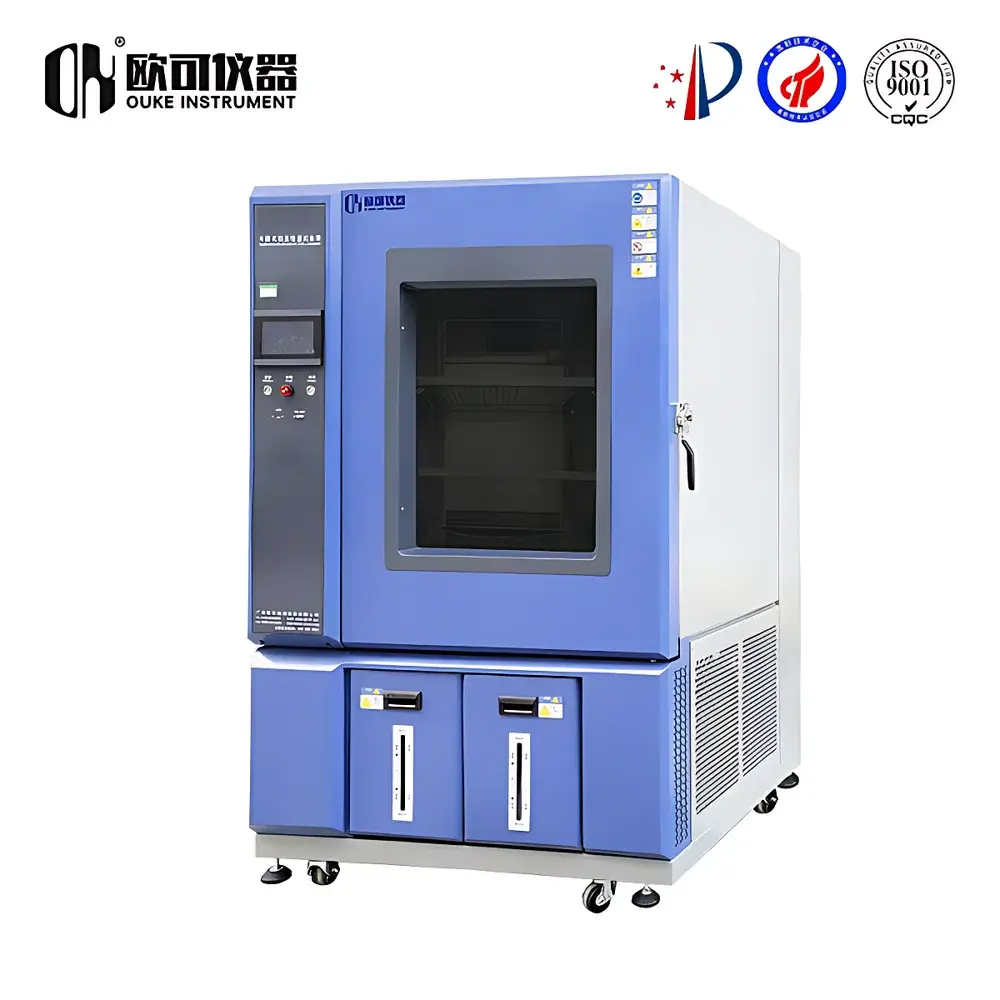
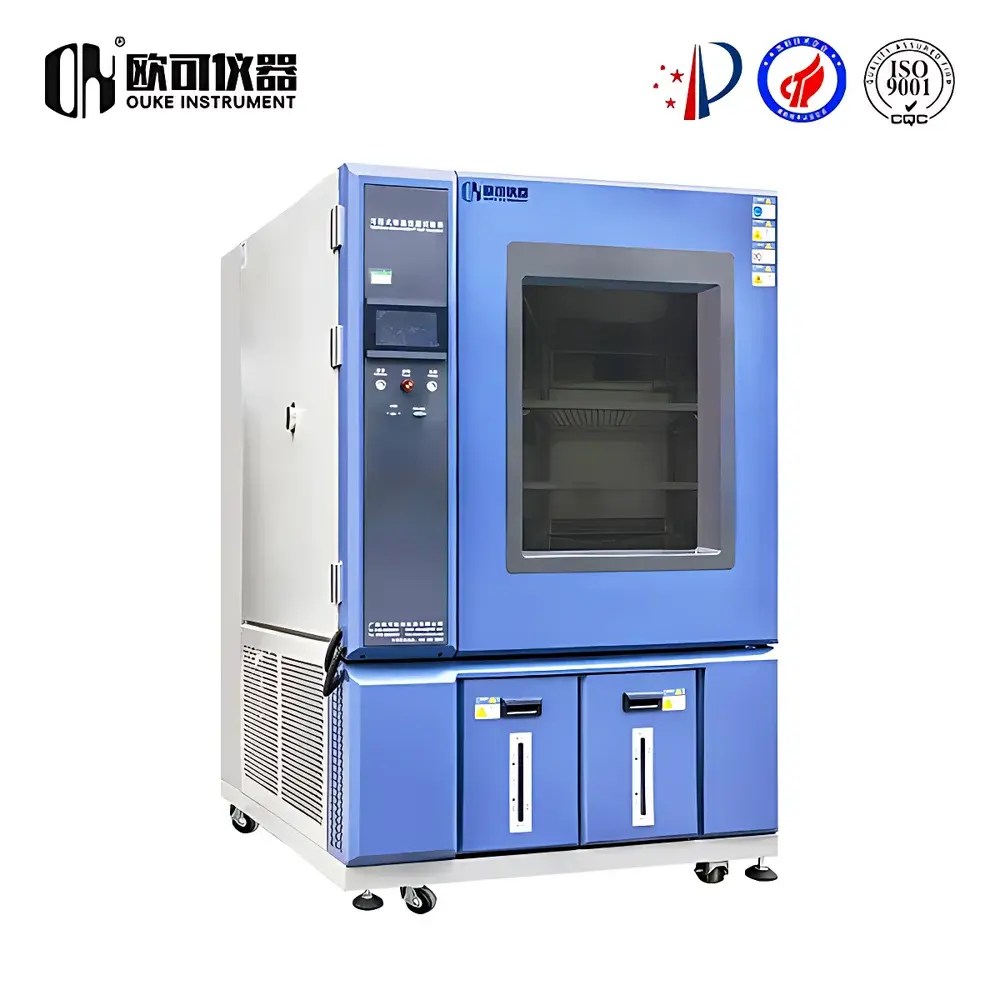
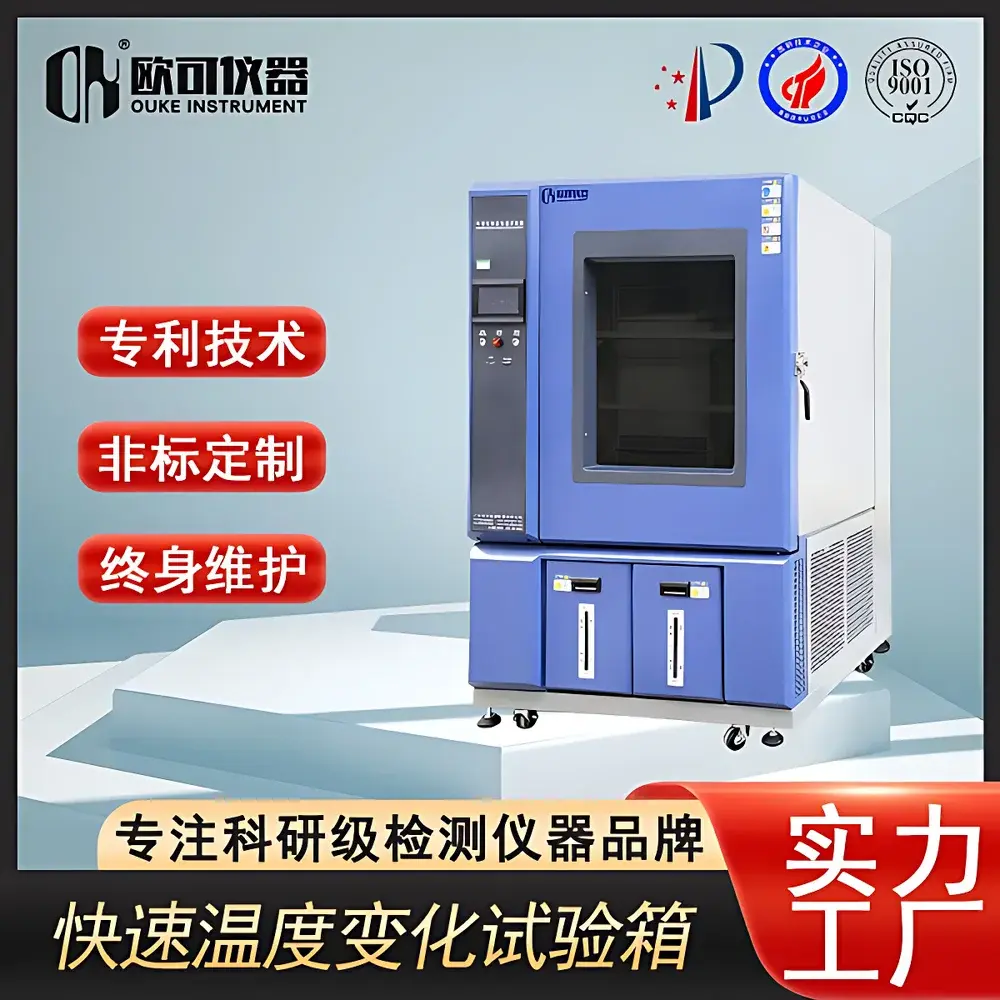
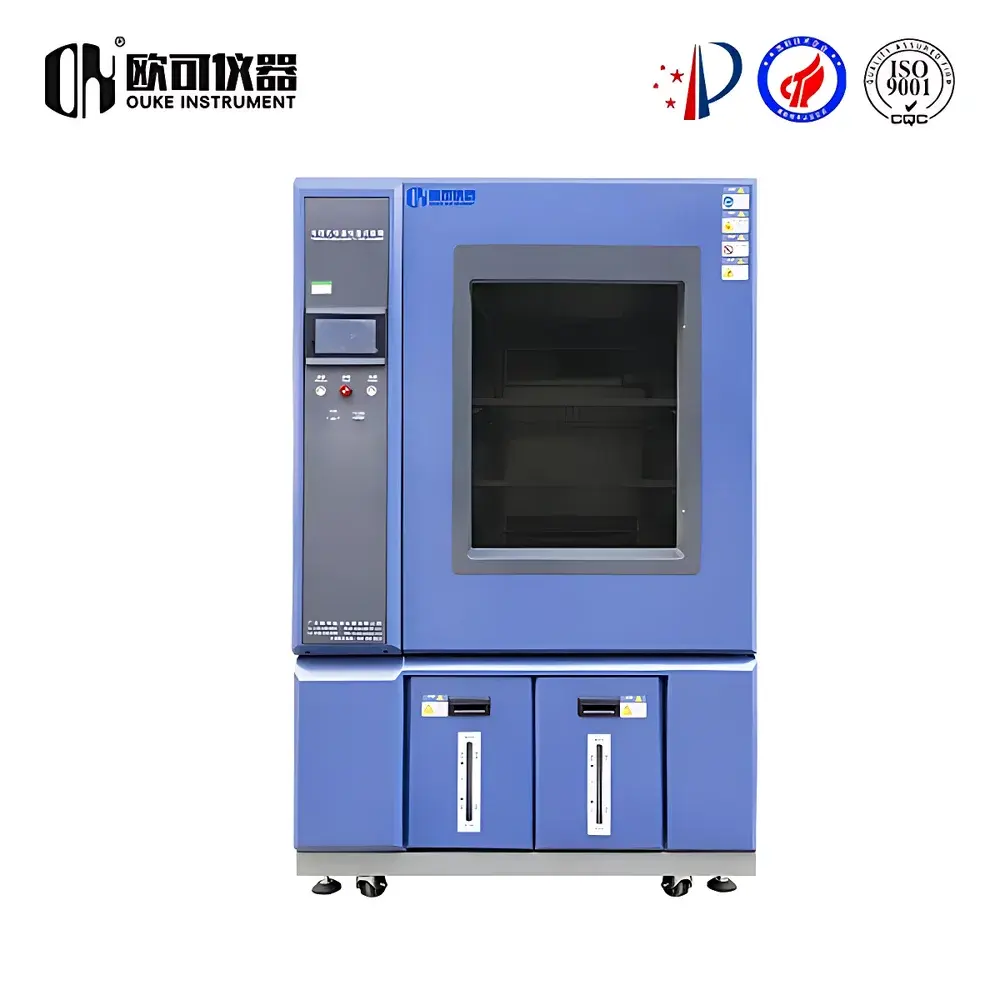
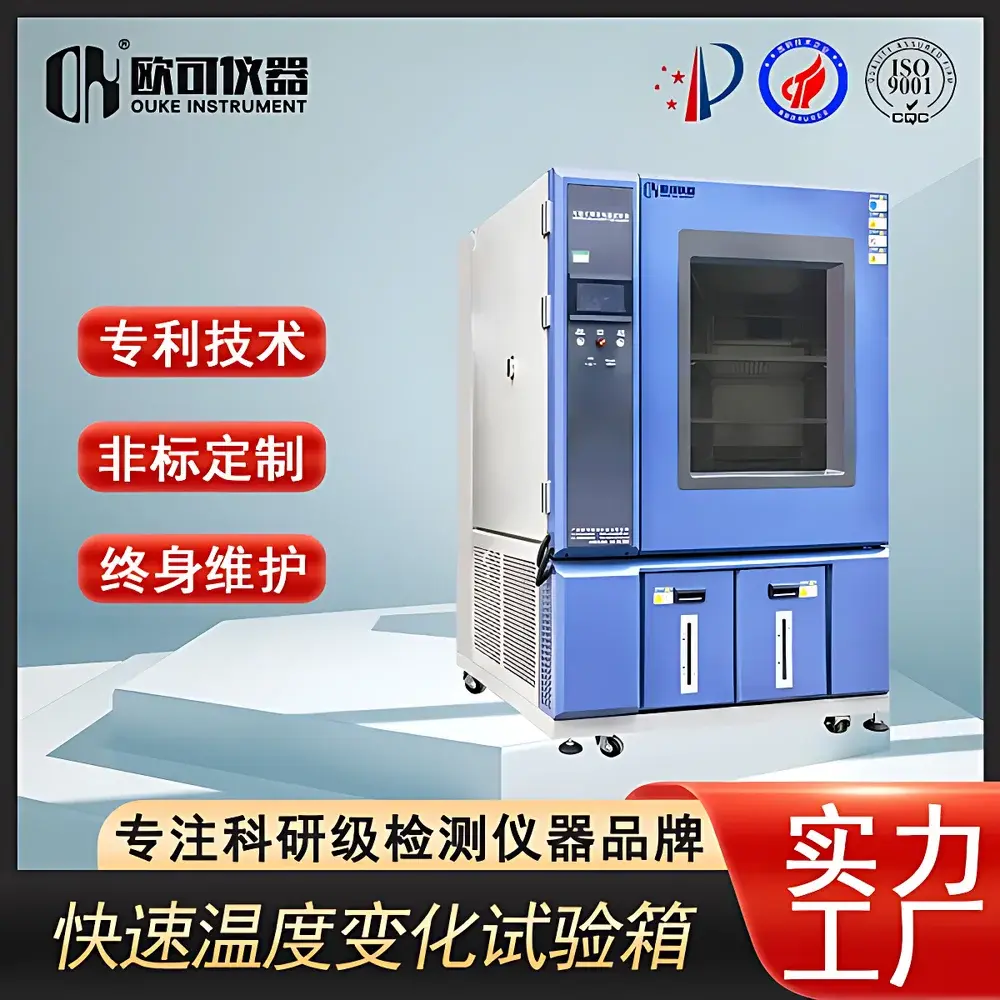
OK KS-TH-150 High-Speed Temperature Ramp Chamber
| Brand | OK Instruments |
|---|---|
| Origin | Guangdong, China |
| Manufacturer Type | OEM/ODM Producer |
| Country of Origin | China |
| Model | KS-TH-150 |
| Price | USD 14,200 (FOB Guangdong) |
Overview
The OK KS-TH-150 High-Speed Temperature Ramp Chamber is an engineered environmental reliability test system designed to subject electronic, automotive, aerospace, and industrial components to controlled, accelerated thermal cycling under stringent time–temperature profiles. Unlike conventional temperature chambers—whose ramp rates are typically limited to 1–3 °C/min—the KS-TH-150 achieves programmable average ramp rates of up to 25 °C/min across its full operating range (–70 °C to +150 °C), enabling realistic simulation of real-world thermal stress conditions such as engine cold starts, aircraft ascent/descent, or rapid ambient transitions in consumer device usage. Its single-chamber architecture utilizes dynamic refrigeration and heating modulation—not mechanical transfer—making it fundamentally distinct from two- or three-zone thermal shock systems. The chamber operates on the principle of forced-air convection combined with high-capacity cascade refrigeration and precision PID-controlled resistive heating, ensuring reproducible thermal transients while maintaining spatial uniformity and temporal fidelity per IEC 60068-2-14 and GB/T 2423.22.
Key Features
- Single-chamber design with integrated high-efficiency air circulation: Dual centrifugal blowers and multi-directional airflow ducting ensure ≥90% volumetric air exchange per minute and temperature uniformity ≤ ±2.0 °C (at steady state) and ≤ ±3.0 °C during active ramping.
- Cascade refrigeration system: Two-stage (or optionally three-stage) compressor configuration using R404A (HT stage) and R23 (LT stage) refrigerants enables stable operation down to –70 °C with sustained cooling capacity >4.5 kW at –40 °C.
- High-power heating assembly: Nickel-chromium alloy heating elements (total rated power ≥6.8 kW) coupled with adaptive power modulation deliver precise, overshoot-minimized ramp control.
- Advanced controller: OYO 8227 or equivalent 7-inch color touchscreen HMI with 200-segment programmable profile capability; supports ramp/soak, cycling, and user-defined non-linear temperature trajectories.
- Robust chamber construction: Interior chamber fabricated from 2.0 mm SUS304 stainless steel with passivated surface finish; exterior housing in powder-coated cold-rolled steel for long-term corrosion resistance.
- Comprehensive safety architecture: Independent dual-limit overtemperature protection, phase failure detection, refrigerant high-pressure cutout, motor thermal overload sensing, and earth-leakage circuit interruption (ELCI).
Sample Compatibility & Compliance
The KS-TH-150 accommodates samples up to 450 mm × 450 mm × 450 mm (W×D×H) with maximum mass loading of 35 kg. It supports both passive (non-powered) and powered-in-test configurations—equipped with 4 × Ø25 mm cable ports (with silicone grommets) and optional DC/AC feedthroughs rated to 300 VAC/60 A. All operational parameters comply with international test standard requirements including IEC 60068-2-14 (Change of temperature), GB/T 2423.22 (Environmental testing — Part 2: Tests — Test N: Change of temperature), and JESD22-A104 (Temperature Cycling). While not inherently 21 CFR Part 11 compliant, audit-ready data logging—including timestamped setpoint, actual chamber temperature, ramp rate, and alarm history—is exportable in CSV format and supports GLP/GMP traceability when paired with validated external software.
Software & Data Management
The embedded controller logs all operational data at user-selectable intervals (1 s to 600 s resolution) to internal flash memory (≥16 GB) with automatic rollover. Data export is performed via USB 2.0 port or optional Ethernet interface (Modbus TCP or HTTP API available upon request). Optional PC-based OK-TempView software provides real-time remote monitoring, multi-chamber synchronization, statistical process analysis (SPC), and automated report generation (PDF/Excel) compliant with ISO/IEC 17025 documentation requirements. All logged events—including operator login/logout, program edits, and fault resets—are time-stamped and immutable, satisfying basic audit trail expectations for regulated QA/QC environments.
Applications
- Automotive electronics: Validation of ADAS sensors, infotainment modules, and battery management systems under simulated diurnal cycling and cold-start thermal gradients.
- Consumer electronics: Reliability screening of smartphones, wearables, and UAV flight controllers subjected to rapid ambient shifts between indoor/outdoor use.
- Aerospace components: Qualification of avionics enclosures, optical housings, and composite structural joints per MIL-STD-810H Method 503.5.
- Semiconductor packaging: Assessment of solder joint integrity, die attach delamination, and CTE-induced warpage in QFN, BGA, and SiP assemblies.
- Energy storage systems: Cycle-life evaluation of lithium-ion pouch and prismatic cells under accelerated thermal aging protocols (e.g., U.S. DOE HPPC guidelines).
- Industrial IoT devices: Endurance testing of edge computing nodes deployed in uncontrolled outdoor or factory-floor environments.
FAQ
What is the difference between a high-speed temperature ramp chamber and a thermal shock chamber?
A high-speed ramp chamber changes temperature within a single chamber using optimized refrigeration/heating dynamics, achieving typical ramp rates of 10–25 °C/min. A thermal shock chamber uses physical sample transfer between separate hot and cold zones, delivering near-instantaneous transitions (≤ 10 s), but imposes mechanical handling constraints and higher maintenance overhead.
Does the stated ramp rate apply under loaded conditions?
The published ramp rate (e.g., 25 °C/min) is measured per IEC 60068-2-14 Clause 6.2 under no-load conditions. Actual loaded performance depends on sample mass, specific heat, surface emissivity, and internal thermal mass. OK Instruments provides load-performance validation reports upon request.
Can the KS-TH-150 be integrated into an automated test line?
Yes—via optional RS485 (Modbus RTU), Ethernet (Modbus TCP), or dry-contact I/O interfaces. PLC-level integration with Siemens S7, Rockwell ControlLogix, or Beckhoff TwinCAT is supported through documented register maps.
Is calibration certification included with shipment?
Each unit ships with a factory-as-built calibration certificate (NIST-traceable reference sensors) covering temperature uniformity, stability, and ramp linearity at three points (–40 °C, 25 °C, +85 °C). UKAS or A2LA-accredited field calibration services are available separately.



